The Dangers of Selective Prosecution for Democracy and the Rule of law
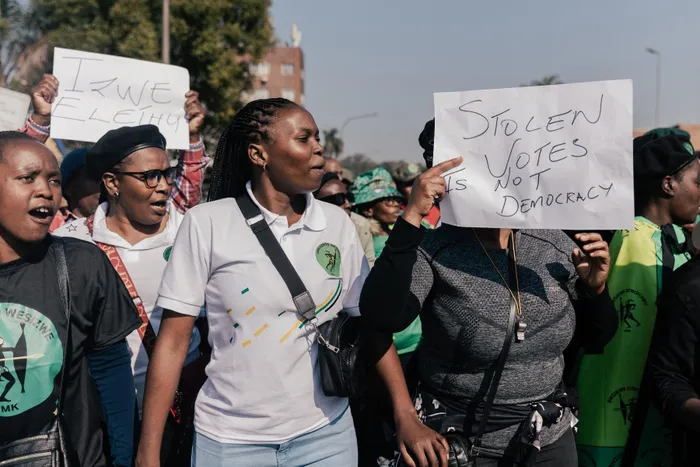
Supporters of uMkhonto weSizwe Party (MKP) protest outside the Pietermaritzburg High Court on June 26, 2024 following the appearance of IEC official Musawenkosi Mnikathi on a charge of election misconduct after allegedly being found with ballot boxes without supervision. From the outset, the IEC emphasised that transporting voting materials to voting stations without a police escort was not illegal, says the writer.
Image: AFP
Justice Dhaya Pillay
Should a person be prosecuted for breaking a law that does not exist? The answer is obvious. No. Why would a person be prosecuted for a law that does not exist? The answer to this question is what I am looking for. It turns out that selective (non)prosecutions is an international scourge contributing to democratic decay.
Case Study: South Africa
In preparation for the May 29, 2024, general elections, Musawenkosi Mnikathi was employed as an area manager by the Electoral Commission of South Africa. Based on the complaint of a political party, which followed and handed him over to the police, he was charged and prosecuted for illegally transporting voting materials in his private vehicle without a police escort.
From the outset, the IEC emphasised that transporting voting materials to voting stations without a police escort was not illegal. No law required area managers to be escorted by the police when transporting voting materials. With the support of the IEC, Mnikathi applied unsuccessfully for his discharge from prosecution.
The trial commenced with members of the political party testifying for the prosecution. For the defence, the Provincial Electoral Officer and the IEC trainer testified. None of the IEC witnesses was even cross-examined.
A year after his arrest, and after many court appearances at great cost and inconvenience to Mnikathi, Magistrate Edmund Szudrawski accepted the evidence of the IEC officials. He acquitted Mnikathi.
The question arises: Why did the prosecution proceed when, manifestly, no law existed requiring area managers to be escorted by the police? By what law did the police effect the arrest?
The application for discharge, which pertinently raised the validity of the prosecution, allowed both the prosecutor and the magistrate another opportunity to rethink the soundness of their resolve to prosecute Mnikathi. Still, the slow wheels of the criminal justice system trundled on to trial.
Acquittal was the only sensible outcome to avert an embarrassing appeal. An enquiry into the conduct of state officials involved in persisting with the prosecution, when no law requiring a police escort existed, would not be off limits.
Non prosecutions
Simultaneously with and compounding the egregiousness of Mnikathi’s prosecution were two non-prosecutions. The IEC complained to the South African Police Services about individuals unlawfully entering its warehouses in Ethekwini. Despite producing a video recording of this transgression, no arrests have been made.
Similarly, no one has since been charged arising from an IEC complaint about another incident in eThekwini when a voting station presiding officer was woken at home in the middle of the night and harassed about bulk materials lawfully stored at the voting station in Chesterville.
Case Study: India
In India in 2019, Rahul Gandhi, a leader of the Indian National Congress, a political party that lost its dominance to the BJP political party, was prosecuted for defamation for insulting the relatives of Prime Minister Narendra Modi. Criminal, instead of civil defamation, was preferred.
The case started slowly. Apparently dissatisfied with the judge rejecting his application to have Gandhi appear in person in court, the complainant, Pranesh Modi, asked that the prosecution be halted indefinitely.
In 2023, as the presidential elections of 2024 loomed, Modi claimed that he had new evidence and that the prosecution of Gandhi should resume. The hearing proceeded before another judge. Gear change and progress were unprecedentedly swift. Seven hearings held over 20 days resulted in Gandhi being convicted of defamation.
Alarmingly, the judge imposed the maximum penalty of two years’ imprisonment. Such a penalty disqualified Gandhi from serving as a member of parliament and standing for elections in 2024. Even before Gandhi had the chance to appeal, the lower house of parliament disqualified him from his parliamentary duties. Had he been sentenced to even a day less than two years, he would not have been disqualified.
Gandhi’s appeal to both the lower court and the High Court failed. Eventually, India’s Supreme Court posed the singular unanswered question that matters in selective prosecution cases: Why did the trial judge find it necessary to impose the maximum sentence of two years?
To the High Court, the Supreme Court repeated the question. Considering the “voluminous pages” spent in rejecting the application for stay of conviction, an explanation had “not even been touched in their orders.”
The Supreme Court stayed the conviction, saying that it affected not only Gandhi’s right to continue in public life but also the right of the electorate, who had elected him, to represent their constituency. Additionally, “no reasons have been given by the learned Trial Judge for imposing the maximum sentence, which has the effect of incurring disqualification”.
Case Study: Türkiye
In 1995, Sevan Nişanyan, a 60-year-old Turkish-Armenian journalist, writer and linguist, returned to develop his home village of Şirince, Izmir province, Turkey.
Sirince had been declared a protected area. Nişanyan needed permits for his developments. He tried persistently to get permits. None was forthcoming. He proceeded to build without permits.
In 2014, the court of appeals approved his two-year jail sentence on charges of illegal construction of a 40-square-meter shed on his own property. Piled on this charge were many others arising from Nisanyan’s development of the village.
In 2017, he had another 10 years to serve in jail before he became eligible for parole. Whilst furloughed, he escaped from imprisonment and sought asylum in Greece.
The question is: Why a jail sentence? Violators of building laws usually pay an administrative fine, or the authorities demolish the building.
Why prosecute Nişanyan? He was not the only one violating construction laws. The Turkish landscape is littered with buildings that manifestly fail to meet even basic building standards.
In contrast, Prime Minister Recep Tayyip Erdogan had his palace built on the Atatürk Forest Farm, despite court orders aimed at protecting the environment. Without any explanation for selecting Nişanyan for prosecution, he and those involved in the local and international petition campaign calling for his release, conclude that he is being punished for his history, literary work challenging the official ideology, criticisms of Muslim beliefs and Islam, being Armenian and “doing something out of the box”.
Conclusion
It is not that people who commit crimes should not be prosecuted. Rather, everyone who commits a crime should be prosecuted. That is what equality before and under the law means. Eroding equality corrodes one of democracy’s constitutive values.
When the question Why? Elicits no response; the probabilities are that there is no rational or lawful response. When officials in the criminal justice system act irrationally or unlawfully, users of their services may also cease to be rational and lawful themselves. Therein metastases the cancer of democratic decay. Paradoxically, decay occurs when the assassins of democracy use its institutions to camouflage their true aim, that is, to eviscerate democracy itself.
* Dhaya Pillay is a Judge of the High Court of South Africa (retired) and a Commissioner of the Electoral Commission of South Africa. She writes in her personal capacity.
** The views expressed do not necessarily reflect the views of IOL or Independent Media.