Reviving People’s Power and Making Your Vote Count in Upcoming Polls
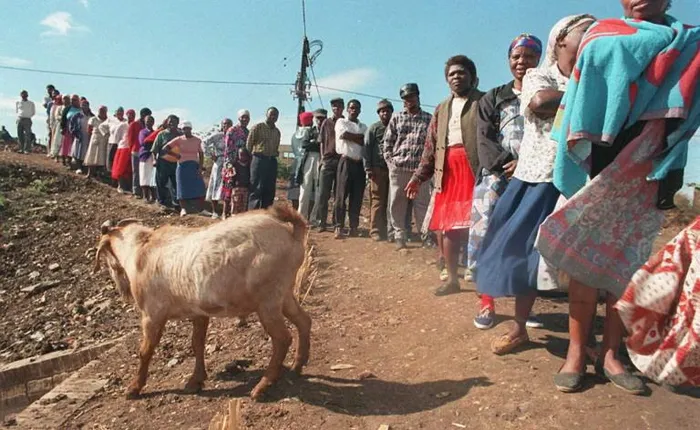
Voters wait in the rough terrain of Lindelani, outside Durban during the first local government elections in the era of democracy on June 26, 1996. The November local government elections offer citizens an opportunity to reclaim the spirit of popular participation that sustained communities during the liberation struggle, says the writer.
Image: Rajesh Jantilal/AFP
Dr. Reneva Fourie
On 4 November 2026, South Africans will once again have an opportunity to participate in local government elections. It is imperative that every voter registers and goes to the polls.
For decades, the majority of South Africans were denied the vote and any meaningful say over the conditions under which they lived. Colonialism and apartheid concentrated political and economic power in the hands of a minority while the masses carried the burden of exploitation, dispossession and poverty.
Black working-class communities largely experienced the state as a force imposed from above. Hence, the liberation struggle was based on the premise that ordinary people should shape the direction of society through collective participation and organised action, underpinned by the slogan ‘Amandla ngawethu – Power to the people’. A key demand was for everyone to have an equal right to vote in a non-racial, united South Africa.
To give effect to this approach, historically marginalised communities across the country built structures to provide residents with alternative means of power. During the 1980’s, in particular, street committees, housing action committees, youth formations, civic associations and worker locals became pillars of grassroots democratic participation and drivers of progressive change.
Residents gathered to debate local problems, coordinate campaigns around rents, transport and schooling, and to develop practical solutions to immediate challenges. These structures nurtured leaders from within communities and ensured that various sectors of society possessed a voice in collective decision-making.
Supported by the underground Area Political Committees of the liberation movement, the United Democratic Front, and later the Mass Democratic Movement, united most of the formations into a broad national force against apartheid. Mass mobilisation and the underground formed part of the four pillars of resistance, the other two being international solidarity and armed struggle.
These organic organs of people’s power carried immense political value because they encouraged citizens to become active participants in revolutionary governance rather than passive observers. Many ordinary residents developed confidence in their collective ability to solve problems and effect change. Communities exercised direct oversight over local conditions, and leaders within these structures remained answerable to the people who elected them.
Political education flourished because people learned through participation and practical engagement with everyday challenges. Communities understood that democracy required continuous organisation and permanent involvement from the people themselves.
After its unbanning, many of these popular political formations were absorbed into the liberation movement. After 1994, some civil society bodies became formally linked to state structures, such as parents-teachers associations that became school governing bodies and peace committees that became community policing forums.
In hindsight, this weakened grassroots participation and hindered bottom-up governance. Community initiatives lost momentum as power shifted away from neighbourhood organisations and towards institutions removed from the daily experiences of ordinary residents.
Citizens increasingly became spectators who engaged in politics only during election periods, with only a few participating in political party branches. Accountability weakened because organised communities no longer possessed the same collective capacity to monitor public representatives and mobilise around local concerns. The weakening of local democratic culture created space for disengagement and opportunism.
Voter participation in South Africa is declining steadily. Turnout in the 2021 local government elections was 45.86 per cent, down significantly from 57.94 per cent in 2016. While wards like Stellenbosch Central had voter turnouts exceeding 60 per cent, some wards, like in Tembisa, recorded an average voter turnout of approximately 34 per cent, and the by-elections in late 2025 saw this drop further to roughly 28.46 per cent.
This trend reflects growing disengagement from electoral participation driven by rising frustration with ineffective local governance and corruption.
However, withdrawing from voting weakens the ability of citizens to effect change. Local government remains the sphere closest to the people. Municipal decisions affect everyday life through housing, sanitation, roads, electricity, refuse collection and public safety.
Elections, therefore, provide communities with an opportunity to choose public representatives and hold them accountable. Every unused vote results in the emergence of poor candidates and reduces the collective strength of organised communities.
The grassroots activism of the 1980s should be revived to ensure that we get the right people into local government. The right to vote now belongs to every citizen regardless of race, gender or class. Millions sacrificed their freedom and their lives so that ordinary people could determine the future of the country through democratic participation, including elections.
The vote, therefore, carries deep historical meaning. It represents dignity, recognition and political agency for the working class and the poor. Every ballot cast affirms the principle that political authority must arise from the people themselves.
The system does not limit us to voting for a political party. Anyone can stand for the position of councillor. There is still time for communities to encourage principled and capable people to stand for elections at the local sphere and to find mechanisms to assist such candidates in addressing barriers such as resource and support mobilisation. Councillors who emerge from community struggles often understand the daily realities facing residents and remain connected to public concerns after elections.
Experiences within the UDF and MDM have taught that organised community participation can produce a voting culture that restores ethical, efficient and responsive governance that is rooted in, and accountable to, the people. Organised communities can monitor municipal budgets, attend ward committee meetings and demand transparency regarding service delivery and local economic development plans.
Residents should also drive local campaigns and support initiatives that improve neighbourhood conditions. Communities grow stronger when pensioners, workers, students, religious organisations and youth formations participate in public life together.
The November local government elections offer citizens an opportunity to reclaim the spirit of popular participation that sustained communities during the liberation struggle. Registering to vote, ensuring that credible candidates appear on the ballot and mobilising neighbours to participate are essential democratic responsibilities.
Real power grows when organised, active citizens use every democratic tool available to them. The ballot remains one of the most important instruments through which ordinary people can make their voices heard and influence the future of the places where they live and raise their families.
* Dr Reneva Fourie is a policy analyst specialising in governance, development and security.
** The views expressed do not necessarily reflect the views of IOL or Independent Media.