Ramaphosa’s ‘Cynical’ Tactics a Desperate Bid to Suppress the Truth
PHALA PHALA SCANDAL
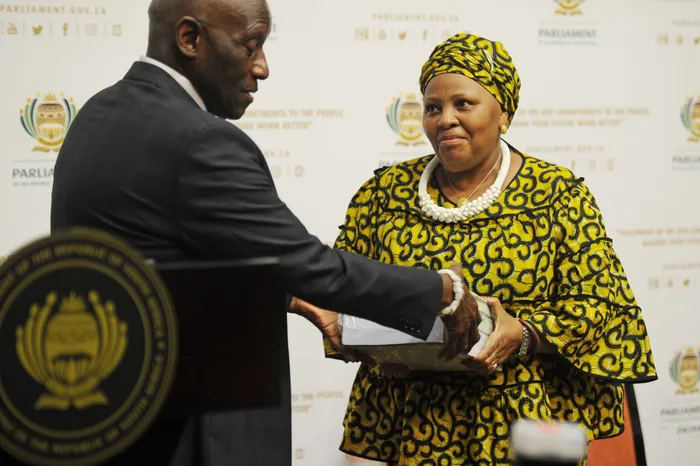
Retired Chief Justice Sandile Ngcobo presents the Section 89 Panel report to then Speaker of the National Assembly Nosiviwe Mapisa-Nqakula in Cape Town on November 30, 2022. President Cyril Ramaphosa’s decision to revisit the judicial review of the Section 89 Independent Panel report is a masterclass in deception and obfuscation, says the writer.
Image: Armand Hough/Independent Media
Prof. Sipho Seepe
President Cyril Ramaphosa’s decision to take the Section 89 Independent Panel Report on Phala Phala for judicial review is a cynical, self-serving manoeuvre.
It is not a genuine attempt to clear his name but a calculated response to the Constitutional Court’s recent judgment, which dismantled his efforts to bury the scandal. Ramaphosa is betting on two outcomes: that the review will stymie the Impeachment Committee’s work and that prolonged litigation will shield him from accountability for years.
Three years ago, Ramaphosa approached the Constitutional Court seeking direct access to review the Independent Panel’s report, which found prima facie evidence that he may have committed serious violations of the Constitution and anti-corruption laws. Luthuli House then used the application as a pretext to instruct ANC MPs to reject the report in the National Assembly. They obliged with enthusiasm.
Having neutralised the immediate threat, Ramaphosa lost the appetite to clear his name. He declared the matter moot after the Assembly’s 13 December 2022 vote against referring it to an impeachment committee. The Constitutional Court later dismissed Ramaphosa’s application for failure to make a case for exclusive jurisdiction or direct access.
Fast forward to 2026. The Constitutional Court has ruled that the National Assembly's vote was unconstitutional. It struck down Rule 129I, which had allowed the Assembly to terminate the impeachment process prematurely — before a full investigation and proper ventilation of the facts. The apex court was clear: where the Panel recommends proceeding with a Section 89 inquiry, the matter must be referred to an Impeachment Committee unless the Report is successfully set aside on review.
Ramaphosa’s decision to revisit the judicial review of the Section 89 Independent Panel report is a masterclass in deception and obfuscation. He has repeatedly weaponised legal processes to evade substantive accountability — a tactic that has too often worked because he can count on compliant mainstream media, quiescent civil society, and organisations such as COSATU that instinctively protect him.
As Justice Malala observed in the Sunday Times (10 January 2021): “It must be nice to be in President Cyril Ramaphosa’s administration… There is no accountability, no taking responsibility, and no consequence.” Peter Bruce described South Africa’s COVID-19 response as an “omnishambles” — a comprehensive failure marked by blunders and miscalculations. Yet the ANC and sympathetic media have since rewritten this period as evidence of Ramaphosa’s sterling leadership.
Ramaphosa and his praise-singers also blame COVID-19 for the economy’s collapse. The facts contradict them. In March 2019, even the Business Day noted that 2018 growth had slumped to a mere 0.7% — below the 1.3% achieved in Jacob Zuma’s final year and far short of the 5% required to address unemployment. The downward spiral began long before the pandemic.
At the core of Ramaphosa’s resistance lies his deep attachment to office. He has ruled out resignation, insisting he has “not stolen public money, committed any crime nor violated [his] oath of office.”
The emphasis on “public money” is a deliberate red herring. Neither Arthur Fraser’s complaint nor the Independent Panel accused him of stealing state funds. In his complaint, Mr Arthur Fraser alleged that an undisclosed number of hundreds of thousands of US dollars was brought in from certain Middle East and African countries and concealed in his farm in the couches with the full knowledge of the President. Nothing about the public money. The issue centres on hundreds of thousands of undeclared US dollars concealed at his Phala Phala farm.
The Panel found Ramaphosa’s explanation difficult to believe. According to his version, a Mr Hazim arrived unannounced on Christmas Day 2019 carrying at least US$580,000 in cash to buy buffaloes.
The Panel posed direct questions: How did Hazim Mustafa know there were buffalo for sale? Was the sale advertised? How did he know the exact purchase price unless carrying far more cash? How did he bring this huge sum into South Africa? Did he declare it at the point of entry? What is its source? Did he have authority from his country to export it? Why carry more than half a million dollars in cash across borders and then to the farm — behaviour the Panel described as un-businessman-like? Why not use a money transfer, as is normal in such transactions?
These questions remain unanswered. Ramaphosa has also failed to explain why the burglary at the farm and attempts to recover the stolen money were never reported to the police. The Panel rightly observed that someone concealing large amounts of illicit cash is unlikely to involve the authorities for fear of exposure.
The Panel’s findings were damning. It concluded there was prima facie evidence that the President may have committed serious misconduct and serious violations of the Constitution. Specifically:
- He was prima facie obliged under section 34(1)(b) of PRECCA to report the theft of foreign currency to the Directorate for Priority Crime Investigation, but failed to do so.
- There was a deliberate decision to keep the investigation secret.
- He abused his position as Head of State by involving the Namibian President in apprehending a suspect.
- He acted in a manner inconsistent with his office and exposed himself to a conflict between his official responsibilities and private business interests, violating section 96(2)(b) of the Constitution.
Rather than seize the impeachment process to clear his name under public scrutiny — as someone confident of innocence would do — Ramaphosa has rushed to the courts when it suits him. He understands the political and reputational dangers of full disclosure.
Professor emeritus Raymond Suttner captured the deeper malaise: “There is little in the record of Ramaphosa to suggest anything more than a self-indulgent, narcissistic attachment to the idea of being president, a presidency that has little content. What ideas, what vision, what ethics, if any, drive this man, and for that matter the organisation that he leads?” (Daily Maverick, 9 January 2021).
The Constitutional Court has now removed the procedural shield Ramaphosa relied upon. Parliament must proceed with the impeachment inquiry. With the Independent Panel having established prima facie that he has a case to answer, nothing prevents any party from opening a criminal case against President Ramaphosa.
South Africans deserve a comprehensive examination of the facts, not further evasion disguised as respect for legal process. Ramaphosa’s refusal to confront the substance of the allegations through an impeachment process only confirms that self-preservation, not principle, dictates his response.
* Professor Sipho P. Seepe, Higher Education and Strategy Consultant.
** The views expressed do not necessarily reflect the views of IOL or Independent Media.