BRICS 2026 Summit: Navigating Challenges in a Divided International Order
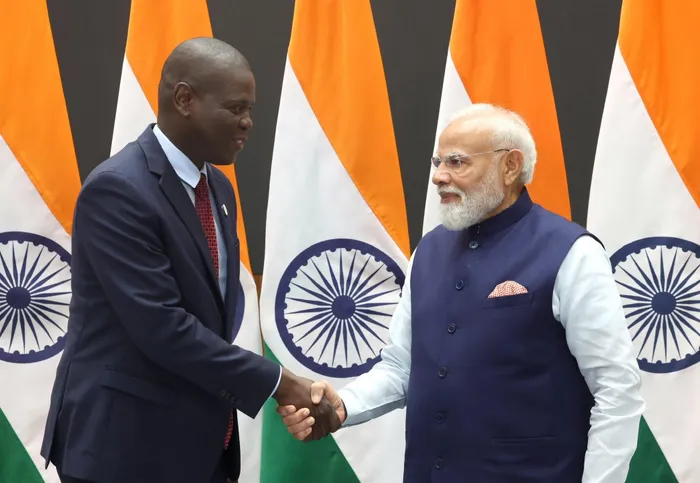
MINISTER of International Relations and Cooperation Ronald Lamola (left) greets Indian Prime Minister Narendra Modi on the sidelines of the BRICS Foreign Ministers meeting held in New Delhi on May 14. India will host the BRICS 2026 Summit.
Image: DIRCO/X
Ashraf Patel
The ongoing disruption of Trump 2.0, including trade and energy wars that are choking supply chains, is reverberating globally and regionally. An estimated 60 million citizens have been pushed below the poverty line, with millions of jobs lost in the past few months.
The Trump-Xi summit in Beijing this week will impact the global economy as the two giants commence strategic dialogues that will set the tone for trade, investment, and technology, and address complications on the big, intractable issues in the year ahead.
As the BRICS Plus bloc prepares for its 2026 summit, these issues loom large. Aside from energy and tariff shocks, other challenges, such as WTO Governance, remain anaemic and a push towards ‘Free Trade Agreements ’ FTAs where asymmetrical power is leading to unfair trade and investment deals. In this context, the BRICS trade is deepening, but many challenges remain.
UNCTAD's report on intra-BRICS trade
In this context, a new report from the UNCTAD assessing Two Decades of Intra-BRICS trade paints a dynamic picture of deepening co-operation as well as gaps. BRICS members are fully aware of the potential of intra-group trade. In the group’s Strategy for BRICS Economic Partnership 2025, BRICS leaders committed to “continue to explore opportunities for intra-BRICS trade and economic cooperation in the areas where BRICS members have already reached joint arrangements and results” (BRICS, 2020).
The report shows that trade between BRICS members has grown rapidly since 2003, driven by strong complementarities in natural resources, manufacturing and technology, as well as a changing global context. Yet constraints in policy-level cooperation still limit the full potential of intra-BRICS trade – highlighting the need for targeted strategies to strengthen cooperation and build deeper trade networks.
Rising intra-BRICS trade
The BRICS bloc's varying economic rise shows the weight of geoecomics is shifting South and East. Challenges such as unfair world trade regimes, monopoly and concentrated industries, rapid urbanisation and energy access and refining capacity in some BRICS nations are still a challenge. The need for decarbonisation and climate change still remains central to sustainable economic-industrial pathways.
The total merchandise exports from BRICS countries to the world increased dramatically from $906 billion in 2003 to $5.9 trillion in 2024. This growth has resulted in a steady increase in BRICS' share of global exports from approximately 12 per cent to about 24 per cent, demonstrating the growing importance of BRICS countries in global markets
Intra-BRICS merchandise trade has expanded more than 13-fold since 2003. Exports reached $1.17 trillion in 2024. China remains the central driver and, alongside Brazil, India, Indonesia, Russia and the United Arab Emirates, significantly accounts for the most dynamic trade flows among the BRICS members.
The total merchandise exports from BRICS countries to the world increased dramatically from $906 billion in 2003 to $5.9 trillion in 2024. This growth has resulted in a steady increase in BRICS' share of global exports from approximately 12 per cent to about 24 per cent, demonstrating the growing importance of BRICS countries in global markets ( UNCTAD, 2026)
These figures show that the structure of intra-BRICS trade has evolved. Many BRICS members demonstrate persistent dependence on primary products exports while importing manufactured goods with higher technology intensity, though some of them show mixed pictures with exports of technology-intensive products as well.
Here, the reality is that the phenomenon of Deindustrialisation is a reality in nations such as South Africa, Brazil, and others, while the oil-exporting powers of BRICS also face the phenomenon of the resource curse thesis, where a concentrated oil – gas industry determines their political economies and geopolitics. Even the Gulf’s famed consumerist-economic model has been exposed in the current Middle East wars.
Another dimension is that the BRICS bloc also has varying degrees of wealth distribution pathways and domestic consumption potential. The United Arab Emirates leads with a per capita GDP of $41, 989, followed by China at $12,706, while the three countries with the lowest per capita GDP are Ethiopia ($869), India ($2,418), and Egypt ($4,017). Regarding economic growth rates, the BRICS countries have performed unevenly but collectively outpaced the global average. Between 2003 and 2024, the BRICS achieved an average annual growth rate of 6.2 per cent, significantly exceeding the world average of 3.0 per cent during the same period ( UNCTAD, 2026)
The decision by China to extend duty-free access to 54 African nations is a game-changer and can potentially enable industrialisation and job creation in many countries.
Is a BRICS trade agreement possible?
Annual FDI flowing into BRICS economies is eyewatering and has surged from $84 billion in 2003 to $331 billion by 2024, representing the share of the global total rising from 15.2 per cent to 21.9 per cent during the same period. BRICS countries have also played a leading role in global trade. The 10 member countries collectively account for about 24 per cent of world merchandise exports.
However, the intra-BRICS trade connections present a mixed scenario. On the one hand, it has grown very rapidly at a double-digit rate for the last two decades. On the other hand, the scale of the intra-BRICS trade remains “small” (relative to their share of the world’s GDP or the global total trade) and policy-level cooperation is limited (compared to their growth rate and potential).
The report cites that there is no region-wide trade agreement despite many bilateral agreements among the members, and that, despite the rapid growth and vast potential of intra-BRICS trade, policy-level cooperation has not been fully aligned with the dynamics.
The current default position is that BRICS members rely on soft initiatives to lay the groundwork for deeper and more concrete cooperation. The ten BRICS member countries have joined numerous preferential trade arrangements, but a comprehensive trade agreement encompassing the entire bloc has yet to be established.
This report suggests that BRICS may adopt a Trade+ strategy to build political willingness, initiate a region-wide trade agreement, foster linkages between trade and other policy action areas and reform BRICS trade workstreams.
These super trade and investment figures suggest that at a trade and investment level, BRICS nations are developing ever deeper coherence as the world faces uncertainty due to Trump 2.0 trade wars and energy shocks. Here, the themes for the BRICS 2026 Summit in India and its themes on building resilience, fostering innovation, and strengthening cooperation in the face of global economic challenges are timely. Can it take the Global South along?
Key agenda item areas for the BRICS Trade Strategy in 2026 include:
- Response to Protectionism & Tariffs: Addressing the surge in unilateral tariff and non-tariff measures (such as proposed 25% tariffs on certain goods) that distort trade.
- WTO Reform: Pushing for serious reform of the World Trade Organisation (WTO), particularly the restoration of the Appellate Body, as discussed in this 2025 joint declaration.
- Supply Chain Cooperation: Strengthening cooperation in agriculture, health, energy, and supply chains to mitigate global shocks.
- Global South Trade Fund: Considering a mechanism to buffer against tariff wars for Global South nations, supporting MSMEs,
- Investment & Trade Facilitation: Promoting a policy framework for trade and investment among BRICS members, focusing on digital currencies to reduce dependence on the dollar.
- Sustainability & Standards: Implementing the BRICS Trade and Sustainable Development Framework.
As the world fractures along geopolitical and geo-economic forces atop the Polycrises, and as the BRICS bloc diversifies its economic and development, there is a need to align innovation and enterprise with principles of equity and inclusion in industrial development.
* Ashraf Patel is a Senior Research Associate at the Institute for Global Dialogue, UNISA.
** The views expressed do not necessarily reflect the views of IOL, Independent Media or The African.