Nuclear Hypocrisy: The NPT's Failure to Uphold Disarmament
Non-Proliferation of Nuclear Weapons
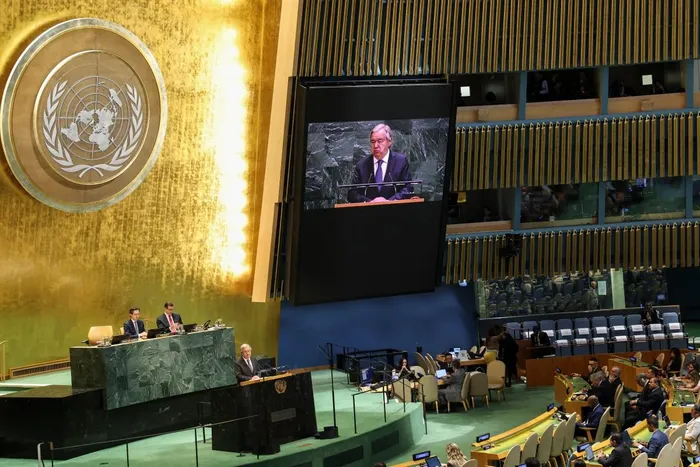
UN Secretary-General Antonio Guterres speaks during the 11th Review Conference of the Treaty on the Non-Proliferation of Nuclear Weapons (NPT) at the United Nations Headquarters in New York on April 27, 2026.
Image: AFP
Dr. Reneva Fourie
When world leaders and diplomats gathered at United Nations Headquarters in New York on 27 April for the opening of the 11th Review Conference of the Treaty on the Non-Proliferation of Nuclear Weapons (NPT), the intent was to revitalise an ageing framework designed to pull humanity back from the nuclear brink.
Yet, within days of the conference opening, it had revealed itself to be its usual theatre of great-power hypocrisy and institutional bad faith. That raises a fundamental question about whether being a signatory to this treaty holds any value at all.
The NPT, which entered into force in 1970, was premised on a deal in which non-nuclear states would forgo developing weapons, while nuclear-armed states would work in good faith towards disarmament.
More than five decades on, that deal has been comprehensively dishonoured by those with the most power to honour it, with South Africa standing as the sole exception.
Both the 2015 and 2022 Review Conferences collapsed without producing a consensus final document. A treaty that requires resuscitation every five years and has twice failed to reach agreement, even on an outcome document, cannot be considered a functioning pillar of international law. It has become a ritual increasingly regarded as impotent.
Non-nuclear signatories saw bad faith on the part of nuclear powers before the conference even began. The 2026 conference opened under a dark sky, with global military spending having hit $2.89 trillion in 2025, the last bilateral US-Russian arms limitation treaty having expired in February without a replacement, and nuclear arsenals, for the first time in decades, actually growing.
France announced it will expand its nuclear arsenal and agreed to new deterrence cooperation with Germany, formally establishing a nuclear steering group to coordinate their defence strategies.
The United Kingdom continues to modernise its submarine-based deterrent by updating the nuclear warheads to maintain what the government calls a "minimum credible deterrent" to at least 2060.
The United States maintains its extended deterrence network across NATO. It stations a stockpile of nuclear warheads on the soil of non-nuclear allies. Russia stations nuclear weapons in Belarus. China appears to be rapidly expanding its arsenal.
Non-aligned nations argue this is plainly incompatible with the spirit, if not the letter, of the treaty. These actions strike at the core of the treaty’s architecture. When nuclear states expand and modernise their arsenals while demanding restraint from others, they do not reinforce non-proliferation. They entrench a nuclear hierarchy that serves their own interests.
The conference's moral bankruptcy is most visible in its treatment of Iran. Iran has been subjected to more International Atomic Energy Agency (IAEA) investigations than any other country in the treaty's history. It has been scrutinised, inspected and examined with a thoroughness applied to no nuclear-armed state.
The IAEA has found no credible evidence of a current weapons programme. Iran's nuclear programme is civilian in nature, as demonstrated by the fact that every baby born in Iran is screened for 56 metabolic disorders using nuclear technology.
Despite this, the conference’s opening deliberations cited Iran’s nuclear capabilities as placing an unprecedented strain on the non-proliferation regime, grouping it rhetorically alongside North Korea’s demonstrated nuclear tests and intercontinental ballistic missile launches.
This conflation constitutes a political choice rather than a technical assessment. Iran is framed as a threat largely because influential countries, especially the United States, find it expedient to do so.
Recent United States military attacks on Iran and language implying the potential use of overwhelming nuclear force further undermine the system. A state cannot credibly champion non-proliferation while simultaneously threatening one of the most heavily inspected signatories.
In contrast, Israel is an illustration of a jarring oversight by global nuclear governance. Though widely believed to possess between 80 and 400 nuclear warheads, Israel has never signed the NPT, never accepted IAEA inspections, and never officially confirmed its arsenal. Its policy of deliberate ambiguity enables it to enjoy strategic advantages without legal constraints, highlighting divergences in how international norms are enforced.
Israel's nuclear development is deemed to involve covert collaboration with apartheid South Africa in the 1970s and 1980s, including possible transfers of nuclear materials and expertise. The 1979 Vela incident, widely assessed as a potential nuclear test near the Prince Edward Islands, remains unexplained.
The lack of a thorough investigation into whether this was a joint Israeli-South African test and the absence of any official inquiry expose a significant weakness in the international system's oversight.
The contrast with Iran is glaring. Iran is a signatory, repeatedly inspected, consistently cleared, yet persistently condemned. Israel, a non-signatory, is shielded from scrutiny by the United States’ diplomatic protection and faces no formal censure. The non-proliferation regime applies unequally, bearing down heavily on some countries while barely touching others.
The value of continued NPT membership is now a mainstream concern. The protection and legitimacy once offered by staying inside the tent have steadily eroded. This undermines the treaty's deterrent value.
The DPRK withdrew in 2003 and developed a nuclear arsenal. India, Pakistan and Israel never signed and face no international consequences. Iran, which signed and complied, faces sanctions, military attack, and ritual condemnation at every multilateral forum.
The lesson for smaller and medium-sized countries is troubling. Having nuclear weapons appears to provide deterrence, while compliance offers neither security nor respect.
This creates a dangerous incentive structure that will persist unless nuclear powers display a genuine commitment to their own obligations.
The 11th NPT Review Conference is, at best, a necessary conversation happening in an atmosphere of deep bad faith. At worst, it is an exercise in institutional theatre that legitimises the nuclear order whilst pretending to challenge it.
For it to have any lasting value, the nuclear states must cease modernising and expanding their arsenals. The IAEA must be seen to apply its scrutiny evenly. And the grotesque spectacle of a nuclear-armed power threatening a compliant signatory whilst chairing non-proliferation discussions must be confronted directly, not swept beneath the diplomatic carpet.
Until that day comes, non-nuclear states are entirely reasonable to ask what, precisely, their signature is worth.
* Dr Reneva Fourie is a policy analyst specialising in governance, development and security.
** The views expressed do not necessarily reflect the views of IOL or Independent Media.