'Macron's Summit a Rebranding of Imperialism and Exploitation'
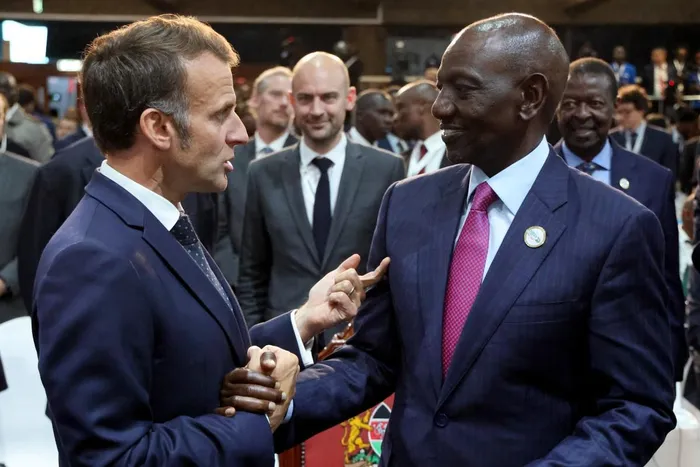
FRENCH President Emmanuel Macron (left) and Kenya's President William Ruto interact ahead of the Africa Forward Summit's closing plenary session in Nairobi, Kenya on May 12. The Summit was part of a carefully calculated strategic recalibration for France after the collapse of Françafrique in West Africa, says the writer.
Image: AFP
Kim Heller
"We are the true pan-Africanists," the French President, Emmanuel Macron, proclaimed at the Africa Forward Summit, held in Nairobi, Kenya, from 11 to 12 May 2026.
This unscrupulous assertion by the leader of a Western nation conceals the brutal history of colonialism on the Continent.
Pan-Africanism is the very antithesis of European colonialism. This philosophy was rooted in resistance to external domination and a vision of self-determination. France cannot claim Pan-Africanism, for it was among the European powers that carved up the Continent, imposed contrived borders and pillaged Africa. France did not build Africa, but was part of its orchestrated underdevelopment.
However, France still wants a decisive piece of the Continent. Post-independence, its influence has continued through the CFA franc, which is maintained by 14 African states and gives France considerable power over economic policy and reserves. In the current day Africa, France has continued to extract minerals.
For decades, French-owned and controlled companies extracted uranium from Niger to power France's nuclear plants. There are persistent allegations of French involvement in coups in its former colonies. It is telling that, about two months before the Summit, more than 800 French soldiers arrived in Kenya aboard three French warships.
The Summit, co-chaired by French President Emmanuel Macron and Kenyan President William Ruto, was touted as a move towards "equal partnership, innovation and growth". However, this is hardly true. The Summit was part of a carefully calculated strategic recalibration for France after the collapse of Françafrique in West Africa.
Macron is still licking his wounds after French troops were effectively frogmarched out of the Sahel. In countries like Mali, Burkina Faso and Niger, military juntas expelled French forces, terminated uranium export deals heavily favourable to Paris, and turned instead to new partners such as Russia.
France lost military bases and prized access to mineral resources. In William Ruto, Macron appears to have found a President with a voracious appetite for Western affirmation. Kenya is emerging as the new anchor of Western influence in East Africa, especially for France, which has lost much of its foothold in the Sahel.
There are significant rewards for Kenya: 11 bilateral agreements, including major rail and port infrastructure upgrades, joint nuclear energy and wind power projects, and sustainable aviation fuel production. In addition, Africa is expected to benefit from energy transition, agricultural and artificial intelligence investments totalling $16.4 billion in private and public funds from French-owned companies and $10.5 billion from African companies.
These investments are anticipated to create 250,000 jobs across France and Africa.The Nairobi Declaration, signed at the conclusion of the Summit, was lauded as a new framework for "Africa–France partnerships for innovation and growth" ahead of the upcoming G7 summit in France.
However, the declaration is no great victory for Africa. History has shown how investment and development on the Continent have often benefited multinational corporations far more than local economies. Such agreements frequently reproduce unequal trade relations and deepen dependency.
The Summit does not address critical pan-Africanist imperatives: the underlying power imbalance, control over infrastructure, local beneficiation and resource sovereignty. Professor P. L. O. Lumumba was scathing about Macron's intentions. Lumumba dismissed the notion that the Summit represented a genuine partnership.
Rather, he argued that the Nairobi gathering was a desperate attempt by France to regain leverage in new territories after its humiliating expulsion from the Sahel. Lumumba characterised the move as a calculated assault on African sovereignty.Hundreds of ordinary Kenyans took to the streets in protest, carrying "France Out of Africa" and "No to Neo-Colonial Deals" placards.
They argued that the Summit was little more than a rebranding of imperialism and exploitation. Police responded with teargas and arrests. As Ruto and Macron embraced warmly and congratulated one another on the Summit and the Nairobi Declaration, they did so in an Africa where the old architecture of domination and extraction is increasingly governed and protected by African presidents themselves.
Ruto has become a useful ally in preserving the old colonial order and its modern neo-colonial economic, military and psychological manifestations. A new future is possible for Africa, but without a clear vision grounded in sovereignty, industrialisation and regional solidarity, the Continent will continue to function as a site of geopolitical contestation and extraction by global powers.
True pan-African progress demands a significant reduction in reliance on external powers. The imprint of empire remains etched across the African landscape. Worse still, it carries the endorsement of leaders such as William Ruto, whose pan-Africanism appears to have been lost in the splendour of Western romancing and red-carpet diplomacy.
Macron declared: "When Africa succeeds, Europe succeeds, and vice versa."
He described Africa Forward as an action summit. However, Africa is not moving forward. It remains trapped in a vicious cycle of dependency. The Spearhead, a new African news portal, was critical of how Ruto is helping Macron re-enter Africa, arguing that Kenya should know better than to help France laud its image in Africa.
Before the Summit, Macron told the French-based Africa Report that colonialism could no longer be blamed for all of Africa's challenges.
"We must not exonerate from all responsibility the seven decades that followed independence," he said, calling on African leaders to improve governance. Macron is wrong about colonialism, for its legacy is engraved on the planes of contemporary Africa.
However, his reflections on African governance are not entirely incorrect. African leaders must enhance governance. However, as long as governance in Africa is not rooted in self-determination and economic sovereignty, it is no governance at all.
* Kim Heller is a political analyst and author of No White Lies: Black Politics and White Power in South Africa.
** The views expressed do not necessarily reflect the views of IOL or Independent Media.