China's Zero-Tariff Initiative: Opportunities and Challenges for Africa
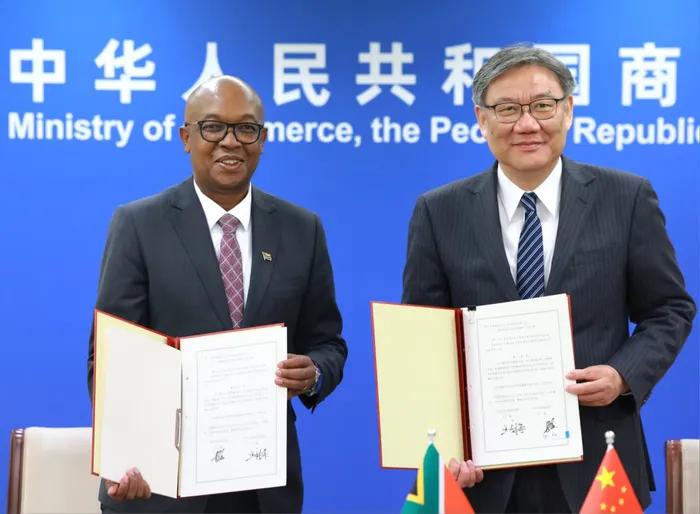
Minister of Trade, Industry and Competition Parks Tau (left) and China’s Minister of Commerce, Wang Wentao, following the signing of a China–Africa Economic Partnership Agreement (CAEPA) on February 6 in Beijing. China’s zero-tariff treatment is not charity, and it should not be romanticised. It is significant by the mere fact that the policy is strategically motivated, says the writer.
Image: DTIC/X
Prof. David Monyae
China’s decision to extend zero-tariff treatment in Africa is a calculated soft-power move with clear geopolitical consequences and a signal to African countries that their best interests and solutions lie in Beijing.
From May 1, 2026, to April 30, 2028, it has expanded its duty-free treatment from 33 least-developed African countries to all 53 African nations with diplomatic ties. The policy is straightforward, yet the message is more significant.
In a global environment increasingly shaped by protectionism and trade coercion, China is occupying the moral and political high ground, lending credence to its narrative of a reliable partner, particularly for Africa.
China long understood that solidarity and partnership with Africa is no longer a buzzword in international relations. For it to distinguish itself, soft power can no longer be sustained by speeches and summits, but through concrete actions that African governments and businesses can see and feel. The policy is not accidental; it is diplomacy by trade policy.
By removing tariffs on African exports, Beijing is not simply encouraging more imports from Africa but also responding to long-standing African complaints and demands about trade imbalance, market access, and the need for a more balanced economic relationship.
Leaders such as South Africa’s President Cyril Ramaphosa and Uganda’s President Yoweri Museveni have repeatedly called for greater trade openness and export of finished African products. China’s move suggests that it is listening and acting.
This strategic gesture has clear geopolitical implications. It positions China as the trade liberaliser at a critical moment when many Western economies are tightening access or weaponising tariffs. This contrast consolidates China’s narrative of solidarity with the Global South and reinforces its claim to be a responsible global power, dependable ally and partner, especially in Africa.
It also aligns neatly with China’s broader multilateral rhetoric on global governance. By unilaterally extending zero-tariff treatment, Beijing is signalling support for fairer trade and a more open international economic order, even as protectionist pressures intensify elsewhere.
This is where the soft power value becomes visible. African governments do not just ask who offers the biggest investments; they also ask who shows up with respect, consistency, and a willingness to accommodate their priorities.
China’s latest move strengthens that perception. It tells African capitals that Beijing is prepared to take initiative, bear some political cost, and publicly align itself with African development aspirations. There is also a deeper strategic logic, as such gestures have been the key drivers of China’s growing influence in Africa for decades.
Sino-African relations have always carried geopolitical weight, rooted in narratives of equality, mutual respect and historical marginalisation that call for solidarity and coalition building in an unjust international system.
Africa’s 54 countries remain a substantial voting bloc in the United Nations and a valuable diplomatic ally and vast market for Chinese products and technology. In an era of intensifying great-power competition, it is unsurprising that China is committed to consolidating its goodwill across the continent through trade liberalisation to serve its wider geopolitical goals.
Critics are right to point out that tariffs are not the only barrier facing African exporters. In fact, they are not even the biggest barrier. Production constraints, weak logistics, poor standardisation, high transport costs, limited industrial capacity, and cumbersome administrative procedures often matter more than tariffs themselves.
Moreover, non-tariff barriers can quietly do more damage than customs duties because they raise costs, delay shipments, and discourage firms from entering foreign markets at all. But that is exactly why China’s move should be seen as an important step rather than a final answer. Policy change often works incrementally.
Tariff removal does not solve every structural problem, but it does open a door. It creates a more favourable market environment and gives African firms a better chance to test, learn, adapt, and scale.
China seems to understand this, too. The zero-tariff policy has been paired with trade facilitation measures such as green lanes for selected agricultural products, a China-Africa trade cooperation fund, and specialised financial products designed to support enterprises expanding in Africa.
In other words, Beijing is not only lowering customs barriers, but it is also trying to improve efficiency along the trade chain. South African apples were the first products to enter China under the expanded policy, after clearing customs in Shenzhen.
Symbolically, it showed that the policy is operational, not rhetorical. Practically, it demonstrates that when market access improves and procedures are aligned, African exports can move.
Still, Africa must take responsibility and not mistake access for automatic competitiveness. The challenge is that a tariff-free market is only useful if producers can meet market demand consistently, competitively, and at scale. That is why African governments must treat China’s zero-tariff treatment as a first step and not an end in itself.
The priority must be production capacity. African countries must work together to produce in sufficient quantity and quality through value addition. It must process more of what it grows and extracts to benefit from China’s gesture. African exporters will need stronger national quality systems and better alignment with international requirements.
Logistics is another major constraint as costs rise and products lose value when they are delayed at ports, stuck in ineffective customs systems, or moved through inefficient transport corridors. This is why regional infrastructure, rail links, roads, ports, warehouses, and cold chains are critical.
It is also why China’s own Belt and Road Initiative projects across Africa, which include roads, railways, special economic zones, dams, power plants and connectivity assets, should be seen as part of the same trade story as market access and logistics capacity must work together.
Initial responses from some African countries are encouraging; however, the continent must be up to the task and implement measures to build the necessary capacity without fail. For example, Kenya’s trade minister said the country must “urgently bridge the readiness gap,” while agencies such as the Kenya Export Promotion and Branding Agency work to train exporters, facilitate certification, and connect firms with Chinese buyers.
South Africa has moved quickly to align customs procedures and legislative frameworks so that certificates of origin can be issued efficiently. These are the kinds of practical adjustments Africa needs: readiness rather than slogans and speeches.
While China’s policy initiative is short-term (2 years), the long-term opportunity is greatest if African countries use this policy to move beyond raw materials or primary commodities. China’s market is large, sophisticated, and increasingly open to differentiated consumer goods, agricultural products, and processed foods.
If African economies can diversify exports, improve packaging, strengthen branding, and move up the value chain, the zero-tariff arrangement could become far more meaningful than a symbolic gesture. The best response is not passive gratitude but disciplined preparation.
That will require the necessary industrial policy, investment in agribusiness, better regional coordination, and a more serious commitment to intra-African trade under frameworks such as the African Continental Free Trade Area.
In fact, the logic of this trade policy should push African states to act regionally. Individual countries may struggle to meet export volumes alone, but regional value chains could make African exports more reliable and competitive.
China’s zero-tariff treatment is not charity, and it should not be romanticised. However, it is significant by the mere fact that the policy is strategically motivated. It reveals a China that wants to be seen as a serious, listening, reliable partner in a period when many African governments are tired of lectures, conditionality, and coercive trade measures.
It also raises the bar for how major powers should engage Africa: not through rhetoric alone, but through concrete market access and tangible respect. From Africa’s viewpoint, therefore, this is a positive development and a meaningful soft power win for China.
* Prof. David Monyae is the Director of the Centre for Africa – China Studies at the University of Johannesburg.
** The views expressed do not necessarily reflect the views of IOL or Independent Media.