Phala Phala judgment: What it means for Cyril Ramaphosa and SA's political balance of forces
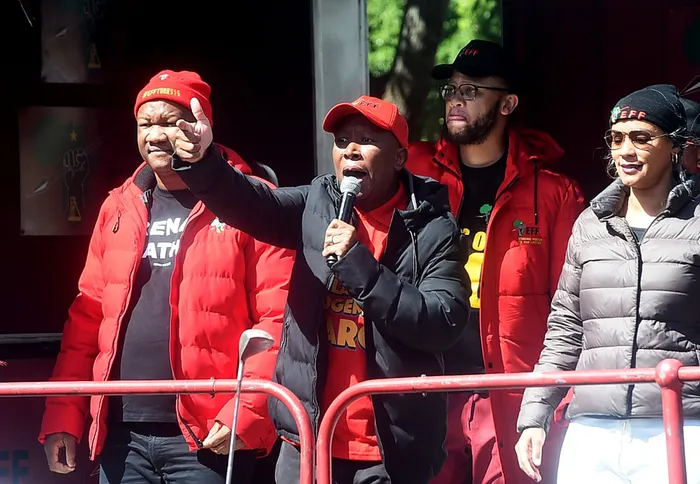
Leader of the Economic Freedom Fighters (EFF) Julius Malema addressing party supporters at the Constitutional Court in Braamfontein on May 8. Today's Phala Phala judgment has clearly vindicated the Economic Freedom Fighters (EFF) and African Transformation Movement (ATM) for taking the matter up in defence of the constitution, says the writer.
Image: Itumeleng English
Prof. Bheki Mngomezulu
May 8, 2026, will go down in history as a momentous occasion in South African history for two reasons.
Firstly, it was on May 8, 1996, when the Constitutional Assembly adopted the current constitution that has been hailed by the global community as one of the best in the protection of human rights. Therefore, the date marks the 30th anniversary of the country’s constitution and presents an opportune moment to test South Africa’s democratic consolidation and its maturity.
Secondly, the date has put to the test the independence of the judiciary as contemplated in the constitution, which states that the executive, parliament, and the judiciary are the three arms of government – each of which enjoys its independence from the other arms of state.
The fact that the judges were divided into three groups on this matter is indicative of the seriousness of the Phala Phala matter and the determination by the judiciary to demonstrate to the nation that it upholds its expected independence and respects the constitution. Each of the three groups of judges crafted its judgment by interpreting the Constitution.
When juxtaposing today’s ruling with previous court decisions on various matters that were deemed controversial and partisan, this ruling brings a semblance of hope that the judiciary could be revamping itself to regain its lost credibility and public trust.
What was also remarkable was when Chief Justice Mandisa Maya began her delivery of this judgment by making an honest public apology to the nation for the delay in pronouncing on this matter. She even regretted any inconvenience anyone may have experienced or suffered due to this delay.
It is not common to hear someone in her position making such a public apology. This, too, instils hope in the public about the independence of the judiciary and its respect for the citizens of this country and the constitution.
But what implications will this judgment have on various role-players – directly or indirectly?
Perhaps before even addressing this very critical question, it is worth stating that the vote of 214 members of the National Assembly on December 13, 2022, who rejected the independent panel finding that President Ramaphosa had a case to answer to, versus 148 who accepted former Chief Justice Sandile Ngcobo’s panel report, was tantamount to postponing a funeral that was going to eventually happen anyway.
The first person to be affected by this ruling is President Cyril Ramaphosa. The ruling means that he is not out of the woods yet. Although the ruling does not say that the president must leave office immediately, it means that he will still be subjected to the Section 89 impeachment committee processes.
Whether he will survive or not remains a moot point for now. But what we know is that the Constitutional Court judgment has reactivated this matter as was intended by the two political parties that took the matter to court.
On the other hand, the judgment vindicates Ramaphosa, who realised that the Phala Phala matter was indefensible and thus took an honourable decision to pen his resignation letter. It was the ANC that convinced him to rescind his resignation – a decision that negatively affected the party as evidenced in the 2024 general election.
People like Gwede Mantashe, Fikile Mbalula and others who mobilised ANC members to defend Ramaphosa should regret their decision to convince Ramaphosa not to resign in 2022. By now, this issue would be a thing of the past. Perhaps even the ANC would have recovered from it.
The ANC will also be negatively affected by this court ruling. In the past, the ANC has always enjoyed the majority in parliament during the first six administrations from 1994 to May 2026. This is no longer the case following the party’s dismal performance in the May 2024 general election. Should Section 89 be invoked to impeach Ramaphosa, will the ANC win the day as it did in December 2022? This remains a critical question with many possible implications.
Another test will be on the survival of the multi-party coalition commonly dubbed by many as the Government of National Unity (GNU). To what extent will the multi-party coalition remain intact after this judgment? If voting were to happen soon, how would individual political parties vote now that they are part of the government and are no longer on the opposition benches? Would they protect Ramaphosa to keep their positions, or would they defend the country’s constitution? How would their decision influence the electorate in this year’s election and in the 2029 general election?
Regarding the Democratic Alliance (DA), which was the official opposition in 2022 and was vocal on the Phala Phala matter, where will it stand now that it is working with the ANC, and some of its members are holding cabinet positions? Will they vote for the retention of blue lights that they obtained by agreeing to work with the ANC, or would they uphold the constitution and truly represent the people of South Africa and not their own interests? This would be a great test for their loyalty.
Helen Zille has on several occasions been upfront, saying that the DA’s deal is with Ramaphosa and not the ANC. In other words, the DA pins its trust on the individual, not the party. If Ramaphosa were to resign, what would be the DA’s stance on its participation in the ANC-led multi-party coalition government?
Given that the ANC will hold its elective conference in 2027, will the DA still want to work with the ANC post-Ramaphosa’s ANC leadership, or will the party go back to its original position of being the official opposition in preparation for the 2029 general election? Only time will tell.
In other words, today’s judgment is an indictment of the ANC for having abused its majority in parliament to protect Ramaphosa. The party may now regret its decision to use its majority in parliament to defend Ramaphosa at the expense of the constitution and the people of South Africa.
The judgment has clearly vindicated the Economic Freedom Fighters (EFF) and African Transformation Movement (ATM) for taking the matter up in defence of the constitution. What was initially dubbed as ‘political grandstanding’ by these parties’ political adversaries has proved to be a rational decision.
This being the Local Government Election (LGE) year, today’s judgment could boost the political image of these two parties. Surely, they did not plan this to coincide with the LGE, but would be pardoned to enjoy the benefits that might accrue from this judgment.
Parliament will equally be affected by this judgment. Parliamentary Rule 129(i) was at the centre of today’s judgment. The majority decision, which concluded that this rule is inconsistent with the country’s constitution, also stated that the voting that happened on December 13, 2022, should be deemed invalid and set aside. This means that more work should happen in parliament to correct this anomaly so that the country does not find itself in a similar situation in future.
Today’s judgment indirectly raises questions about the decisions of the Public Protector and the South African Revenue Service, which cleared Ramaphosa. It will have serious ramifications for various individuals and institutions.
* Prof. Bheki Mngomezulu is Director of the Centre for the Advancement of Non-Racialism and Democracy at Nelson Mandela University.
** The views expressed do not necessarily reflect the views of IOL or Independent Media.