How China is Gaining Geopolitical Influence Amidst American Disorder
GEOPOLITICS
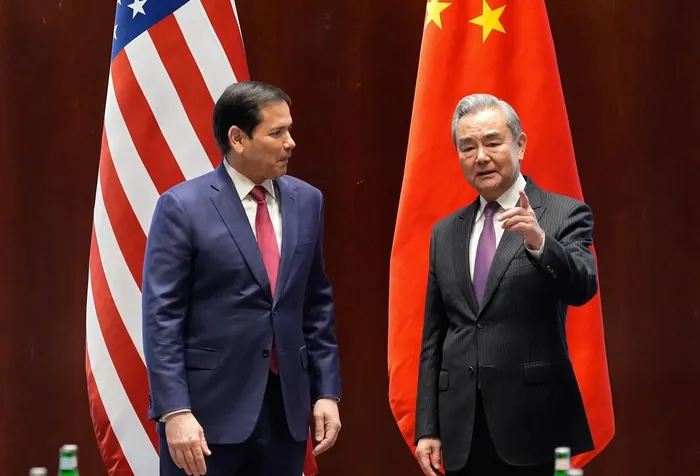
US Secretary of State Marco Rubio (left) and China's Foreign Minister Wang Yi at the Munich Security Conference on February 12, 2026. China’s advantage is not that countries are choosing Beijing over Washington. It is that they are choosing not to depend entirely on Washington, says the writer.
Image: AFP
Ambassador Ntsiki Mashimbye
America is still the world’s most powerful state. But power is not the same as control. What the current crisis around Iran, Europe and Asia reveals is not simply a contest between Washington and Beijing. It reveals something deeper: the United States is increasingly using power in ways that frighten even its friends, while China is converting that fear into leverage.
The central fact is this: China does not need to defeat America militarily to weaken American influence. It only needs to present itself as the steadier alternative in a world unsettled by American unpredictability.
For Beijing, recent U.S. actions are not just episodes of military adventurism. They are strategic gifts. The war in Iran, threats toward Greenland, public contempt for allies, and coercive use of sanctions all reinforce China’s core message: the U.S.-led order is no longer rules-based; it is power-based.
China’s response has been disciplined. It does not loudly denounce Washington at every turn. It watches, absorbs the consequences, and builds around them. That is why Chinese anxiety about American behaviour is mixed with opportunity. The U.S. may still command the battlefield. China is positioning itself to command the system that comes after the battlefield.
Europe is the clearest case. The old bargain was simple: America provided security; Europe accepted dependence. That bargain is cracking. The EU’s Readiness 2030 plan aims to mobilise up to €800 billion for defence, partly to reduce reliance on U.S. protection and U.S. weapons supply chains.
This shift is not limited to defence. Europe is also searching for alternatives in payments, software, finance and strategic reserves. The logic is blunt: dependence on America has become a vulnerability. Once allies begin building alternatives, those alternatives develop their own political life.
Canada is moving in the same direction. Asian allies are doing so too, especially where energy security is concerned. Japan, South Korea and India cannot afford a world in which every U.S. military escalation becomes an energy shock. The more Washington acts unilaterally, the more its partners hedge.
China benefits from that hedging.
Its strength is not only diplomatic. It is industrial. China dominates key sectors of the future economy: roughly 80% of global solar panel manufacturing, about 60% of wind turbines, around 75% of batteries, and more than two-thirds of EV production.
That matters because influence now travels through supply chains. A country that needs solar panels, batteries, ports, railways, telecoms, minerals processing or affordable EVs increasingly has to deal with China. Beijing’s offer is rarely sentimental. It is transactional: finance, infrastructure, technology, market access and long-term dependency.
The Belt and Road model is often criticised as debt diplomacy, and sometimes rightly so. Sri Lanka’s Hambantota port remains the cautionary tale. But the deeper point is that China has built a form of influence that does not require bases, lectures or invasions. It builds roads, ports, grids and payment systems. Then it waits.
Iran shows the model clearly. China has become Iran’s key economic outlet, especially for oil. Recent U.S. sanctions have targeted Chinese-linked refineries and shipping networks involved in Iranian crude, confirming how central China has become to Iran’s sanctions survival strategy.
The Iran-China relationship is not just about oil. It is also about currency and financial architecture. Payments increasingly routed outside the dollar system support Beijing’s long-term ambition to internationalise the renminbi.
That is where CIPS, China’s cross-border payment system, matters. It is not yet a replacement for SWIFT. That claim is exaggerated. But it is part of a larger Chinese strategy: reduce exposure to U.S. financial surveillance, create options for sanctioned states, and slowly weaken the monopoly power of the dollar system.
This is the real contest. America uses sanctions, military force and alliance pressure. China uses infrastructure, manufacturing scale, discounted energy, alternative payments and patient diplomacy.
One makes headlines. The other builds habits.
But the argument should not be overstated. China is not loved. Europe, Canada, India, Japan and South Korea are not about to become Chinese clients. They have serious disputes with Beijing over Ukraine, subsidies, EVs, market access, critical minerals and security. They do not trust China. But they increasingly do not fully trust America either.
That is the strategic opening.
China’s advantage is not that countries are choosing Beijing over Washington. It is that they are choosing not to depend entirely on Washington. In geopolitical terms, that is already a victory for China.
The U.S. still has unmatched military reach, the world’s deepest capital markets, leading universities, powerful technology firms and a vast alliance network. But alliances are not machines. They run on trust. Once allies begin to believe that American protection can become American coercion, they start buying insurance.
China is selling that insurance.
The new world order may not arrive through a dramatic Chinese victory. It may arrive quietly, contract by contract, port by port, payment system by payment system, battery by battery. America is trying to preserve primacy through pressure. China is building influence through dependence.
And in this moment of American disorder, Beijing does not need to fire a bullet. It only needs to keep building.
* Ntsiki Mashimbye is South Africa’s Ambassador to the Arab Republic of Egypt.
** The views expressed do not necessarily reflect the views of IOL, Independent Media or The African.