Navigating the Trade Wars: SADC's Challenges and Opportunities
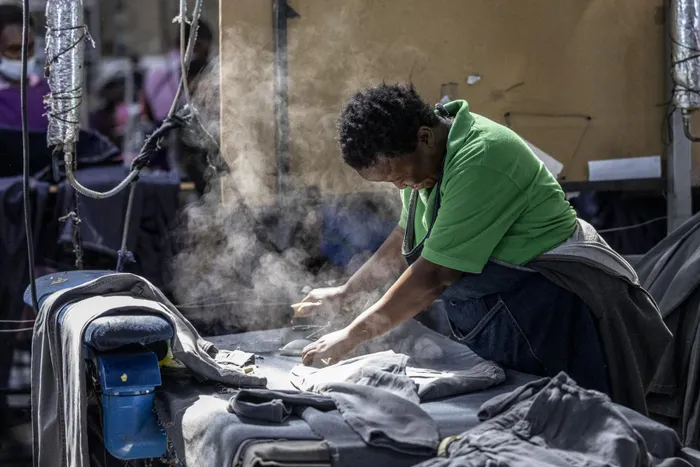
A worker uses a steam iron at the Afri-Expo Textile Factory in Maseru, Lesotho on March 19, 2025. While SADC's energy-exporting nations are in a new bonanza cycle, its poorest nation, Lesotho, is suffering mass job losses from the effects of tariffs in the textile industry, says the writer.
Image: AFP
Ashraf Patel
Donald Trump’s MAGA disruptive policies have plunged the world into a violent, dystopian, Orwellian world order.
The energy crisis and fallout from the Middle East war means that global inflation and supply chain instability have led to a cost-of-living crisis and fertiliser shortages affecting Africa to a greater extent.
Even worse is Trump 2.0's new Free Trade Agreements (FTAs), a recalibrated reverse AGOA that guarantees US firms access to African markets while posing multiple challenges for the region.
Atop these polycrises is the great game for access to Africa’s critical minerals, which is fuelling a ‘resource curse’ narrative in which extractive zones are sites of conflict, pollution and poverty. Fragmentation in peace and security and electoral violence adds more fragility in our Southern African region.
With energy-exporting nations in a new bonanza cycle, while its poorest nation, Lesotho, is suffering mass job losses from the effects of tariffs in the textile industry. In this milieu, in 2026, the Southern African Development Community (SADC) will hold key meetings focused on industrialisation, agricultural transformation, and energy transition.
According to economist John Stuart,
“US President Donald Trump kicked off his second term of office with unprecedented tariff actions against the US’s entire group of trading partners. Developing regions were not spared this onslaught, and in some cases were more heavily punished than developed trading partners. In his ‘liberation day’ tariffs announced in April 2025, Trump imposed a 50% tariff on Lesotho and a 47% tariff on Madagascar, both LDCs. Among the hardest-hit African countries were those in Southern Africa: Mauritius (40%); Botswana (37%); Angola (32%), South Africa (30%); Namibia (21%); Zimbabwe (18%); Zambia (17%) and Malawi (17%).”
Key sectors such as South Africa's automotive industry, Kenya's textile sector (supporting 660,000 livelihoods), and Lesotho's export-driven economy (mostly based on apparel exports) are at high risk of significant job losses and investment flight. The economic damage is concentrated in sectors that had thrived under AGOA, with severe consequences for employment and investment.
From South Africa’s G20 in 2025, to the EU-AU Luanda 2025 summit, to the FOCAC and now the France- Africa Summit 2026, the feeling is that Africa is on ‘the menu and not on the table’. This sobering view suggests a dire lack of African agency, fragmentation and even ‘divide and rule’ of African regional powers amidst great power competition.
Energy and the Resource Curse
Uneven extractive development has been a hallmark for South Africa whose economic structure has been trapped in the Minerals -Energy Complex (MEC).
The current oil shocks emanating from the current destructive Middle East war have seen an intensification of investment for African oil and supply route access. Here, Angola and Mozambique are core energy-exporting states.
Yet poverty and violence in oil extractive zones continue due to weak regional and local government while weak development programs and outcomes mean more extremism. South Africa suffers from perennial refining capacity challenges, while Nigeria’s Dangote Group is investing in massive refining capacity, and the dividends are paying off in real time.
Namibia is also being primed as a core hydrogen-exporting state, primarily for the EU markets. Yet the Southern African region needs energy to boost its own industries in an age of Green industrialisation.
Critical Minerals in the extractive-conflict nexus
At the epicentre of these multiple global headwinds, much of the region also faces a new push for its vast Critical Minerals. The DRC, Zambia and Zimbabwe are sites of massive investment and geo-economic contestation for access to cobalt, lithium, copper and other core minerals for the Green and AI industries.
Trump-style dealmaking and strong-arm trade deals by the Trump administration are brash and bold in demanding more resources, concessions and access to African markets, with the USA-Zambia FTA criticised for its demands to access health data.
This brash approach in FTAs is having major setbacks for their own industrialisation plans and puts SADC's Regional Industrialisation Plan at risk.
Logistics Bottlenecks
Despite progress, high transportation costs, such as shipping routes in East Africa, continue to act as barriers for Small and Medium Enterprises (SMEs) looking to access broader markets.
Way Forward
Flowing from its G20 Presidency and themes, South Africa, as a regional power, has the opportunity to show more robust leadership by suggesting a bold new industrial development agenda for the SADC summit in August 2026 including:
1. SADC Trade & Development cushion fund for Vulnerable nations: A regional trade fund would work whereby nations contribute based on their GDP and export windfalls. Vulnerable nations such as Lesotho, etc., can tap into such a fund to stave off the effects of tariff wards
2. Boost Africa and Regional connectivity to enhance trade: As the AFCFTA gains momentum at a policy level, there needs to be special investments in digital capacity to boost trade. Here, there needs to be investments in digital transformation. Africa’s border nodes need a seamless digital interface. Reduction of documentation processing times can be expected to be reduced to a few hours via harmonised e-certificates, e-invoices and online payments model.
3. Common SADC digital trade currency: As the Pan African Payment Systems (PAPSS) gains momentum and standardisation, the moment provides an opportunity for a regional currency for intra-trade within SACU and SADC. This model is being piloted in ASEAN nations on some categories of trade, and is a model to emulate.
4. Towards a Regional Sovereign Wealth Fund: Finally, desperate times call for creative measures. The current trade wars and energy disruptions are the ‘new norm ’of the international order, and their effects will be with us for years ahead. Here, the leading SADC economic powers need to show leadership and agree to set up a regional Sovereign SADC Wealth Fund. This can be funded by energy export revenue and digital and social media taxes.
The resources can then be channelled into vulnerable regions, nations such as Lesotho, as well as sectors such as connectivity, food and agriculture security and nations facing climate crises and emergencies and migration flows.
There are moments in history when bold leadership and decisions are required. The Southern African region rose to the challenges and embraced the ‘democratic wave of the early 1990s’. In summary, the democratic dividend has not led to development outcomes.
Our region now needs a new narrative and hence a new Development and Green Industrialising model moving towards a balanced integration in the decade ahead. Time is running out!
* Ashraf Patel is a Senior Research Associate at the Institute for Global Dialogue, UNISA.
** The views expressed do not necessarily reflect the views of IOL, Independent Media or The African.