Escalating Violence in Mali Jeopardises Sahel's Stability
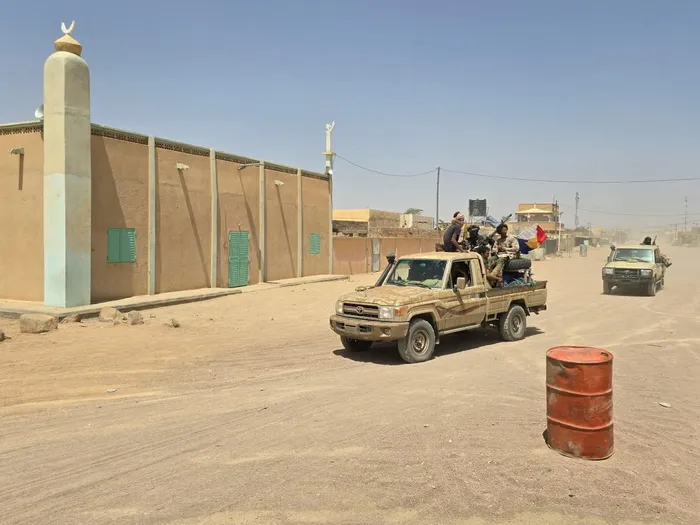
Tuareg rebels of the Azawad Liberation Front (FLA) coalition ride on the back of a pickup truck in Kidal, on April 26, 2026. Shock attacks, synchronised by Tuareg rebels of the Azawad Liberation Front (FLA) coalition and the jihadist Group for the Support of Islam and Muslims (JNIM), targeted several areas in the vast arid country.
Image: AFP
Kim Heller
The people of Mali awoke to terrifying bursts of gunfire and explosions on Saturday, 25 April 2026, when insurgents connected to Jama'at Nusrat al-Islam wal-Muslimin (JNIM) and Tuareg separatists from the Azawad Liberation Front (FLA) struck military positions across the country.
In Kati, the strategic and operational nucleus of Mali's military order, Defence Minister General Sadio Camara, was killed after a vehicle loaded with explosives slammed into his family home in a well-coordinated large-scale offensive. To date, sixteen military and civilian deaths have been officially reported.
This attack and assassination were a calculated strike at the very architecture of the new Malian state. For insurgents to strike Kati and assassinate a key leader sends a menacing signal about the intention and capability of the rebel groups.
Government spokesperson Issa Ousmane Coulibaly described the assault as a "terrorist attack". He stated that Malian forces had responded "with professionalism and determination," and that the situation was under control. However, reports of real-time conflicts in several regions suggest that the situation remains volatile.
The timing of the attacks is significant. Mali is highly invested in reclaiming and redefining its sovereignty after a decade-long dependence on external military intervention. Mali's rejection of foreign-backed destabilisation threatens the imperialist agenda. The coordinated attacks on Mali are an attempt to rattle Mali and imperil its path towards self-determination.
The battlefield is dangerously unpredictable as alliances between insurgents form in the shadows. For many years, French forces marketed themselves as essential partners in the fight against insurgency in Mali. However, the French were highly ineffective, despite their strong footprint. Insurgency rose amid an untenable situation as instability took hold.
After the 2020 and 2021 coups, Colonel Assimi Goïta took power and made the historically significant decision to oust French troops from Mali. This was a courageous declaration of sovereignty that has become the new anthem of liberation across much of the Sahel.
When Mali turned to Russia for security support, it was seen as a contentious, if not inflammatory, move by Western leaders. However, this new military pact was part of a broader recalibration across the Sahel to work with partners who respected, rather than subverted, the region's charter of self-determination.
It was a bold declaration that Mali has no business subcontracting its security to a former colonial power whose presence did more harm than good. Just days after the attack, President Assimi Goïta met with the Russian Ambassador Igor Gromyko in Bamako to discuss the security situation. Gromyko reiterated Russia's commitment to assisting Mali in its fight against terrorism.
Russian officials said the African Corps units had supported Malian forces against the insurgents. In an emotional tribute to Camara, Goïta declared: "The commitment of General Sadio Camara will remain etched in our memories." He added that no violence, intimidation, or attempts to destabilise Mali would reverse the course of our country.
Regional bodies condemned the attacks. The African Union Commission Chairperson condemned the "cowardly acts", reaffirmed the continent's solidarity with Mali, and urged for stronger security coordination. Despite its strained relations with Mali, ECOWAS denounced the "heinous" assaults, calling for collective mobilisation against terrorism.
In many respects, Mali is a microcosm of the Sahel's struggle for true sovereignty. There is an unavoidable interconnectivity between the bitter battles being fought by Sahel nations. Alioune Tine, the founder of the Afrikajom Centre, stated: “If Mali falls, the whole Sahel will follow."
In particular, Burkina Faso and Niger face similar threats from insurgencies. Coastal states such as Ghana, Togo and Benin are not immune to waves of terrorism across the region as the southward creep of extremist violence threatens to erupt into violence.
In response to growing security threats, Mali, Burkina Faso, and Niger formed the Alliance of Sahel States (AES) to reimagine sovereignty and solidarity outside frameworks perceived as compromised or externally influenced.
The AES provides a necessary platform for collective security and protector of African self-reliance — it is a promising, proactive undertaking. In its infancy, it has yet to face the might of imperialist alliances, but its capacity will grow over time.
On the ground, the battlefield remains fluid and unforgiving. The matrix is becoming dangerously explosive as the battle over security and sovereignty in the region intensifies. Jihadist elements and separatist movements now appear to be operating in tandem.
Moussa Ibrahim, a political analyst and former Libyan official, has argued that the conflict is not simply about terrorism but about sovereignty, unity, and control over resources. He traces the instability back to the 2011 NATO intervention in Libya, which dismantled the Libyan state, unleashing a flood of weapons and fighters across the Sahel. Ibrahim argues that the Sahel is not a lone zone of insurgency but rather a frontier shaped by the aftershocks of geopolitical decisions made far beyond its borders.
Mali, like all Sahel states, is struggling to develop and implement an autonomous and effective security framework. Sovereignty without security invites chaos, yet security without sovereignty is little more than a gilded cage. Mali is trying to avoid both pitfalls.
The Malian transitional government is working hard to construct a state embedded in sovereign control over its wealth and destiny. The attacks of April 2026, however, expose the gap between this noble political vision and the stark reality of operational capacity.
For now, the Sahel is unsettled, and the struggle is set to continue. What is less certain is on whose terms the fight will be fought.
* Kim Heller is a political analyst and author of No White Lies: Black Politics and White Power in South Africa.
** The views expressed do not necessarily reflect the views of IOL or Independent Media.