Reawakening Worker Activism To Unite SA's Fractured Labour Movement
INTERNATIONAL WORKERS' DAY
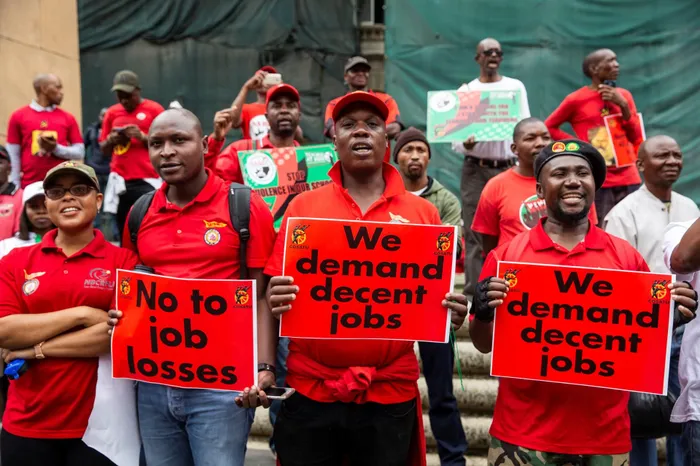
COSATU supporters at a demonstration against government policies leading to job losses and deepening poverty held in Johannesburg on February 13, 2019. Meaningful change cannot be carried out by trade unions alone. It requires a revolutionary vanguard party, grounded in the interests and lived realities of working people, says the writer.
Image: AFP
Dr. Reneva Fourie
International Workers' Day traces its origins to the 1889 gathering of the Second International in Paris, where labour and socialist parties called for a global demonstration to demand the eight-hour workday.
The date was chosen to honour the 1886 American general strike, when over 300,000 workers walked off the job, often working 12 to 16 hours a day amid dangerous conditions and low wages. That strike led to the Haymarket affair, and the day soon became an annual symbol of solidarity. By 1904, the movement had grown into a worldwide call for workers' rights, social justice and enduring peace.
South Africa's History of Worker Struggles
In South Africa, it carries deep resonance rooted in earlier formations like the Industrial and Commercial Workers' Union (ICU) of the 1920s and later the South African Congress of Trade Unions (SACTU), which, through organisations like the Communist Party of South Africa (SACP) after its banning, linked labour struggle to national liberation.
This tradition deepened in the 1970s–80s as militant shop-floor organisation and mass strikes challenged apartheid, uniting workplace and community struggles and reinforcing the belief that worker power is central to political and economic freedom.
Why 1994 Did Not Bring Economic Justice?
Yet the democratic transition of 1994 did not equate economic transformation. It transferred formal political power while leaving the economy's ownership and structural character intact. The deep problems in South Africa's job market aren't accidental.
They are the natural result of an economy that benefits the rich and is tied to a global system where wealthy countries control poorer ones on unfair terms. That system now forces workers to confront new frontiers of precarity and technological displacement.
Impact of Unemployment
The Q4 figures released by Statistics South Africa in 2025 place the unemployment rate at 31.4 per cent, with approximately 7.8 million people unemployed. When discouraged work-seekers are included, the rate rises to 42.1 per cent.
Youth unemployment at 43.3 per cent signals a generation excluded from stable participation in the economy. These figures reflect both policy failure and the structural tendency of capitalism to generate a reserve army of labour, disciplining employed workers through the threat of replacement and depressing wages across the economy.
Employment growth remains negligible, with marginal gains unable to absorb new entrants to the labour market. Formal sector employment increased by 320,000 jobs in the last quarter of 2025, mainly driven by the Services, Construction and Finance industries. However, the largest decreases in employment were recorded in the Trade, Manufacturing, and Mining industries, with the informal sector contracting by 293,000 positions.
Economic Restructuring
These figures reveal a deeper restructuring as production is reorganised to reduce reliance on stable employment. Deindustrialisation has weakened manufacturing's contribution to the economy, compounded by instability in energy and water supplies and deteriorating infrastructure.
This process follows the logic that powerful companies move production to places where labour is cheaper while turning poorer economies into markets for finished goods and sources of raw materials. The result is a labour market defined by insecurity.
The Decline of Trade Union Power
Amid this crisis, trade unions have seen their influence wane. After the democratic breakthrough in 1994, the role of organised labour evolved. Trade unions became institutional actors within a legal framework of collective bargaining, and many leaders entered formal politics, as witnessed in other capitalist countries.
The Tripartite Alliance bound the Congress of South African Trade Unions (Cosatu) to a governing party that pursued neoliberal policies, privatisation and fiscal austerity. Union leaders largely became administrators of class compromise rather than organisers of class struggle.
Union density in the formal sector has fallen to an estimated 25-27 per cent, down from roughly 45-50 per cent in the late 1980s and 1990s. Currently, fewer than one in three formal sector workers are unionised.
New Threats: Casual Work and Automation
Casualisation, outsourcing and labour brokering fragment the workforce and limit collective organisation. At the same time, advances in artificial intelligence and automation are reshaping production processes.
Under capitalism, such technology serves to intensify the extraction of surplus value and to render workers disposable. The task is not merely to adapt to these changes but to challenge the class relations that determine how technology is deployed.
The Labour Movement's Internal Struggles
Compounding these structural pressures are internal contradictions within the labour movement. Internal divisions and leadership conflicts have weakened federations such as Cosatu and the National Council of Trade Unions, as well as newer formations such as the South African Federation of Trade Unions.
A stratum of union officials has also emerged, whose conditions of life resemble those of the petty bourgeoisie rather than those of the workers they nominally represent. Vigilance for the emergence of a labour aristocracy that benefits from class collaboration must therefore always be maintained.
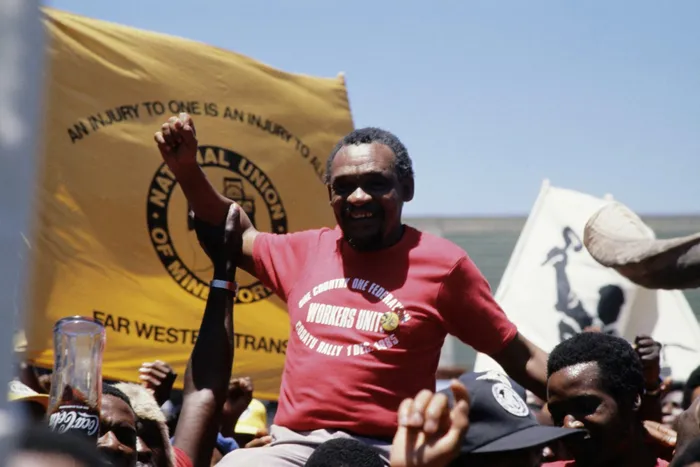
FIRST president of the Congress of South African Trade Unions (COSATU) Elijah Barayi celebrating the launch of the federation during a rally in Johannesburg on December 20, 1985. The Tripartite Alliance bound the Congress of South African Trade Unions (Cosatu) to a governing party that pursued neoliberal policies, privatisation and fiscal austerity, says the writer.
Image: AFP
The Path Forward: Unity First
The fragmentation of organised labour is a serious obstacle to worker power. Yet the foundations for renewal remain strong. The first step towards revitalisation is unity. A divided labour movement cannot confront the structural forces that drive unemployment and inequality.
The differences within and between federations should not obscure their shared interests in stable employment, fair wages and economic democratisation.
Union Investment Funds
Beyond the factory floor and the office block, workers must also turn their attention to the investment funds accumulated by their unions. The various investment arms of unions, such as NUM, NUMSA, Nehawu and Solidarity, have portfolios worth several billion rand spanning financial services, property, renewable energy and healthcare.
It is important to note that investing workers' funds in capitalist enterprises does not challenge capitalist relations of production. The returns may fund social programmes, but they are derived from the surplus value extracted from other workers.
However, if coordinated and ethically managed, trade union investment vehicles could provide a meaningful foundation for expanding worker influence in sectors crucial to South Africa's future.
Five strategic steps for unions
Within the constraints of a capitalist economy, unions can pursue several strategic interventions.
First, investment arms should prioritise stakes in productive enterprises rather than passive financial instruments, targeting sectors with potential for job creation and industrial development.
Second, unions must demand board representation and decision-making power commensurate with their shareholding, transforming investment into genuine leverage over corporate governance.
Third, union funds should support worker cooperatives and employee ownership schemes that prefigure alternative forms of production.
Fourth, federations must coordinate their investments to concentrate influence rather than dispersing resources across fragmented portfolios.
Fifth, unions should link investment strategy to broader campaigns for progressive industrial policy, using shareholder power to advocate for local procurement, skills development and decent work conditions.
These efforts will not abolish capitalist relations, but they can expand the terrain of struggle, build organisational capacity and demonstrate in practice that workers can manage economic resources.
The Role of the State and Fighting Corruption
The question of the state is equally central. The democratic order that workers helped to establish cannot be treated as external to their struggles. It is both an arena of contestation and a site of responsibility.
The post-apartheid state, despite universal suffrage and constitutional rights, enforces austerity and neoliberalism. This form of governance is a breeding ground for corruption, particularly in peripheral economies where businesses depend on tenders rather than building productive enterprises.
Workers, through their unions and through their own conduct on the job, must expose and resist corrupt practices. Whistleblowers must be protected. Union officials who collude with corrupt managers or politicians must be expelled. The working class has no interest in protecting the corrupt who treat public resources as personal property.
Defending Public Services is a Class Struggle.
Workers must also lead in improving public sector performance, as the working class and the poor depend most heavily on public services. When electricity fails, less privileged households sit in darkness while the wealthy run generators. When water infrastructure collapses, it is poor communities that queue at standpipes.
When public hospitals deteriorate, it is the masses who wait in overcrowded corridors while those with medical aid access private care. When public transport is unreliable, it is the poor who arrive late to work and risk dismissal. Progressive workers must therefore treat the defence and improvement of public services as a frontline of class struggle.
Why Workers Still Hold The Power
The force that once toppled apartheid now faces a different adversary. An impersonal system of global capital and algorithmic control that values supposed efficiency over justice. But history demonstrates that collective action can humanise even the most dehumanising systems.
Without the labour of millions, nothing would be built, nothing would be transported, nothing would be taught, nothing would be healed. The working class creates all wealth, yet it is excluded from control over production and the state. The stronghold of capitalism depends entirely on worker submission.
A Call to Action this May Day
This May Day requires a reawakening of worker activism. Workers must flood trade unions and strengthen them. Workers are called upon to unite across sectors and organisational divides, to defend existing employment while shaping the future of work, to deploy their collective resources strategically, and to assert their role in the governance of the society they helped to create.
Beyond Unions: The Need for a Revolutionary Vanguard Party
However, meaningful change cannot be carried out by trade unions alone. It requires a revolutionary vanguard party, grounded in the interests and lived realities of working people, to help translate workplace struggles into lasting societal transformation. Stronger coordination between unions, community structures and democratic institutions can deepen worker influence over economic and political decisions.
The forthcoming Conference of the Left could lay an important foundation for advancing worker aspirations. In this way, collective organisation can move beyond resistance, shaping a more equitable and inclusive system in which working people play a central role in determining the country's future.
* Dr Reneva Fourie is a policy analyst specialising in governance, development and security.
** The views expressed do not necessarily reflect the views of IOL or Independent Media.