How the US-Iran War Reshapes China's Geopolitical Strategy
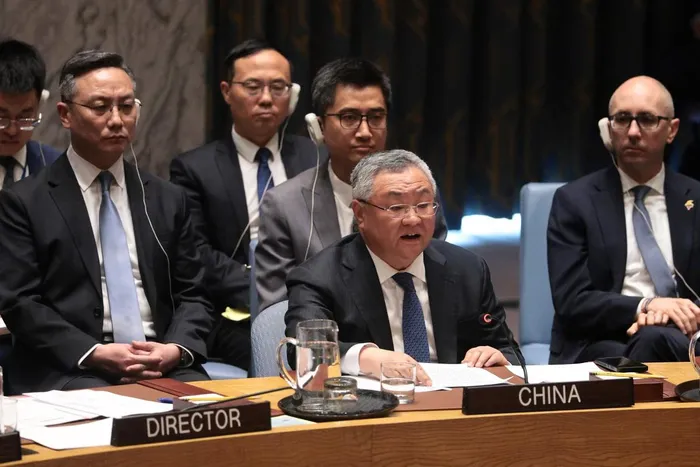
Fu Cong, China's permanent representative to the UN, speaks during a United Nations Security Council meeting regarding the situation in the Middle East on April 07, 2026. The geopolitical turbulence of 2026 is not merely a major external environmental shock, but a fundamental test concerning strategic approaches and development paths for China, say the writers.
Image: AFP
David Monyae and Shengyong QIN
It can be anticipated that the series of strategic offensives launched by the United States in early 2026 will exert a profound impact on China’s strategic environment. This impact will not be confined to a single domain but will span multiple dimensions—including diplomacy, energy, security, and the economy—creating an indirect yet systemic shock.
The United States’ ongoing external military operations have strengthened its image as a capable executor. Its high-tempo and high-intensity combat performance carries not only tactical significance but also invisibly shapes a form of power projection. For China, this is both a source of pressure and a reminder. The image shows an E-2D “Hawkeye” early-warning aircraft taking off from the flight deck of the U.S. aircraft carrier USS Abraham Lincoln during the attack on Iran on March 31.
In the first quarter of 2026, the international strategic landscape is undergoing a series of sudden changes amid rising flames of conflict. The Trump administration of the United States has, in a short period, launched multiple strategic military and sanctions operations, forming a geopolitical linkage extending from the Western Hemisphere to the Middle East. At the beginning of the year, the U.S. carried out a surprise assault on Venezuela and pushed for a major shift in Venezuela’s political direction.
By the end of February, the United States, in coordination with Israel, launched large-scale military strikes against Iran, “decapitating” the supreme religious leader. At the same time, the U.S. significantly intensified sanctions and blockade measures against Cuba, attempting to create further political chain reactions across Latin America.
Within just a few months, multiple long-standing, relatively stable geopolitical axes have been broken, and the global strategic environment has entered a new round of disruption and restructuring.
Regarding the nature and objectives of this series of actions, American and Western strategic observers hold differing interpretations. One view holds that these moves are intended to exert peripheral pressure in service of an overall containment strategy against China.
However, from the perspective of policy logic and historical continuity, this judgment still lacks direct supporting evidence. America’s actions in Latin America are more consistent with a “Western Hemisphere First” strategy: managing illegal immigration, combating drug networks, and restricting the infiltration of external powers. The military operation against Iran continues the long-standing policy of supporting Israel and preventing Iran from acquiring nuclear capabilities.
In our view, these U.S. strategic preemptive actions are not directly targeted at China. Nevertheless, their indirect effects constitute profound, multi-dimensional impacts and constraints on China’s interests.
At the level of partnerships and regional cooperation, China faces a clear structural shock. Over the past fifty years, Iran, Venezuela, and Cuba have respectively served as important nodes of Chinese cooperation in the Middle East and Latin America. These countries have demonstrated considerable alignment not only in political and diplomatic positions but also played key roles in energy supply, infrastructure construction, and investment deployment.
The current round of continuous U.S. strikes essentially aims to weaken or even reshape these nodes. Once regime change or policy shifts occur in the relevant countries, the cooperative foundations that China has cultivated over many years will face uncertainty, and its strategic footholds in peripheral regions will correspondingly weaken.
This change is not a single-point impact but a linear tightening that places overall pressure on China’s external strategic space, causing it to contract.
This round of war in the Middle East has once again highlighted the issue of energy security. As one of the world’s largest energy importers, China’s energy structure relies to a considerable extent on oil-producing countries in the Middle East and parts of Latin America.
Changes in the situations in Iran and Venezuela have exposed the existing supply system to risks of interruption or reconstruction. This will not only drive up procurement costs but also weaken China’s bargaining power in the international energy market.
This shock further reveals the systemic vulnerability brought about by dependence on energy supply lines. Once key regions experience turmoil, the effects will rapidly amplify and transmit downstream through the industrial chain.
From the perspective of military and defence industrial systems, the U.S.-Iran and U.S.-Venezuela conflicts also constitute an indirect real-world test of Chinese weapons systems. Iran and Venezuela had previously imported a considerable number of Chinese air defence and missile systems, but these systems and weapons did not perform satisfactorily in the face of high-intensity U.S. strikes.
Although specific performance was influenced by multiple factors—including command systems, operational environments, and overall capabilities—this reality has still drawn external attention to the actual combat effectiveness of Chinese military equipment.
For China, which is advancing military exports and defence modernisation, this “failed exam” carries significant warning value: How large is the generational gap with advanced Western military technology? Where exactly do the problems and gaps lie at their root?
China’s “Belt and Road” layout is also facing turbulent changes. Iran holds a pivotal position in the Eurasian continental transportation and energy networks, serving as a key corridor connecting western China with the Middle East and even Europe; progress in this area has only recently reached a preliminary stage.
Venezuela carries important Chinese investment and resource cooperation projects in Latin America, while Cuba holds both symbolic and strategic significance in geopolitical terms. If these nodes experience major instability, it will directly affect the advancement and security of existing projects and may even weaken the overall connectivity and reliability.
This indicates that the strategic value of infrastructure depends not only on the construction itself but also on the security and stability of the geopolitical and national political environment in which it is located.
From the perspective of global supply chains, the impact of the U.S.-Iran war presents complex bidirectional characteristics. On one hand, tensions in the Middle East may drive up prices of energy and related basic commodities, to some extent strengthening China’s relative advantage in manufacturing and processing links and making its “midstream position” in the global supply system even more prominent.
On the other hand, if upstream raw material supplies continue to be disrupted, China’s midstream advantages will struggle to function independently. The stability of supply chains is fundamentally a systemic project; any fluctuation in key links may weaken overall efficiency and security.
At the level of strategic psychology and the perception of competitive advantage, the United States’ continuous military actions have reinforced its external image of strong execution capability. Its high-tempo and high-intensity combat performance carries not only tactical significance but also invisibly shapes a form of power projection.
This will translate into psychological advantage in potential future strategic confrontations. For China, this is both a source of pressure and a reminder that an opponent’s advantage derives not only from advanced equipment but also from sustained real-combat accumulation and systemic operational effectiveness.
China’s development over the past several decades has relied to a large extent on gradual advancement within a stable environment—the so-called “long-term planning” approach—which has demonstrated clear advantages in most circumstances.
However, the current situation also serves as a warning that the international system does not always evolve linearly; sudden and leapfrog changes are becoming important variables affecting the strategic landscape.
In this context, the fable of the tortoise and the hare offers a metaphor worth re-examining. The tortoise’s victory was built upon the hare’s complacency and pause. If the hare remains constantly vigilant and continues to accelerate forward, the tortoise’s reliance on endurance and time alone will not be sufficient to secure ultimate advantage.
The geopolitical turbulence of 2026 is posing a pointed question. For China, this is not merely a major external environmental shock, but a fundamental test concerning strategic approaches and development paths. When the carriage is still pondering how to accelerate by relying on stronger horses, the sudden appearance of the automobile completely upends the situation.
When the post office is still striving to find faster tools for delivering letters, email arrives globally with the click of a finger. Constant experimentation, innovation, and self-transcendence are the keys to victory in the 21st century.
* David Monyae is the Director of the Centre for Africa – China Studies at the University of Johannesburg. Shengyong QIN is based at the School of International Relations, Sun Yatsen University.
** The views expressed do not necessarily reflect the views of IOL or Independent Media.