From Hope to Betrayal: The Lost Promise of SA's Liberation Dividend
FREEDOM DAY
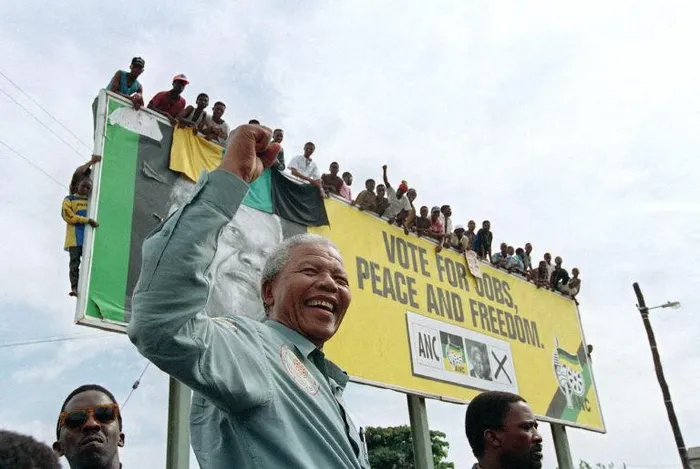
African National Congress (ANC) President Nelson Mandela greets party supporters atop a billboard ahead of him addressing an election rally in Durban on April 16, 1994. The promise of equality and dignity remains central to the national vision, yet its realisation depends on the integrity of those who hold power and the strength of the institutions that support them, says the writer.
Image: AFP
Dr. Reneva Fourie
On 27 April 1994, South Africa erupted into a moment which felt larger than history itself. Before sunrise, streets were crowded with people who carried hope like a shared torch, standing in queues that stretched for kilometres, bound by the simple and powerful act of voting. They voted in the country’s first democratic, non-racial and non-sexist election.
There was joy; there was pride; there was a sense that dignity long denied was finally being restored through collective will. That day was not only the end of apartheid; it denoted a people reclaiming their future. Freedom Day was born.
Yet, as the recollection of that extraordinary moment lingers, it sits uneasily alongside a different ache. An ache not of past oppression, but of betrayal from within, defined by a painful erosion of trust.
The very people who were swept into power on that wave of hope have compromised institutional integrity spanning all three arms of government, affecting every facet of the state. The same constitutional democracy that was celebrated as a miracle is now gasping under the weight of leadership that loots, appoints cronies and turns law enforcement into a shield for the powerful.
The country’s final Constitution, adopted in 1996, is widely regarded as one of the most progressive and transformative in the world. It offers strong protection of socio-economic rights, equality and dignity. This legal framework has been supported by the establishment of robust public policies and institutions designed to advance the democratic promise.
Chapter 9 institutions were established to monitor and uphold these gains. Government departments were reconfigured to serve the public interest rather than the ruling party’s elite. These institutional arrangements represented a material break from the apartheid past, where law and order served a minority regime. For millions of working-class and poor South Africans, especially Black communities, the Constitution became a weapon against repression, dispossession and neglect.
Just over three decades later, a profound governance crisis has emerged. Despite this acclaimed constitutional order, South Africa now faces a deep and widening crisis. The executive, parliament and the judiciary have all seen their institutional integrity compromised.
Some of the people elected to lead the country and appointed to steer its institutions have turned those institutions into instruments of private enrichment and political protection. This crisis represents a profound violation of constitutional governance by those in power.
Such conduct disproportionately harms the poor, the working class and the historically marginalised. When law enforcement shields wrongdoing; when justice systems fail those who speak out; when public services break down and when state institutions serve vested interests rather than the people, it is the ordinary citizen who bears the cost in unsafe streets, failing services and unaccountable power.
The most damning evidence of this institutional abuse comes from the series of commissions of inquiry that have become a permanent feature of South Africa’s democratic landscape. The signs of the malfeasance were there soon after the advent of democracy with the arms deal. It was brushed over because we never thought it would get to the levels where it is today.
Then, the Commission of Inquiry into State Capture, chaired by then Chief Justice Raymond Zondo, exposed the extent of institutional manipulation by private interests and political actors.
The commission documented how various government departments and state-owned enterprises were systematically captured to protect looters and punish whistleblowers. The final report concluded that the corruption, mismanagement and state capture that took place under executive watch represent a fundamental betrayal of constitutional governance.
The proliferation of such commissions confirms the systemic nature of the crisis.
The Nugent Commission examined governance failures at the South African Revenue Service. The High Level Panel on the State Security Agency revealed a shift towards politically motivated security operations. The Sandy Africa Commission highlighted the failure by security services to anticipate or prevent the July 2021 violence, as well as the internal friction and leadership gaps within the police and intelligence services.
The current Madlanga Commission was established following explosive allegations that a powerful criminal group had compromised law enforcement structures. Each commission produced detailed, practical recommendations for reform. Yet many of those findings remain unimplemented. This raises serious questions about the political will to enforce accountability.
The existence of these commissions of inquiry is a testament to institutional decay rather than a sign of a healthy and functioning democracy. The state has among the best policies and institutions, yet it suffers from a crisis of leadership and integrity. In the absence of principled leadership, these structures are weakened from within, weakening public trust and undermining their ability to deliver justice and dignity.
South Africans are exhausted by inquiry fatigue. We witness commission after commission produce damning reports that gather dust while the politically connected escape justice. Those elected to lead have abused their power.
Those appointed to lead institutions have facilitated corruption. The commissions established to investigate these abuses have become exercises in futility. They are permanent fixtures of a state in crisis. The rot is not at the policy level. It lies at the very heart of the country’s leadership and governance.
The consequences of this crisis are felt across society. Public confidence in state institutions has been diminished, and the gap between constitutional ideals and lived reality has widened. Communities experience the effects of weakened governance in their daily lives, from fears about safety to frustrations with service delivery.
The promise of equality and dignity remains central to the national vision, yet its realisation depends on the integrity of those who hold power and the strength of the institutions that support them.
Freedom Day offers an opportunity to reflect on past achievements and present responsibilities. If South Africa is going to clean up this decay in its democracy, we, the people, must make our voices heard. The energy and determination shown by citizens in the struggle against apartheid and in the 1994 election demonstrated the strength of collective action.
That same spirit remains a vital resource today. Democratic participation goes beyond voting. It includes ongoing public participation, active oversight of public officials, and a commitment to holding leaders accountable.
Freedom Day is not simply a holiday for braai and rest. It is a reminder of what collective courage once achieved. That spirit still lives in the people. It can be called upon to restore the promise of democracy.
* Dr Reneva Fourie is a policy analyst specialising in governance, development and security.
** The views expressed do not necessarily reflect the views of IOL or Independent Media.