Enhancing Intelligence Coordination in a Fragmented Security Landscape
FREEDOM MONTH
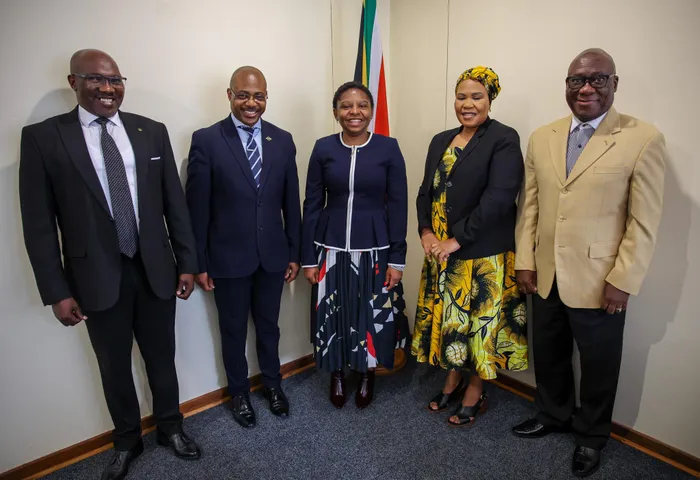
(FROM LEFT) Lt-Gen. Dumisani Khumalo (Head of Crime Intelligence), Dr. Ntandazo Sifolo (Acting Coordinator for Intelligence), Minister in the Presidency Khumbudzo Ntshavheni, Lt-Gen. Thalita Mxakato (Chief of Defence Intelligence), and Ambassador Tony (Gab) Msimanga (Acting DG of the State Security Agency) at the launch of the National Centre for Intelligence Coordination (NCIC) in Pretoria on April 14.
Image: GCIS
Reneva Fourie
April 27 marks Freedom Day, and this year also marks 30 years since the adoption of our new Constitution as a democratic South Africa.
Section 12 of the Bill of Rights sets out the right to freedom and security of the person, with further detail in Chapter 11. Attaining these aspirations has, however, been challenging, as demonstrated by the many institutional reforms, including the establishment and disbanding of the Scorpions, the creation of the Hawks, and commissions of enquiry such as the Zondo and Madlanga Commissions.
Tactical updates, new recruitment, and isolated successes have happened within agencies. Despite these, progress remains fragmented. Agencies struggle to work together, and the national security system is slow to adapt to domestic and global threats.
President Cyril Ramaphosa recently embarked on renewed efforts to strengthen the state's response to crime. These efforts include deploying the defence force to confront illegal mining and gang activity, and appointing KwaZulu-Natal Police Commissioner Nhlanhla Mkhwanazi to lead a national initiative against organised crime.
The evolution of the criminal justice system remains critical to delivering on constitutional commitments to safety and security. Hence, the launch of the National Centre for Intelligence Coordination (NCIC) on 14 April could significantly improve intelligence coordination, contributing to the overall effectiveness of the system.
The existence of multiple coordinating bodies, such as the National Intelligence Coordinating Committee (NICOC), the Justice, Crime Prevention and Security Cluster (JCPS), and the National Joint Operations and Intelligence Structure (NatJOINTS), among others, reflects efforts toward integrated governance. The system has accumulated structures without resolving foundational design flaws, producing an arrangement that struggles to deliver integration.
Officials dutifully attend meetings and check the requisite boxes, but their real energy remains hoarded for their own silos, budgets and fiefdoms. Policy coordination blurs dangerously into operational coordination, leaving no one certain who is responsible for strategy and who is accountable for action.
The proliferation of committees and task teams has become a substitute for, rather than a pathway to, effective crisis management. Add to this the chronic plague of overlapping and ill-defined mandates among the intelligence services, and you have a system designed for failure.
Domestic intelligence responsibilities are divided across structures with intersecting areas of focus, including organised crime, terrorism and extremism. Legal distinctions between investigative support and strategic intelligence are not consistently reflected in operational practice. This creates duplication, competition and inefficiency.
Functional gaps persist across critical areas of national security. There are entire domains where coordination is absent: between national, provincial, and local government, and between the state and the private sector.
Border management, despite the establishment of the Border Management Agency, continues to involve multiple departments with distinct mandates, resulting in enduring weaknesses. The protection of critical infrastructure lacks a centralised mechanism for continuous monitoring, particularly against cyber threats.
In the foreign domain, defence intelligence, diplomatic structures and civilian intelligence services operate in overlapping spaces, further complicating coordination and diluting accountability.
The cumulative effect is duplication and a lack of strategic focus. Multiple departments maintain parallel capabilities in open source intelligence, monitoring and analysis. Similar information is processed across different locations, leading to overlapping assessments.
This dispersal of effort limits the development of specialised expertise and reduces the efficiency of resource allocation. It also constrains the production of high-value intelligence derived from covert sources, which requires concentrated investment and coordinated direction.
These structural weaknesses are unfolding alongside acute institutional instability. The suspension of the Inspector General of Intelligence has raised serious concerns about oversight. The office is central to civilian monitoring of intelligence services, as required by the Constitution. Its disruption weakens accountability at a critical moment.
The situation is compounded by the legal and operational difficulties faced by Crime Intelligence's leadership. The Head of Crime Intelligence is currently out on bail and facing fraud charges related to irregular appointments. Allegations of irregular appointments, resource constraints and organisational paralysis point to a division under severe strain.
Without effective intelligence, policing becomes reactive. In this context, the deployment of the armed forces to support internal security operations reflects a significant erosion of policing capacity and intelligence support.
Recent developments in the Western Cape introduce an additional dimension. Cooperation between provincial authorities and United States security personnel in the training of metropolitan police has generated concern about legality, oversight and sovereignty.
The national framework places policing and intelligence under central authority. External engagements by subnational actors create complexity in relation to coordination and the management of intelligence flows. This reflects tensions between national and provincial priorities and highlights the risks associated with fragmented governance in the security domain.
The establishment of the NCIC must be understood against this background. In theory, it solves the fatal flaw identified by the 2018 Mufamadi High-Level Review Panel. The panel found that Nicoc was structurally impotent because it was a committee of rival agency heads with no enforcement power.
The NCIC’s legal foundation lies in Section 4 of the National Strategic Intelligence Act of 1994, as amended in 2024. It is aligned with the Constitutional requirement for national legislation to regulate intelligence services, ensure coordination and provide for civilian oversight. The NICOC was created to fulfil the coordinating function at a strategic level, bringing together the leadership of the intelligence services to synthesise information and advise the executive.
The NCIC operationalises this mandate by providing permanent capacity for continuous coordination. It will integrate intelligence across the community, produce consolidated assessments, ensure information flows to decision-makers, and deliver administrative, analytical, and organisational support.
Its relationship with Nicoc will run through the Coordinator’s office – the committee leads strategic coordination and high-level assessment, while the NCIC handles daily integration and analysis. This structure addresses a longstanding weakness, the lack of an institutionalised, authoritative, and independent coordination capability with clear accountability and defined processes.
The relationship is similar to that of Australia and the United Kingdom, in which one entity focuses on high-level alignment and the other serves as an operational hub.
The effectiveness of the NCIC will depend on implementation. Compliance and organisational culture are central factors to its success. Beyond institutional design, leadership should prioritise overcoming entrenched patterns of fragmentation, competition and limited information sharing by setting clear expectations for interagency cooperation.
The NCIC offers an opportunity to strengthen coordination, but lasting impact will depend on decisive implementation, clear authority and sustained commitment to integrated governance across South Africa’s evolving national security landscape.
* Dr Reneva Fourie is a policy analyst specialising in governance, development and security.
** The views expressed do not necessarily reflect the views of IOL or Independent Media.