UN Secretary-General Race: Too Many Candidates Without Political Support
MULTILATERALISM
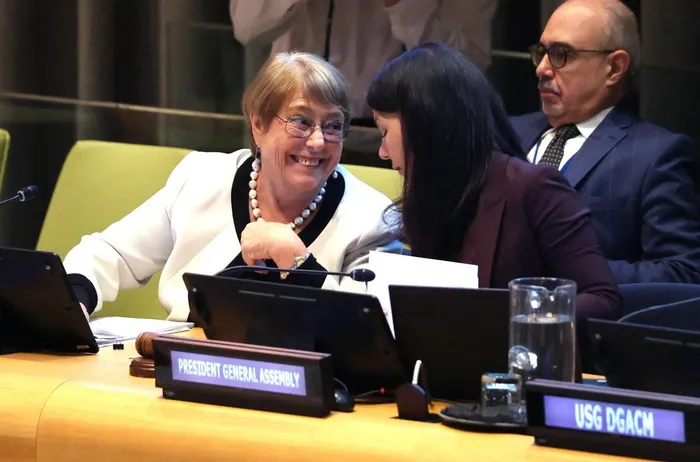
Former Chilean president Michelle Bachelet (left) speaks with Annalena Baerbock, President of the UN General Assembly, during a hearing for Bachelet to be considered as the next Secretary-General of the United Nations at the UN Headquarters in New York, on April 21, 2026. Bachelet is among four candidates vying for the position currently held by Portugal's Antonio Guterres.
Image: AFP
Daniel Safran-Hon
The selection of a secretary-general ranks among the most consequential decisions the United Nations makes. If, as some have argued, the secretary-general is a secular pope, then this is the conclave.
While the General Assembly has made progress in improving the transparency of the process, much of it remains opaque. It is therefore important to follow it closely, shed as much light on it as possible, and draw lessons as the process advances. One key lesson has already emerged from the 2026 campaign: candidates should reflect harder on their own prospects before entering the race.
Former Under-Secretary-General Virginia Gamba’s short-lived campaign is a concerning case in point. On March 11th, the Permanent Mission of the Maldives formally nominated Gamba, a veteran UN senior official, for the position of secretary-general. She had no evident connection to the Maldives before the nomination.
The nomination letter disclosed that the campaign would be funded by her own finances and through in-kind donations from the International Model United Nations Association, a student organisation that runs high school and college conferences. Fourteen days later, without explanation, the Maldives withdrew the nomination in a two-sentence letter.
What makes the episode noteworthy is that it comes from someone who surely understands what a viable candidacy requires: genuine political backing from states with significant Security Council influence, a realistic prospect of acquiescence from the five permanent members, and a nominating government with both the will and the capacity to sustain a campaign through a long and difficult process.
The Gamba candidacy had none of these. The pattern, however, is not limited to her, which is what makes it worth examining more carefully.
The broader field presents related concerns, though the cases differ in important ways. Michelle Bachelet, a former President of Chile and also a veteran UN senior official, was originally nominated with the backing of Mexico, Brazil, and Chile, which was led at the time by a leftist government.
As first reported by Devex, she now faces organised opposition from US Republican lawmakers who wrote to Secretary of State Marco Rubio, urging the Trump administration to use its Security Council veto to block her candidacy.
In addition, Chile’s newly elected right-wing government has withdrawn its support. Her foresight in securing multiple supporting states suggests she anticipated the risk. Whether their backing will be sufficient remains to be seen.
Macky Sall’s situation is even more troubling. The former president of Senegal entered the race, nominated by Burundi, a country with which he had no close prior relationship, but that happened to hold the African Union’s rotating chair. The circumstances of the nomination misled many to assume he carried continental backing.
His subsequent attempt to secure formal AU endorsement through the bloc’s “silent approval” procedure collapsed when 20 of the AU’s 55 member states actively either objected or requested an extension of the 24-hour deadline, clearing the threshold required to block the decision. Among them was Senegal itself, whose government stated it had “at no stage” endorsed his candidacy.
Both Bachelet and Sall have announced they will remain in the campaign despite what appear to be significant structural obstacles. That is their right. But in so doing, they risk their own reputations and could harm the organisation they claim to support by crowding out more viable contenders and diverting diplomatic attention and political capital away from the serious vetting of candidates who do have a credible path forward.
The historical record should give them pause.
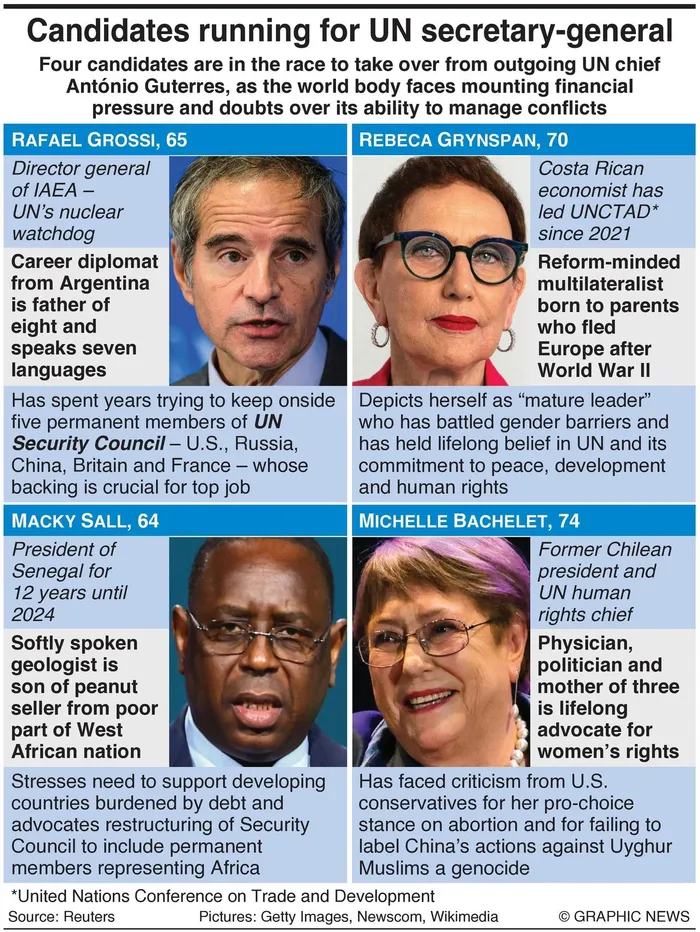
Candidates running for UN secretary-general.
Image: Graphic News
No secretary-general has ever been elected without the support of their own government. In 2016, Kevin Rudd, the former prime minister and former foreign minister of Australia, sought his government’s nomination and, when Prime Minister Malcolm Turnbull declined, found himself with no viable path forward and ended his campaign.
That same year, Irina Bokova continued her candidacy after Bulgaria withdrew its support and nominated a second candidate, Kristalina Georgieva, in the final weeks of the race. Neither prevailed.
An oral history of the successful 2016 Portuguese campaign for current Secretary-General António Guterres, published in the Portuguese outlet Observador in late 2016 and based on testimony from key campaign insiders, further confirms this point.
As Portuguese Foreign Minister Augusto Santos Silva recounted, the team ensured cross-party political support before formally launching, consulting the outgoing president, the president-elect, and all major party leaders to present the candidacy as a national one. By their own account, that unity was essential.
While not stipulated in Article 97 of the Charter, the requirement that candidates be nominated by at least one member state has been an ongoing practice that was subsequently codified by the General Assembly. This is not an argument against the important democratic principle that any qualified person should be able to run regardless of nationality.
There may come a time when an outstanding candidate’s government withholds its support, and that candidate can nonetheless build a viable campaign. But such a candidate would carry an additional burden: to demonstrate, through the strength and breadth of their alternative backing, that they can compensate for this absence.
The current cases do not pass that bar. The secretary-general selection is not a testing ground. Candidates who cannot make a robust case for their own viability do a disservice to a process the organisation depends on to produce a credible outcome. They also risk allowing this failure to overshadow their hard-won legacies.
The secretary-general selection is unfolding against an unusually difficult backdrop. The next secretary-general will inherit an institution under significant financial and political strain. The field may yet change, as the rules allow for new candidates to enter even after the General Assembly hearings.
But those considering a late entry should carefully weigh whether they can clear the bar a credible candidacy requires. A repeat of the Bulgarian episode, with its last-minute competing nominations, would serve no one. Among those already in the race with their home governments’ backing are Rafael Grossi of Argentina and Rebeca Grynspan of Costa Rica, a reminder that the bar is not too high.
The interactive dialogues convened by the president of the General Assembly, scheduled for April 21–22, will be an important test. Candidates should use them not only to present a thoughtful platform but also to demonstrate the robustness of their political backing and show that their candidacy rests on strong foundations.
Unlike a conclave, part of this process takes place in full view. That is why it matters how candidates conduct themselves. Those who cannot make the case convincingly should reflect on whether remaining in the race serves the organisation’s interests, or indeed their own, and act accordingly.
* Daniel Safran-Hon served with the UN in several positions in the Executive Office of the Secretary-General, the Development Cooperation Office and field missions in the Middle East and Africa. He is an independent researcher who writes on UN affairs. This article was produced by https://theglobalobservatory.org/
** The views expressed do not necessarily reflect the views of IOL or Independent Media.