Safeguarding Democracy: The Role of Electoral Justice in Maintaining Integrity
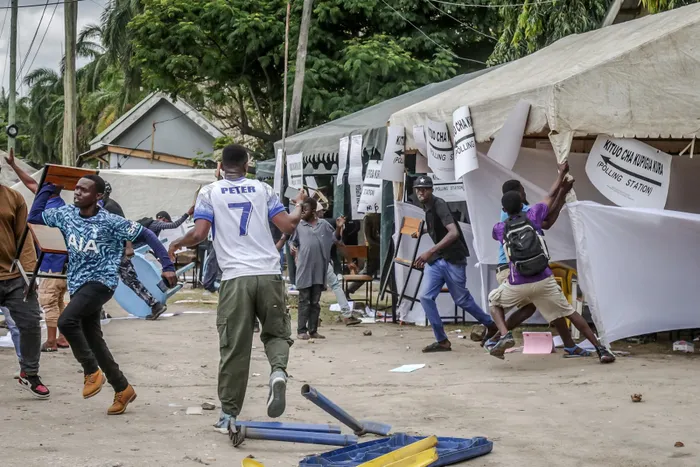
Protesters attack a polling station as clashes erupt in Dar es Salaam on October 29, 2025, during Tanzania’s presidential elections. The East African country went to the polls in elections where the main challengers have either been jailed or barred from standing.
Image: AFP
Justice Dhaya Pillay
Democracy is threatened, and justice is invoked to protect democracy.
Threats to democracy are the context in which the adjudication of electoral matters takes place. Democratic recession or backsliding is generally acknowledged to be one of the greatest threats to liberal constitutional democracies globally. This fact was unanimously acknowledged in October 2022 at the Association of World Election Bodies conference of 75 election management bodies held in Cape Town.
Of all manifestations of backsliding, the people’s disaffection, distrust and disillusionment with participation in elections is particularly devastating.
Other manifestations include impeding and annihilating civil society, non-governmental organisations and opposition; obstructing, interfering, arresting and even murdering members of the media; threatening and intimidating judges and packing the courts; unconstitutional amendments to constitutions and changes in government; weakening and undermining institutions necessary for enabling and sustaining democracy and generally disregarding foundational principles of accountability, transparency, rule of law and legality.
Wars and Geopolitical Conflicts
Ratcheting up the recession are wars and geopolitical tensions. They evidence democracy declining to unprecedented depths. Now, not only must election management bodies and electoral courts be concerned about democratic recession in their own nation-states and regions, but also in the world.
The loss of the lives of soldiers and victims of war is more than a mere manifestation of conflict. Rather, they betray the faith and trust bestowed upon elected representatives. Distrust in elected representatives extends beyond to contaminate institutions of democracies. Election management bodies and electoral courts are targeted as co-conspirators aiding and abetting the betrayers.
The voters’ mandate could not be to permit elected representatives to expose them, their families and future generations to the hardships and the dangers of war. Their mandate is always to engage in dialogue. Dialogue is not limited to reaching across the aisle but also across oceans and airspaces in search of solutions to mutual and multilateral problems.
Free, fair and inclusive elections cannot be conducted without peace and nonviolence, sovereignty and mutual respect, multilateralism and (economic) interdependence and, above all, human rights. The current failure of politics is the legacy bestowed on future generations.
Additionally, a scorched earth and global economic recession induced by the destruction of essential commodities and rising debt so tarnishes democracy itself that many wonder: what’s the point, if elections yield psychopaths and crooks for representatives? And War, not words, is a tool of communication?
Why Words?
Democracy is only as strong as the dialogue it enables. Every conflict ends through dialogue. A week ago, we went to sleep holding our collective breaths at the prospect of an entire civilisation of 92 million people being eviscerated. We awoke to the relief of dialogue and diplomacy returning.
At the cusp, the world chose Words over War. Again. A poignant moment in history, defining what it means to be human.
Dialogue is the lifeblood of democracy. It shapes the form of democracy, designs its institutions, rules, and safeguards to protect people and maximise happiness. Dialogue manages competition, accommodates differences, mediates disagreement, and prevents and resolves conflict to avoid resorting to force or violence. Elections are intensely dialogical processes.
Without Elections, Then What?
Even in authoritarian conditions, merely holding elections provides a barrier against the beasts of chaos, anarchy and lawlessness. Elections at least identify representatives with whom dialogue can be conducted. Importantly, elections enable voters to assert their constitutional power to change political representatives.
Voter inequality, economically and at multiple other levels, is trumped by all votes having equal weight. Presidents’ and paupers’ votes each count as one. Therefore, while democracy is derailed to achieve evil ends, its resilience restores it on track.
Self-conscious Adjudication
In this context, how should adjudicators decide on electoral disputes? Adjudicators are human beings. They have their own worldview and predilections. Adjudicators hold opinions on many matters, including the state of politics and economics and ways to fix governments.
To expect adjudicators to be ideologically agnostic would be unrealistic. Neutrality or disinterest is an attribute assigned to amoeba, not adjudicators.
However, adjudicators must be impartial, independent and imbued with integrity. They must self-consciously check their own views and rein in their preferences.
Judges exercise considerably more choice than election management bodies executing administrative law adjudication functions. The common law and national constitutions bestow on judges wide powers of granting just and equitable remedies. However, election management bodies have their discretionary power cut within the confines of electoral and administrative laws.
In appeals from decisions of election management bodies, recognising this disparity in power is vital for preserving predictability and certainty of the law. Assessing whether the election management bodies interpret and apply the law correctly ought to be straightforward when the facts are not in dispute, and the law is clear.
However, even when they are clear, the considerable freedoms that judges exercise over form and substance in adjudication result in unpredictable outcomes.
An appellate court might conclude that the election management body did not interpret and apply the electoral laws correctly. Can that court reject the outcome of the election management body’s decision? The only basis on which a court may do so is if it finds that the law applied is unconstitutional. Or that corruption contaminated the decision.
Such a finding must be thoroughly reasoned to avoid speculation of unarticulated influences bearing on the judgment. Remedies the court devises of suspending the law, striking off offending parts or reading in text to correct the flawed law must be equally clear and precise, leaving no doubt about what is to be done.
However, if an appellate court concludes that an election management body interpreted and applied the electoral laws correctly, and that the laws applied are constitutionally compliant, then, however unpalatable the outcome is, the decision of the election management body must be upheld, and the appeal dismissed. Certainty and predictability of electoral laws are a priceless virtue.
Adjudicators ought to be acutely conscious of the election timetable. Once triggered, timetables induce a momentum, which, if interrupted, could have catastrophic domino effects on the elections.
Towing the rule of law and legality line safeguards democracy. Becoming players instead of remaining referees in political contestation would aid and abet democracy’s slippery slide into partisan politics and recession.
* Dhaya Pillay is a Judge of the High Court of South Africa (retired) and a Commissioner of the Electoral Commission of South Africa. She writes in her personal capacity. This is an edited version of her address to the Zambian judges’ conference themed 'Strengthening democracy and electoral governance'.
** The views expressed do not necessarily reflect the views of IOL or Independent Media.