Strengthening Ties: South Africa and China's New Citrus Export Agreement
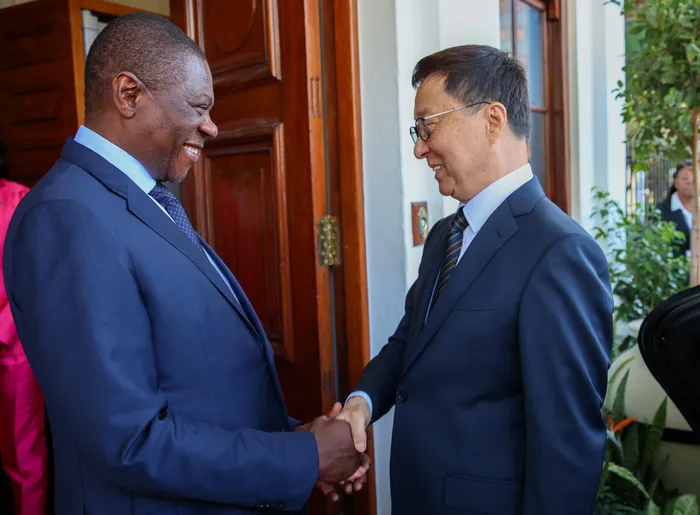
South Africa's Deputy President Paul Mashatile and the People’s Republic of China Vice President Han Zheng, at Tuynhuys, Cape Town on March 26. The two leaders co-chaired the 9th South Africa-China Bi-National Commission (BNC). South Africa’s citrus sector will also be in a position to take advantage of China’s new zero-tariff policy, which will kick in on the first of May, says the writer.
Image: GCIS
Prof. David Monyae
The South Africa-China relationship, especially in the realm of economic diplomacy, continues to grow from strength to strength.
This was after the two countries signed a new phytosanitary agreement – the Supplementary Phytosanitary Requirements for the Export of South African Citrus to China - amending the cold treatment requirements for citrus exports.
The new agreement comes hard on the heels of the ninth session of the South Africa – China Bi-National Commission (BNC), which took place earlier this month and the Economic Partnership Agreement Framework signed by the Chinese and South African trade ministers in February 2026.
The new amendments will see new treatment options and regulatory stipulations come into place, which are expected to improve the quality of the product reaching the Chinese market, reduce supply chain costs, and enhance the efficiency of trade flows between China and South Africa.
The old protocol on phytosanitary requirements governing the export of citrus fruits from South Africa to China has several rather stringent regulations. Article 4.2 of the protocol stated that any lemon exported from South Africa should undergo cold treatment of 3 degrees Celsius and below for 18 consecutive days to get rid of Ceratitis capitata, a destructive fruit pest that is found in sub-Saharan Africa.
The protocol also dictates that any citrus fruit, except lemon, exported from South Africa to China should undergo cold treatment of minus 0.6 degrees Celsius for not less than 24 consecutive days to rid them of pests such as Cryptophlebia leucotreta, Ceratitis capitata and C. rosa.
If at any stage during the stipulated treatment period, the temperature exceeds 0 degrees Celsius, the treatment would be nullified. However, this treatment is said to have damaged the fruits and made them less competitive in the Chinese market.
Going through such a treatment required an expensive and energy-intensive cold supply chain, thus increasing the compliance costs, which most South African farmers could not afford.
The new amendments will change these parameters in a manner that will significantly reduce the supply chain and logistics costs. They will, among other things, lower the required duration of cold treatment and also raise the threshold of treatment temperatures. South Africa’s Minister of Agriculture, John Steenhuisen, was quoted as saying, "These agreements are the result of trust, respect and sustained cooperation, and they are helping open doors for our producers at a time when diversification has never been more important."
South Africa’s citrus sector will also be in a position to take advantage of China’s new zero-tariff policy, which will kick in on the first of May. In 2025, South Africa exported about 11.5 million cartons of citrus fruit valued at US$130 million to the Chinese market, representing about 6 per cent of the sector’s total exports.
With the new measures, the sector’s market share in China is likely to increase significantly. The citrus sector is one of South Africa’s major export earners and employers. Just last year, South Africa exported 193 million cartons of fruit, earning the country US$2.4 billion in export revenue, which cemented South Africa’s position as the second largest exporter of citrus globally.
Further, the sector employs about 140,000 people directly and tens of thousands more indirectly in the logistics, distribution and export services sectors, making it one of the pillars of the rural economy in South Africa, thus helping with the eradication of poverty, which is concentrated in the rural areas.
At the end of 2025, China agreed to open its market to multiple South African stone fruits, namely peaches, apricots, nectarines, plums, and prunes. This will see millions of cartons of these fruits being shipped to China and earning South Africa much-needed revenue while also creating more jobs.
South Africa’s growing agricultural cooperation with China shines the spotlight on a critical issue which has to be addressed if China is to expand its agricultural cooperation with the rest of the African continent.
In 2023, China committed to growing its agricultural imports from Africa from the current US$9 billion to US$20 billion within the next decade (by 2035). While the zero-tariff policy will certainly boost agricultural trade between China and Africa, with the latter’s agricultural products having duty-free access to the Chinese market, it is not clear whether African countries are ready to meet China’s phytosanitary requirements and standards.
Africa’s agricultural sector has to undergo a thorough modernisation process if it is to meet China’s phytosanitary requirements and access the Chinese market. The 2024-2027 Forum on China-Africa Cooperation Action Plan identifies this as one of the priority areas when it states that “The two sides will strengthen cooperation on inspection and quarantine mechanisms for African agricultural exports to China, enrich and improve the 'green channel', and explore agricultural trade cooperation through interactions between China’s tariff-free zones and free trade zones in Africa.
The two sides will encourage the construction of the China-Africa cross-border agricultural products storage logistics project.” South Africa may have the capacity to meet China’s phytosanitary requirements, but most of its fellow African countries lack that capacity. As such, there must be a concerted effort towards the modernisation of African agricultural production and supply chains if the continent can take full advantage of China’s zero-tariff policy.
* Prof. David Monyae is the Director of the Centre for Africa – China Studies at the University of Johannesburg.
** The views expressed do not necessarily reflect the views of IOL or Independent Media.