Palestinian Prisoners’ Day: Torture, Abuse, and the Need for Global Accountability
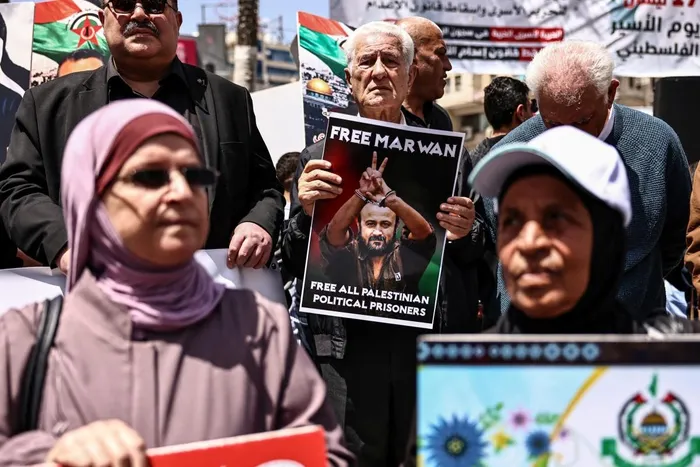
Palestinians hold pictures of prisoners held in Israeli jails, including jailed Palestinian leader Marwan Barghouti, during a rally in Ramallah in the occupied West Bank on April 16, 2026 to mark Prisoners' Day and to protest against Israeli parliament's approval of a new death penalty bill for Palestinians convicted of deadly attacks.
Image: AFP
Woody Aroun and Anna Weekes
Today (17 April 2026) is the 52nd annual Palestinian Prisoners’ Day, dedicated to the liberation of prisoners in Israeli jails and commemorated across the Middle East.
This year’s Prisoner’s Day is undoubtedly the worst ever for Palestinian prisoners, marking three horrific developments that the world must take a stand against.
The first is the introduction of the death penalty for Palestinian political prisoners last month.
The second is that 66-year-old Marwan Barghouti, a Palestinian member of parliament and high-profile leader of Fatah (the party ruling the West Bank), has reported to his lawyers that he’s been severely beaten in prison by Israeli guards three times this month, with military dogs instructed to bite him. Barghouti has been in prison for 24 years for organising non-violent marches in 2002 against the Israeli military occupation of Palestine.
The third and most terrifying development is the release of a new report by the Geneva-based Euro-Mediterranean Human Rights Monitor into the rape and sexual torture of Palestinian prisoners in Israeli jails over two years, described as “another genocide behind walls”.
The report is made up of interviews with Palestinian survivors of and witnesses to sexual violence between October 2023 and October 2025. The findings are backed by leaked CCTV footage of sexual assault aired on Israeli TV and testimony from Israeli whistleblowers.
The new wave of extreme sexual abuse of Palestinians began shortly after the Israeli genocide started in October 2023. The media documented hundreds of Palestinian men forced by Israeli soldiers to strip to their underwear and line up in Gaza before being taken, or abducted, to Sde Teiman.
This is a new Israeli detention centre in the Negev Desert where tens of thousands of Palestinian political prisoners are held without trial. There is no human rights oversight of Sde Teiman, and prisoners are not allowed phone calls, clothing, blankets, food, visits from family, or access to lawyers or the International Committee of the Red Cross (ICRC).
The mass arrests by Israeli soldiers continued. On some days, journalists were rounded up and taken to Sde Teiman; while on other days, Israel carried out mass forced disappearances of hospital doctors and nurses. Palestinian women, in some cases carrying babies, were also forced into army jeeps and taken there.
The EuroMed report describes how at Sde Teiman, hundreds of Palestinians are held in fenced pens resembling cages without toilets, chained and forced to “wear diapers and relieve themselves in their sleeping areas while shackled”.
There are “no records or identification. These sites become ‘black holes’ where the worst types of torture are carried out, far from any judicial or human rights oversight,” the report adds.
It also documents how parts of Sde Teiman have been built specifically so that Israeli interrogators can conduct sexual violence. “Detainees described detention spaces with small rooms featuring metal tables fixed to the ground, chains hanging from the ceiling, and surveillance cameras. This spatial and functional setup appears intentionally designed to enable torture and sexual violence”.
Testimonies describe how Palestinian men are stripped naked, tied down, and anally raped by Israeli men, including with objects such as fire extinguisher hoses, bottles, metal rods, and wooden sticks. They also report being raped by dogs trained to do so, with some men sexually assaulted every second day by up to six soldiers at a time.
Other attacks include Palestinian men's testicles being crushed, being kicked in the crotch with military boots, and electric shocks to their genitals.
Palestinian women have their hijabs torn off and are gang raped on metal tables, detained naked overnight without sanitary pads, then raped the next day again, or filmed or “photographed naked or half-naked”. Soldiers “threaten to share these images online to humiliate and socially blackmail them,” the report says.
Prisoners also reported being hung by their hands and legs with chains, suffering torn triceps as a result.
Those subjected to this torture sustained “severe intestinal lacerations, fractures, and permanent physical injuries…catastrophic medical consequences, including severe bleeding, haematuria, chronic pain that hinders movement and sitting, and, in some cases, rupture requiring the surgical removal of a testicle, loss of consciousness, and other serious complications,” the report adds.
Since 7 October 2023, the Red Cross has been denied permission to visit Palestinian detainees in all Israeli places of detention, leaving Palestinians without protection. As news of the EuroMed report spreads across the world, the torture and inhuman treatment of Palestinian prisoners cannot be ignored.
Nor is it sufficient to pass passive resolutions against the Israeli illegal occupation of Palestinian territory, while the cry for help from Palestinians to stop this carnage is deliberately muted.
In many ways, similar to the horrific Section 6 of the Terrorism Act used in apartheid South Africa to detain political activists incommunicado and without trial and recourse to legal representation, Israel’s use of torture and sexual abuse of Palestinian prisoners calls for more direct action to put a stop to this barbaric behaviour.
Global campaigns to hold Israel accountable for its horrific treatment of Palestinian prisoners must be strengthened. Sustained economic sanctions, boycotts and disinvestment brought the apartheid regime to its knees – the same has to happen to Israel!
* Woody Aroun is a former Parliamentary researcher for NUMSA and a former political prisoner. Anna Weekes is a research associate at Rhodes University’s Journalism and Media Studies department and lived and worked in the West Bank for three years.
** The views expressed do not necessarily reflect the views of IOL or Independent Media.