Mali's Backing of Autonomy Plan a Setback for Sahrawi Cause
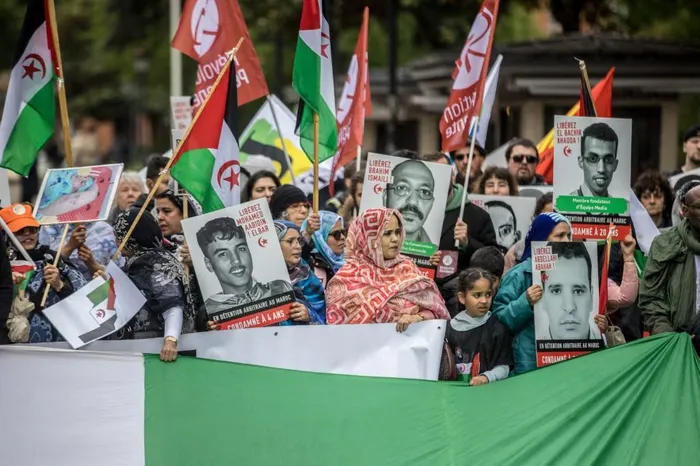
A demonstration in support of the March for Freedom, which aimed to raise awareness of the Sahrawi cause and that of political prisoners, Toulouse, France on April 19, 2025.
Image: AFP
Kim Heller
Western Sahara remains caught in a fraught territorial dispute. The Sahrawi people have battled for self-determination for decades, through the Polisario Front and the Sahrawi Arab Democratic Republic (SADR). Their cause is a legitimate one. Liberation struggles across Africa were based on the principle and promise of self-determination.
Mali's recent endorsement of Morocco's 2007 Autonomy Plan as the only serious and credible solution for the Western Sahara dispute is part of the shifting sands in the self-determination of the Sahrawi Arab Democratic Republic.
In an official statement, the Malian government claims that genuine autonomy under Moroccan sovereignty is the "most realistic solution" for the Sahrawi people. Mali also announced that it no longer recognises the Sahrawi Republic.
Mali's decision to back the Moroccan proposition reflects a wider diplomatic shift. Several African and Latin American countries have suspended or withdrawn their recognition of the SADR. This has left the SADR with diminished diplomatic influence.
With the United States backing Morocco and strengthened trade relations with key European nations, Morocco is gaining strong momentum. As a result, the prospects for full sovereignty for the people of Western Sahara appear bleaker than ever.
Morocco has a high-profile, aggressive campaign which aims to shift international recognition away from the SADR. Morocco is cunningly shrinking the diplomatic space so that the burning issue of self-determination is slowly but surely being snuffed out.
By flexing its financial muscle and prowess, Morocco is trying to influence the terrain and the potential outcome of this long-standing political contestation. It is not accidental that Morocco is aligning itself with powerful international players, including the U.S. and several E.U countries.
Much of the continental and global interest in Western Sahara centres on its economic riches rather than its political wreckage. All eyes are focused on the territory's highly valuable phosphate and hydrocarbon resources rather than its humanitarian crisis.
It is not far-fetched to interpret Mali's sudden decision to support Morocco as a move driven by economic and political interests rather than by political principle. The political economy of survival can override or defer liberatory imperatives.
Mali's post-coup leadership has had to navigate a wave of economic, security and diplomatic challenges. Additionally, tensions with Algeria, a steadfast ally of the Sahrawi, are intensifying. For Mali, a stronger alliance with Morocco presents investment, economic, and security opportunities.
The Moroccan-based news site, Hespress, reported that the Director of the Sahara and Africa Centre for Strategic Studies, Abdelfattah Fatihi, views Mali's decision as a strategic turning point that could influence other countries in the region. Fatihi contends that the move is motivated, in part, by mounting concern among Sahel states about the security risks of insurgents with links to separatist movements.
The Western Sahara case is extremely complex, as it exposes the uneasy interplay of self-determination, territorial integrity, and regional stability in post-colonial Africa. Western Sahara bears the scars of colonially imposed borders, manufactured disunity, and unfinished decolonisation.
When Spain finally released its colonial hold in 1975, Morocco claimed pre-colonial sovereignty over this area. This clashed with calls for independence by the Polisario Front on behalf of the Sahrawi people. With no resolution found, armed struggle broke out, bringing decades of devastation and displacement to Western Sahara.
In 1975, the International Court of Justice issued an advisory opinion which acknowledged Morocco's historical ties, while affirming the Sahrawi people's right to self-determination.
The issue of sovereignty raises questions about inherited colonial borders. Colonial borders, developed in faraway lands that had little love or concern for Africa's historical ecology, culture, or political systems, continue to shape the contours of statehood across the Continent.
There are implications, too. If the Sahrawi Arab Democratic Republic is granted sovereignty, it could set a historical precedent for secessionist movements across Africa and the globe to push for self-determination.
The Polisario Front's attempts to invoke both international law principles and Pan-African solidarity in its pursuit of independence have failed to yield a decisive outcome. Today, Morocco controls the lion's share of Western Sahara and treats it as part of its kingdom.
At the same time, the Polisario Front resides in refugee camps in Algeria alongside an estimated 170,000 Sahrawis—this decades-long territorial dispute and the widespread suffering and displacement that it has caused need to end urgently.
In October 2025, the UN Security Council adopted Resolution 2797, calling for the resumption of negotiations based on Morocco's Autonomy Plan to develop a "mutually acceptable political solution."
Under Morocco's Autonomy Plan, a locally elected legislature, executive, and judiciary would be established. However, Morocco would retain control over religious affairs, defence, and foreign affairs. This is far from the self-determination that the Sahrawi people have fought so hard for.
South Africa has been a long-standing champion of Sahrawi self-determination. In March 2026, the Department of International Relations and Cooperation reiterated its support for "the recognised right to self-determination of the people of Western Sahara." President Cyril Ramaphosa has likened the Sahrawi cause to the Palestinian struggle for self-determination.
For now, the orientation toward managed consensus, managed outcomes, and managed autonomy is a poor substitute for the promised referendum on self-determination. Beneath the seemingly legitimate language of credible, realistic solutions lies the harsh reality that Morocco is downgrading issues of self-determination and decolonisation to mere security and governance concerns.
Sovereignty should not be shaped by financial muscle or influence. The unfinished business of liberation cannot be rewritten by expedient political alliances or the muscle-flexing of wealthy nations. Legitimate calls for self-determination must never be buried under the rubble of economic or political expedience or opportunism.
* Kim Heller is a political analyst and author of No White Lies: Black Politics and White Power in South Africa.
** The views expressed do not necessarily reflect the views of IOL or Independent Media.