Is Julius Malema's five-year sentence a fair punishment or political persecution?
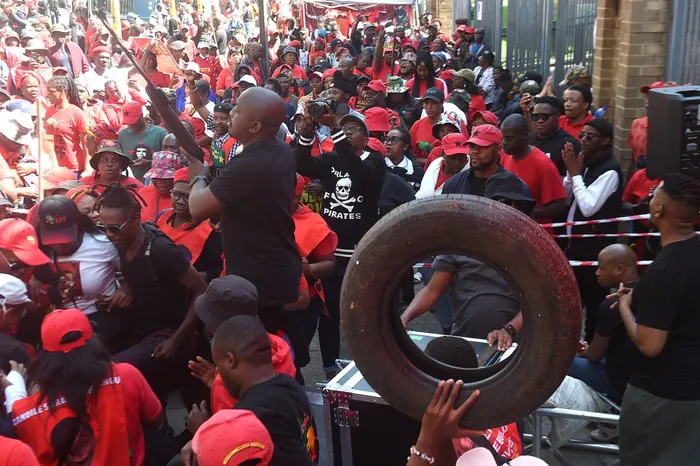
Defiant Economic Freedom Fighters (EFF) supporters demonstrate outside the Johannesburg High Court in support of their leader Julius Malema ahead of his sentencing in the Regional Court, KuGompo on April 16. Malema’s voice, however grating some may find it, articulates the anger and aspirations of millions who feel the democratic dividend has bypassed them, says the writer.
Image: Itumeleng English
Prof. Sipho Seepe
The sentencing of Economic Freedom Fighters (EFF) president Julius Malema to five years’ imprisonment for firing a single shot into the air during the party’s fifth birthday celebrations sent shockwaves through South Africa’s political landscape.
What was intended as a celebratory gesture has been treated by the court as premeditated criminality worthy of a lengthy custodial sentence. A day before judgment, Advocate Tembeka Ngcukaitobi delivered a masterclass in advocacy, systematically dismantling the state’s case and arguing that a prison term would be not only unfair but legally defective.
Ngcukaitobi shredded the four main pillars of the prosecution’s argument for a maximum 15-year sentence.
First, the state claimed the offence was premeditated because Malema had described the planning of the EFF celebration as “perfect and calculated”.
The advocate demonstrated that this statement referred solely to the logistics of the public event, venue, timing, security, and attendance, and not to any unlawful discharge of a firearm. To twist a remark about event management into proof of criminal intent was, he argued, a deliberate misreading of context.
Second, prosecutors repeatedly spoke of two firearms and 22 live rounds as aggravating factors. Yet the court convicted Malema only on the unlawful discharge of a single .223 Remington bullet. Ngcukaitobi insisted it is constitutionally impermissible to punish a person for conduct the judge herself did not find proven. You cannot send a man to prison based on unproven allegations.
Third, the state emphasised Malema’s status as a parliamentarian, arguing that public representatives must be held to a higher standard. The defence countered that this reasoning collides head-on with Section 9 of the Constitution that everyone is equal before the law. Elevating a leader’s responsibility cannot justify unequal treatment; it must still be rooted in the same legal principles applied to ordinary citizens.
Fourth, the defence made clear it was not seeking impunity. It simply requested a non-custodial sentence — a fine, community service, or correctional supervision — any of the many sentencing options available to South African courts. The state’s zero-sum insistence on prison or nothing ignored the judiciary’s wide discretion to craft a punishment that reflects society’s disapproval without destroying a political career.
Fifth, the prosecution claimed Malema showed no remorse. Yet he has publicly expressed regret for the manner in which he acted, while maintaining his constitutional right to appeal the conviction. Remorse does not require surrendering one’s belief in innocence; it certainly does not preclude exercising the right to appeal.
The magistrate was unmoved. In her summation, she stated that “the decision to break the law has been made and it was made with the approval of the accused person and the leadership… He knew it was unlawful; he knew it might cause harm to persons or property… Such acts can never be condoned by this court.” The five-year sentence followed.
Among South Africa’s black youth, the reaction has been visceral: the punishment is outrageously disproportionate to a single celebratory shot fired into the sky. If the appeal fails, they warn, AfriForum will have succeeded in its alleged mission to silence “the voice of the poor, the voice of the landless, the voice of those who have been forgotten by the democratic dispensation”. The question they pose is simple: Does the punishment fit the so-called crime?
This pessimistic reading, however, underestimates the resilience of the EFF, which has grown into a formidable national force with representation in every provincial legislature and a growing parliamentary caucus.
History is littered with leaders whose incarceration burnished rather than buried their legacies. Brazil’s Luiz Inácio Lula da Silva spent 580 days in prison on corruption charges later annulled by the Supreme Federal Court; in 2022, he was elected president for a third time. Malema’s supporters believe a similar political resurrection is possible.
ANC Secretary-General Fikile Mbalula captured the sentiment of many in the liberation movement when he declared: “The main message we are being told here by the racist AfriForum is that if we dare stand up for black people, dare stand up for the marginalised, and dare stand up for our generational mission, we will be targeted. When I fought for Julius to succeed me as ANCYL President, we knew that the road ahead was treacherous and that the grandchildren of apartheid would never rest in their targeting of the Freedom in our lifetime Generation. This sentence is too harsh, and my thoughts are with my brother Julius.”
Predictably, the Democratic Alliance and Freedom Front Plus welcomed the outcome.
DA leader Geordin Hill-Lewis stated that “gun violence is out of control in South Africa” and that illegal firearm offences must be punished harshly. FF Plus MP Heloise Denner added that the sentence proves “no one is above the law” and invoked Section 47 of the Constitution, threatening to push for Malema’s immediate removal from Parliament if the appeal fails.
Their positions are consistent with their ideological opposition to the EFF; they see the judgment as a necessary check on populist excess.
Yet the most uncomfortable question remains about the prominent role played by AfriForum in prompting the National Prosecuting Authority (NPA) to pursue charges.
To what extent has the NPA become an instrument of politically organised formations? Why has the same authority shown such reluctance to prosecute President Cyril Ramaphosa over the Phala Phala farmgate scandal, despite damning allegations of foreign currency found in furniture and questions about undeclared donations? Contrast that hesitation with the swiftness with which the NPA charged Duduzile Zuma over an emoji allegedly inciting violence.
The disparity fuels the perception that justice is not blind but selectively sighted.
South Africa’s democracy is still young and fragile. When the state deploys the full weight of criminal law against an opposition leader for a single symbolic act while seemingly shielding the powerful from scrutiny, public trust erodes.
The EFF has built its brand on unapologetic advocacy for economic emancipation, land expropriation without compensation, and the radical transformation of a society still scarred by apartheid’s legacy. Malema’s voice, however grating some may find it, articulates the anger and aspirations of millions who feel the democratic dividend has bypassed them.
A five-year sentence will not erase that anger; it may amplify it. Whether one views Malema as a reckless demagogue or a necessary disruptor, the principle at stake is larger than any individual. If the law is to command respect, it must be applied consistently, proportionally, and without fear or favour.
The coming appeal will test not only the strength of Ngcukaitobi’s arguments but the maturity of South Africa’s justice system. Should the sentence stand, many will conclude that the real crime was not a celebratory gunshot but daring to speak too loudly for the dispossessed. The court of public opinion, especially among the youth who will shape tomorrow’s South Africa, has already delivered its verdict.
*Seepe, Higher Education and Strategy Consultant.