Kenya's 2027 Elections: Confronting Violence Against Women in Politics
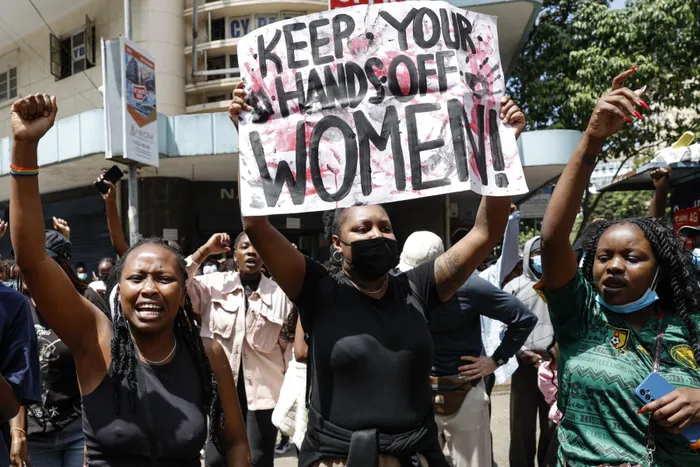
Activists chant slogans and hold placards as they take part in a march against femicide and gender-based violence in Nairobi, on December 10, 2024. In a context of democratic backsliding, rising levels of gender-based violence (GBV), and accelerating human rights abuses in the lead-up to elections in 2027, women’s leadership is needed more than ever, says the writers.
Image: AFP
Nerima Wako-Ojiwa and Devon Knudsen
Kenyan women are at the forefront of defending their democracy. Their recent leadership reflects a long history of pivotal contributions, both to women’s rights and the rights of all Kenyans.
In a context of democratic backsliding, rising levels of gender-based violence (GBV), and accelerating human rights abuses in the lead-up to elections in 2027, women’s leadership is needed more than ever.
However, research shows that women’s leadership, especially in conflict or crisis, is often met with violent pushback. In Kenya and worldwide, violence targeting women in politics is deterring some women from seeking public office and punishing those who do run.
This problem is not new to Kenya, but the dichotomy between the achievements of Kenyan women leaders and the lack of accountability for their attackers, online and offline, is starker than ever.
The United Nations, the African Union, and the government of Kenya are taking steps to analyse the problem and offer recommendations, but tangible implementation lags. Meanwhile, bilateral partners that used to support women’s participation in politics and fund efforts to prevent election-related GBV have pulled back.
Despite the risks and limited tangible support, Kenyan women are pressing forward, but many fear the costs they are asked to bear are unsustainable, not to mention unconscionable.
Women as Defenders of Kenyan Democracy
Women are leading the fight against democratic backsliding in Kenya. During nationwide youth-led protests in 2024 and 2025, which initially arose as a pushback against new taxes and evolved into demands for greater government accountability and reform, women played pivotal roles in voicing citizens’ demands and pressuring the executive branch to respect the rights of protesters.
Hanifa Adan distinguished herself for her broad-based fundraising for the medical costs of injured protesters. Rose Njeri created an online tool making it easier for Kenyans to email officials, and Sumeiya Omar voiced students’ concerns to media outlets. All three of these leaders were detained for their work.
Women were also instrumental in other ways: Zaha Indimuli, a volunteer medic who, in early 2024, helped lead the largest protests against GBV in Kenya’s history, returned to the frontlines of the Gen Z protests and confronted police who were blocking ambulance access to injured demonstrators. Journalist Catherine Wanjeri wa Kariuki continued reporting on police attacks against protesters until she was shot three times.
Within the justice sector, High Court Advocate and Kirinyaga County women’s representative Njeri Maina, along with other women, led a fundraising campaign to pay bail for detained protesters. Florence Muturi, the CEO of the Law Society of Kenya (LSK), and Faith Odhiambo, the 51st LSK president who just concluded her two-year term, provided pro bono legal representation for detainees and victims of police violence.
Odhiambo reminded Kenyan police, politicians, and judges that the constitution not only protects freedom of assembly but also requires that youth be included in socioeconomic and political discussions, and therefore are free to voice criticism in protests, online, or otherwise.
On one occasion, LSK lawyers stayed at the Milimani law courts past midnight to block an attempt to hold 185 detainees, including children, for several weeks while the police looked for evidence against them. Odhiambo also led the prosecution of the acting inspector general of police for contempt of court for ignoring orders for the release of detained protesters. The public dubbed her “The People’s Chief Justice.”
The actual chief justice, Martha Koome, has also frequently stood up to the executive branch’s skirting of constitutional protections. Koome is the first woman chief justice and was one of the lawyers pushing for the repeal of section 2A of the former constitution, restoring multiparty politics in 1992.
During the Gen Z protests, she spoke out against the abduction of protesters by state security forces. In 2025, she led the Supreme Court in upholding lower courts’ decisions against the Constitution of Kenya (Amendment) Bill, which threatened to undermine the separation of powers and rule of law.
These achievements build on a long history of women safeguarding Kenyan democracy. Whereas Koome has been instrumental in defending the constitution, Atsango Chesoni and Njoki Ndungu were instrumental in its drafting and passage back in 2010. Going back further in history to 1974, at age 25, Philomena Chelagat Mutai became the youngest person elected to Kenya’s parliament, beating 11 male candidates.
When she received a full scholarship to attend Harvard, then-President Daniel Arap Moi personally intervened to prevent her from getting a passport. She was arrested but reelected shortly after her release. Even before Kenya’s independence, women played important roles in the struggle against colonial rule, including as leaders within the Mau Mau resistance.
The Backlash against Women’s Leadership
In a survey of 29 Kenyan women running for election in 2022, only two said they did not experience online violence. The survey also found that online violence and harassment were regularly accompanied by the same behaviours over the phone or in person, as seen in the campaign of Mary Mugure, who received threatening calls and messages before being attacked by men on a motorcycle.
Similarly, Liz Njue, a candidate for a county assembly seat, was attacked while trying to cast her ballot during a party primary, and Susan Kihika, one of Kenya’s first female senators, and Wavinya Ndeti, a gubernatorial candidate, were both criticised on social media for their marriage choices. According to the Kenya Women Parliamentary Association, these instances are representative of the experiences of dozens of other women candidates.
Actual numbers are likely higher, given widespread underreporting, and a 2021 Inter-Parliamentary Union study found that nearly half of women parliamentarians in Africa have faced online sexist attacks. The frequency of violence leads to its normalisation and escalation, including physical attacks by Kenyan members of parliament against their women colleagues inside parliamentary buildings.
Unsurprisingly, this environment has discouraged women from running for public office. Although Article 27(8) of the Kenyan constitution requires that not more than two-thirds of elective or appointed public bodies be of the same gender, Kenya has never met that threshold.
In an effort to address this problem, the Senate is required to have 18 women senators nominated by their political parties through a proportional representation system.
Among the 47 elected seats, however, only three were claimed by women in 2022. Some argue that meaningful change would require more transparency in the criteria for nominating women representatives, changed perceptions of nominated offices, and an end to intimidation of women seeking elected office. In the lead-up to the 2027 elections, the harassment and intimidation of women candidates have already started.
The impacts of this intimidation can also be seen at the presidential level, where few women have run for office. A survey conducted in December 2025 showed twelve presidential candidates, two of whom were women.
It’s not just individual women who bear the consequences of systemic obstacles to seeking elected office, argues Dorcas Muga-Odumbe, a journalist at a leading Kenyan newspaper. “Every time we silence women in politics through sexism, we not only fail her, but we’re robbing ourselves of the leadership our nation so desperately needs.”
Gender equality at all levels has been shown to stimulate GDP growth through improved economic productivity and stability, benefitting women and men alike.
Yet women’s exclusion from politics undermines government action to address issues disproportionately impacting women and girls. Research shows that greater women’s representation in elected office leads to lower levels of GBV, a problem that Kenya urgently needs to address.
Nairobi Women’s Hospital sees an average of 4,000 cases of GBV per month, and 2024 was the deadliest year on record, according to research released in 2025. The fact that the 2017 post-election period saw widespread instances of GBV perpetrated by state security forces means the Kenyan government needs to play a role in ensuring state forces do not repeat these abuses in 2027.
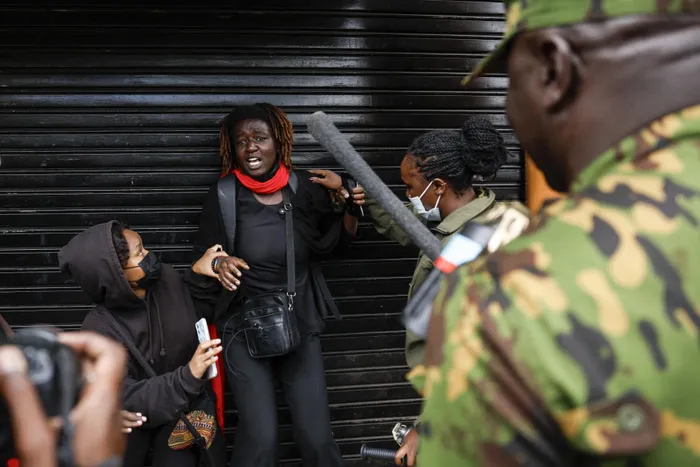
Women activists resist arrest by Kenyan police officers during a demonstration against overtaxation by the Kenyan government in Nairobi on June 18, 2024.
Image: AFP
The Rocky Way Forward
Following mass protests against femicide in 2024, the Kenyan government took several actions. Legal cases against perpetrators saw an increase in convictions by 118% and an increase in the average length of sentences. However, the police have been accused of manipulating and mismanaging high-profile cases such as the Kware femicides.
The administration of William Ruto also established a Technical Working Group on GBV, but its appointees did not include leading experts on the topic. After prodding from civil society, Ruto publicly released the working group’s report in February 2026.
The report’s section on political factors compounding GBV leaves much to be desired. However, it deserves credit for acknowledging that “elections in Kenya have historically been flashpoints for systemic GBV” and that “perpetrators often linked to political or security forces act with impunity.”
The report makes important recommendations, including to “amend the Political Parties Act and the Elections Act to address [GBV] in political processes and the electioneering period.” Kenya has a history of lacklustre implementation of findings from national reports and commissions, so the real test will be the degree to which the government acts upon the report’s recommendations.
International actors also have a role. The UN secretary-general’s 2025 report on WPS called for the enforcement of a zero-tolerance approach to any targeted violence against women peacebuilders and human rights defenders and other women in public life, in addition to monitoring of technology-facilitated threats and attacks on women human rights defenders, peacebuilders and women in politics.
The African Union (AU) Convention on Ending Violence Against Women and Girls was adopted in February 2025 and broadens the AU’s definition of violence against women and girls to include online violence. It aims to establish a legally binding framework to prevent GBV, applying lessons from prior nonbinding agreements.
The African Commission on Human and Peoples’ Rights adopted a resolution on the “Protection of Women against Digital Violence in Africa,” which recognised the obligation of states to adopt legislative, policy, and other measures to ensure online safety for all. AU election observation missions have also included expert networks of women peacebuilders and mediators to improve the efficacy of observation teams and address the prevalence of GBV during elections.
The Intergovernmental Authority on Development (IGAD) released a Regional Gender Equality Strategy in 2023, which encourages meaningful participation of women in elections, although it lacks tangible enforcement mechanisms.
In the lead-up to elections, international actors should avoid publicly engaging with candidates who have threatened or harassed women candidates, including in vernacular languages, to avoid creating the perception that their governments or organisations condone such practices. In meetings with Kenyan officials, international actors can help by ensuring their delegations include women in leadership roles.
Additionally, international actors can remind Kenyan officials that the Kenya National Commission on Human Rights supported Universal Periodic Review recommendations on preventing GBV and request updates on the implementation of the Technical Working Group report’s recommendations.
Bilateral and multilateral donors had historically funded GBV programs, but geopolitical shifts have significantly impacted that assistance. These programs provided medical aid for survivors, technical support on related legal frameworks, capacity-building networks for women candidates, and other initiatives.
Much of this support has been cut, but Kenyan women are still leading the charge to continue the work. For example, Martha Karua, who has long been at the forefront of Kenya’s fight for democracy, also led teams of lawyers and activists defending the rights of opposition candidates in Uganda and Tanzania. She also leads the People’s Liberation Party and is running for president.
At the grassroots level, women like Jayne Waithitu are also pressing forward. Waithitu started organising peace dialogues during the 2007 election and has since been training police officers on responding to GBV.
Whether mobilising peacebuilders or political movements, women’s leadership will be needed more than ever in the lead-up to next year’s election, especially if the violence seen in last November’s by-elections is an indicator of what lies ahead.
Paying tribute to these women during International Women’s Month is a start, but the country as a whole will benefit when these leaders receive the security and justice the law guarantees them and the respect and equal playing field they deserve.
* Nerima Wako-Ojiwa is a Kenyan political analyst who serves as the executive director of Siasa Place. Devon Knudsen is a Senior Fellow with the Alliance for Peacebuilding. This article was produced by https://theglobalobservatory.org/
** The views expressed do not necessarily reflect the views of IOL or Independent Media.