Phala Phala Theft Raises Key Questions About Institutional Integrity in SA
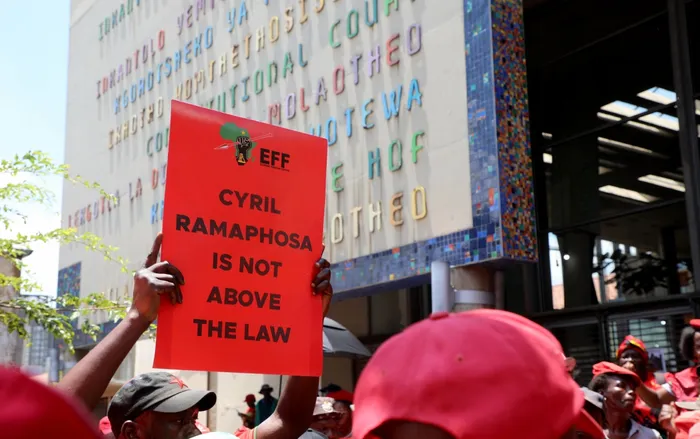
EFF supporters gathered at the Constitutional Court in Braamfontein on November 28, 2025 to demand the release of the Court's Phala Phala judgment. The Phala Phala matter touches on fundamental questions of constitutionalism, the separation of private and public interests, and equal application of the law, says the writer.
Image: Timothy Bernard / Independent Newspapers.
Prof. Sipho Seepe
Much of the public commentary on the Independent Police Investigative Directorate (IPID) investigation into the Phala Phala farm incident has generated more heat than light.
Accusations that IPID “whitewashed” the matter or deliberately shielded President Cyril Ramaphosa by scapegoating Major General Rhoode and Sergeant Hlulani Rekhoto are baseless. They overlook the Directorate’s narrowly defined mandate.
IPID’s role is confined to investigating serious criminal offences or misconduct allegedly committed by members of the South African Police Service (SAPS). It does not extend to investigating the President or making findings on his personal conduct.
In this case, IPID was requested by ATM President Vuyolethu Zungula to probe the actions of Major General WP Rhoode (Head of the Presidential Protection Unit) and other officers in their handling of the reported theft of foreign currency from the President’s Phala Phala farm.
The allegations against the officers included possible failures to report the stated crime under section 34(1) of the Prevention and Combating of Corrupt Activities Act (PRECCA), breaches of the SAPS Act, abuse of state resources, and conducting an irregular “undercover” investigation. IPID’s investigation focused solely on whether these officers violated SAPS policies and procedures.
IPID's investigation concluded that both Rhoode and Constable Hlulani Rekhoto were involved in the alleged cover-up of the theft of hundreds of thousands of US dollars, worth millions of rands, from Ramaphosa’s farm. It directed that disciplinary action be initiated against Major General WP Rhoode and Sergeant HH Rekhoto attached to the Presidential Protection Services Unit at Head Office, Pretoria.
Among its findings, IPID noted that Major General Rhoode and Dr Bejani Chauke (Presidential envoy for Africa) travelled to Namibia using SAPS VIP protection resources. According to the Policy on Risk Management System: Protection Packages (RIMAS), Dr Chauke was not entitled to such protection, as he is not listed as a VIP under the policy. IPID recommended disciplinary action against Major General Rhoode and Sergeant Hlulani Rekhoto for their roles in the handling of the matter.
Importantly, the IPID report neither investigated nor exonerated President Ramaphosa. Any link to the President remains indirect, arising from the proximity of the officers to him and their involvement in addressing the theft from his private property.
The findings of the IPID report on Phala Phala are consistent with those of the Section 89 Independent Panel of Parliament - comprising the former Sandile Ngcobo, Retired Chief Justice, Judge T Masipa, retired Judge of the South Gauteng High Court, and Advocate M. Sello SC, a practising advocate. (see Volume 1, 20 November 2022 Report, Parliament of the Republic of South Africa).
The Section 89 Independent Panel Conclusions
The panel concluded that the information before it, prima facie, discloses that there was, inter alia, a deliberate decision to keep the investigation into the Phala Phala farmgate scandal secret, and that the President instructed General Rhoode to investigate the burglary and theft from his Phala Phala farm.
The investigation pointed out that Major General Rhoode’s “investigating team did not follow the normal SAPS practice of investigation, as there was no case number or a docket. The investigation was carried out using the state resources.”
The panel was not persuaded by the President’s version regarding the source of the stolen money. The panel argued that there were “weighty considerations which leave us in substantial doubt as to whether the stolen foreign currency is the proceeds of sale.”
This was a polite way of saying that the President’s version is untrue. Key concerns regarding the President’s version of events include the absence of evidence on how and when a large sum of foreign currency entered South Africa. The South African Reserve Bank also had no records of the funds being declared or brought into the country.
More embarrassing was that instead of “keeping the money in the safe until the next banking day, the money is kept concealed in a sofa for well over a month.” Even more strange is that for two and a half years, Mr Hazim had failed to collect the 20 buffaloes he had paid for.
Considering all the information at its disposal, the Panel concluded that there is prima facie evidence that President Ramaphosa may have:
(a) Violated section 96(2)(b) of the Constitution by exposing himself to a conflict between his official responsibilities and private business interests (by directing a senior SAPS officer to handle a matter on his private farm).
(b) Failed to uphold, defend, and respect the Constitution as required by section 83(b).
(c) Committed a serious violation of section 34(1) of PRECCA by not reporting the theft to the Directorate for Priority Crime Investigation or opening a formal case.
SARS Confirmation and Broader Implications
Subsequently, the South African Revenue Service (SARS) confirmed that the US$580,000 had not been declared upon entry into South Africa, as required by law. Failure to declare foreign currency is an offence that can lead to criminal prosecution.
Despite the prima facie case having been clearly established by eminent legal experts in multiple instances, National Director of Public Prosecutions Shamila Batohi has chosen to disregard the compelling evidence placed before her.
Instead, the National Prosecuting Authority (NPA) has repeatedly preferred to pursue weak and hopeless cases. In the most egregious instances, the NPA has even failed to formulate proper and competent charges against targeted individuals.
The National Assembly
The National Assembly, dominated by the ANC, declined to adopt the independent panel’s report, which would have led to the establishment of a multi-party committee to investigate the allegations.
This decision drew sharp criticism from opposition parties. Peeved by the ANC’s decision to shield President Ramaphosa from accounting, former President Thabo Mbeki broke ranks and effectively chastised ANC parliamentarians.
Mbeki asked. “Are we saying that we suspect or know that [Ramaphosa] has done something impeachable and therefore decided that we must protect our President at all costs by ensuring that no MPC is formed? If this is the case, what message are we communicating to the masses of our people about the values and integrity of the ANC?”
What about the matter before the Constitutional Court?
Contrary to popular perception, the matter before the Constitutional Court does not directly determine President Ramaphosa’s guilt or innocence. Instead, it examines whether the National Assembly fulfilled its constitutional duty under section 89 to hold the President accountable, faced with prima facie evidence of serious misconduct.
In the Zuma-era Nkandla judgment, the Constitutional Court stressed that section 96 of the Constitution is breached even by the mere risk of a conflict of interest — it does not require actual benefit or harm to materialise.
How the Court will approach the procedural question — and whether it will comment on the substance of the Panel’s findings or the NPA’s apparent inaction — remains to be seen.
The debates in the Constitutional Court were not encouraging. Rather than addressing the big picture, the Court appeared to engage in a game of obfuscation, with the judges debating at length whether the parliamentary panel had established a prima facie case or merely "sufficient evidence." Justice Rogers refused to be drawn into this rabbit hole. For him, the matter was straightforward:
“A person [who] loses 8.7 million Rand… would want to know who the investigating officer is, and has it been reported to the police. Is there a case pending? It is common cause that there wasn't… There was a deliberate decision because the president wanted to keep secret the source of the money; that's the background to where the panel was coming from.”
The Constitutional Court may well restrict itself to the prayers before it. It could, however, seize the opportunity to send a strong message to the National Prosecuting Authority and law enforcement agencies concerning the way they have conducted themselves. That said, I am not holding my breath.
What Next?
Should the National Prosecuting Authority (NPA) continue to show reluctance to pursue the matter, nothing prevents political parties or affected individuals from initiating a private prosecution.
The Phala Phala matter touches on fundamental questions of constitutionalism, the separation of private and public interests, and equal application of the law. Whether South Africa’s institutions will rise to the challenge of genuine accountability — or continue to shield those in power — will say much about the health of our democracy.
What is beyond doubt is this: had Arthur Fraser not gone public with his explosive allegations on June 1 2022, the Phala Phala matter would almost have remained buried. President Ramaphosa would have continued to project the image of “Mr Clean”, delivering high-minded speeches on anti-corruption and ethical leadership while the systematic capture of the country’s law enforcement agencies remained carefully concealed from public view.
* Professor Sipho P. Seepe is a Higher Education and Strategy Consultant.
** The views expressed do not necessarily reflect the views of IOL or Independent Media.