Reversing SA’s Neoliberal Agenda for Economic Reconstruction
THE LEGACY OF CHRIS HANI
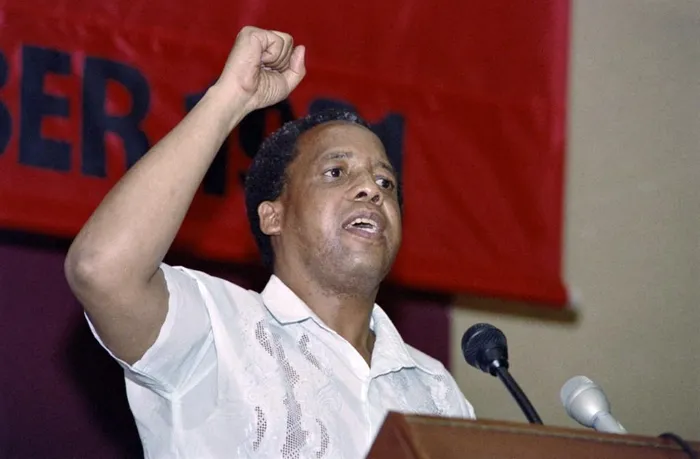
NEWLY elected Secretary General of the South African Communist Party (SACP) Chris Hani salutes delegates at the closure of their first congress inside South Africa in 41 years, in Soweto on December 8, 1991. This year, let us not commemorate Chris Hani as a statue, but revisit his ideals, reenergise them, rebuild institutions to strengthen democracy, says the writer.
Image: WALTER DHLADHLA / AFP
Sithembiso Bhengu
This week marks the 33rd commemoration of the assassination of Chris Hani. At the time of this callous act, Hani was the General Secretary of the South African Communist Party (SACP) and had emerged as the most popular member of the ANC NEC from its 48th National Conference in 1991.
The 33rd commemoration of Chris Hani’s demise coincides with the 30th anniversary of the adoption of the South African constitution, promulgating South Africa’s constitutional democracy. This constitutional democracy was to ensure not just a simplistic majoritarian rule, but one anchored on humane principles and the rights of all people.
Nelson Mandela captured these principles during his 1994 Presidential Inauguration speech, when he said, “Never, never and never again shall it be that this beautiful land will again experience the oppression of one by another and suffer the indignity of being the skunk of the world”.
At the adoption of the constitutional order, every section of freedom-loving people of South Africa, including organised labour, faith-based organisations, progressive traditional structures, and other organs of civil society, celebrated the promulgation of the South African constitution, as providing legislative and institutional infrastructure to advance freedom and a distributive future that is redressing the imbalances of centuries of colonialism and apartheid.
The ideals consolidated in the South African Constitution represented the freedoms for which Chris Hani struggled and sacrificed his life, and which had been concretised in the SACP’s triple H campaign to address housing, health, and hunger.
It is an unfortunate irony that in the year that ended with the adoption of the South African constitution, the governing ‘1996 Class Project’ abandoned the Reconstruction and Development Programme (RDP), replacing it with the Growth, Employment and Redistribution (GEAR).
The adoption of GEAR, along with a slew of other governance interventions, saw a significant shift in government policy towards a neoliberal agenda, which curtailed fiscal commitment to developmental reconstruction and social programs, while introducing the utilisation of private (for-profit) provision of public goods and services through a tender-based procurement system.
Preceding his death, Hani had made some instructive statements, both outlining the practical application of the national democratic revolution (NDR), in particular what socialism should look like for South Africa. Hani also warned the liberation movement and society about the possible pitfalls of elitist transition and corporate capture of politics by selfish bourgeois interests.
On the NDR and socialism, Hani presented a practical definition of what socialism should look like, arguing, “Socialism is not about big concepts and heavy theory. Socialism is about decent shelter for those who are homeless. It is about water for those who have no safe drinking water. It is about health care; it is about a life of dignity for the old. It is about overcoming the huge divide between urban and rural areas. It is about a decent education for all our people. Socialism is about rolling back the tyranny of the market”.
While the democratic dispensation has changed the lives of many of our people, especially in the area of collective and individual freedoms and rights, the majority of working-class households and communities, which Chris Hani was speaking about as motive forces and direct beneficiaries of the South African struggle, remain on the margins of democratic breakthrough, with persisting crisis-levels of unemployment, poverty and inequality.
These predominantly African poor continue to live with very little or no access to basic services, their humanity and dignity made elusive by failures of the government’s protracted neoliberal trajectory since GEAR.
While the promise of South Africa’s constitutional democracy was meant to transform the lives of our people and undo the long history and legacy of oppression, discrimination, and exclusion, thirty years of neoliberalism and austerity have only served to reproduce the contours of our past and have certainly not liberated our people, nor ‘rolled back the tyranny of the market’.
Three decades of neoliberalism also enabled and produced a proliferation of the hollowing of the state, corporate capture of the state, and corrupt arrangements that have only become endemic, permeating almost all institutions and spheres of government.
Hani had warned about the elitist pacts, tendencies of capture of the national democratic revolution by bourgeois interests, what he called allure for ‘black Mercedes-Benz’, presently labelled as ‘blue light brigades’, and the use of political office for class formation and aspirational social mobility.
Not only did neoliberalism entrench macro (fiscal and monetary) policies that have consistently undermined the transformation agenda, but it also hollowed the capacity of the state, bringing private procurement of public services through the tender-preneurship, which has become the bane of our democracy, producing and reproducing all kinds of excess, capture, corruption, and rot at the centre of our politics.
How then should we commemorate and re-member transformative ideals that Chris Hani espoused for a future of South Africa that is progressively addressing our most basic class contradictions of racial capitalism?
First, we must call for an end to neoliberal austerity and push for monetary, fiscal, taxation, and public investment interventions that stimulate growth and create employment.
Second, we must oppose private wholesale of state assets and the private procurement of public services through tender-preneurship.
This means the proposed conversations, both the government-led National Dialogue and more importantly the Conference of the Left spearheaded by the SACP, should culminate at an alternative blueprint for economic reconstruction, undoing the 30-years of a failed neoliberalism that has entrenched racialised inequality, produced crisis-levels of unemployment, and produced a hollow democracy in which mostly African women and children are most vulnerable to worst forms of gender-based violence and femicide.
This, we owe to ourselves as a people, as workers and the poor, to produce a South African economy and society that belongs to all of us. In the spirit of Chris Hani, we must strengthen institutions of democracy, i.e., people’s participation, activist democracy in our communities.
This year, let us not commemorate Chris Hani as a statue, but revisit his ideals, reenergise them, rebuild institutions to strengthen democracy, and organs of people’s power to advance the kind of democracy that produces concrete meaning to human dignity and freedom.
* Sithembiso Bhengu is Executive Director of the Chris Hani Institute.
** The views expressed do not necessarily reflect the views of IOL or Independent Media.