'Israel Remains the Principal Obstacle to Lasting Peace in the Middle East'
WAR ON IRAN, LEBANON
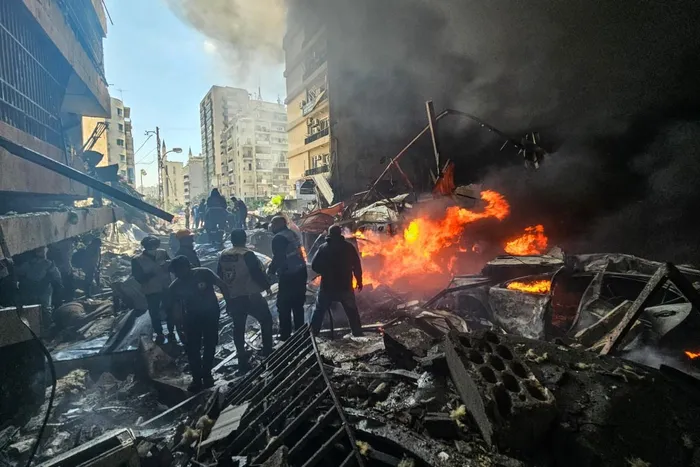
First responders stand amid rubble at the site of an Israeli airstrike in Beirut's Corniche al-Mazraa neighbourhood on April 8. Israel launched a series of strikes in Beirut on April 8 and has insisted that the two-week truce in its war with Iran does not apply to Lebanon.
Image: AFP
Dr. Reneva Fourie
The ongoing aggression across West Asia confirms that Israel remains the principal obstacle to any meaningful peace in the region. Far from a beleaguered state defending itself, its actions, enabled by unconditional United States support, reveal a calculated strategy of perpetual dominance through brute force.
From the skies over Iran to the ruins of Lebanese villages and the occupied territories of Gaza and the West Bank, civilian life and infrastructure bear the brunt of Israel’s aggression.
South Africa has faced considerable pressure for its principled positions on Israel, yet its posture has not wavered. The recent ceasefire between the United States and Iran confirms that South Africa’s steadfast relationship with Iran, its bold advocacy for Palestinian rights, and its insistence on negotiated settlements have been thoroughly vindicated.
The democratic South Africa’s foreign policy has consistently emphasised that coercive strategies, whether in the form of military intervention or economic sanctions, serve only to deepen suffering and entrench conflict. Their reference to the protracted humanitarian consequences of the United States blockade on Cuba illustrates a wider critique of policies that prioritise domination over dialogue.
The failure of the so-called “maximum pressure” campaign against Iran, which has yielded neither capitulation nor stability, reaffirms this perspective. This reality is underscored by the recent two-week interim ceasefire between the United States and Iran, where China’s quiet diplomacy created a pathway out of escalating conflict.
Amid this turmoil, Beijing’s discreet engagement has offered a rare route toward de-escalation, highlighting the value of the Global South, including through platforms such as BRICS Plus, in leading the pursuit of a just and peaceful world order.
However, serious questions remain over whether Israel can be brought into compliance. It has a well-documented history of disregarding ceasefire agreements, as evidenced repeatedly in Gaza and the West Bank.
Netanyahu has already declared that this interim arrangement does not apply to Lebanon, even as Pakistan, a key mediator, insists a ceasefire there forms part of the broader agreement. For any ceasefire to prove sustainable, the United States must move beyond narrow self-interest and control its puppy dog.
The 28 February attack on Iran was explicitly framed around alleged nuclear arms capabilities, yet the temporary ceasefire has now confirmed beyond doubt that Iran never possessed nuclear weapons to begin with.
This revelation exposes the entire campaign as a fabricated pretext, launched merely to appease Israel. What began as an assault on supposed nuclear sites has shifted seamlessly to aggression aimed at controlling the Strait of Hormuz, the essential artery for global oil flows.
Iran responded with strategic restraint, effectively elevating the strait’s importance and redirecting global focus away from nuclear speculation toward accountability for unprovoked aggression. It suffered enormous damage. Joint US-Israeli strikes targeted not only military installations but also civilian infrastructure, including schools, hospitals, residential areas and historical sites.
These actions, framed by Washington and Tel Aviv as pre-emptive defence, disproportionately harmed ordinary Iranians, disrupted essential services and exacerbated humanitarian suffering. Despite this, Iran’s approach humiliated the aggressors and demonstrated masterful control over the narrative.
This logic of indiscriminate force exposed in Iran confirms Israel’s general attitude that the lives of others are expendable. In Lebanon, Israeli aggression over the past month has been equally devastating.
Since 2 March 2026, sustained airstrikes and ground operations have killed more than 1,500 people, including over 100 women and 130 children, while injuring upwards of 4,800 others. Infrastructure lies in ruins, entire towns have been destroyed, over 1.2 million people have been displaced, and waves of up to 10 airstrikes per minute have levelled homes and hospitals.
Israel’s refusal to distinguish between military and civilian targets confirms its unrelenting disregard for international humanitarian law.
The situation in Gaza and the West Bank since the October 2025 ceasefire agreement further exposes Israeli bad faith. That phased accord offered a fragile opening for peace, yet Israel has persisted with operations that have compounded earlier devastation.
Nearly 80 per cent of Gaza’s infrastructure continues to be damaged or destroyed, with over 70,000 Palestinians killed and approximately 172,000 injured since October 2023, the overwhelming majority civilians. Post-ceasefire, low-level violence and settlement expansion have continued unabated.
Approximately 9,600 Palestinians languish in Israeli prisons, many under administrative detention without trial. Most damningly, on 30 March 2026, Israel’s parliament passed legislation making the death penalty by hanging the default sentence for West Bank Palestinians convicted of terrorism related killings in military courts.
This measure, applicable exclusively to Palestinians, reminds us of similar practices by apartheid South Africa, as demonstrated by the recently commemorated death of Solomon Mahlangu.
These developments collectively reveal Israel as the true inhibitor of peace in West Asia. Ceasefire or no ceasefire, Israel, like the United States, cannot be trusted. It is high time for a concerted global effort to deal with both the United States and Israel, whose unbridled belligerence has brought the world to the brink of World War III.
At the centre of any lasting peace must be the realisation that they have to be brought under control. Otherwise, the chaos we have seen in West Asia will spread.
The Global South has demonstrated its important role in maintaining peace, as shown by the stances of South Africa, whereby many countries have joined its action, charging Israel with genocide at the International Court of Justice. In the instance of the ceasefire in Iran, Pakistan, and China have also played key roles.
The imperative now falls to the Global South. Through BRICS Plus and similar forums, nations committed to sovereignty and equity must champion a just world order. This entails pressing for full implementation of international resolutions on Palestine, securing accountability for civilian loss in the region, and advancing inclusive negotiations that address root causes.
Ultimately, peace in West Asia will also require forcing the United States and Israel to abide by international rules. They must realise that they are not above the law. Only then can the peoples of Iran, Lebanon, Palestine, and beyond realise the security and dignity they deserve.
* Dr Reneva Fourie is a policy analyst specialising in governance, development and security.
** The views expressed do not necessarily reflect the views of IOL or Independent Media.