China and South Africa: A New Era of Strategic Partnership
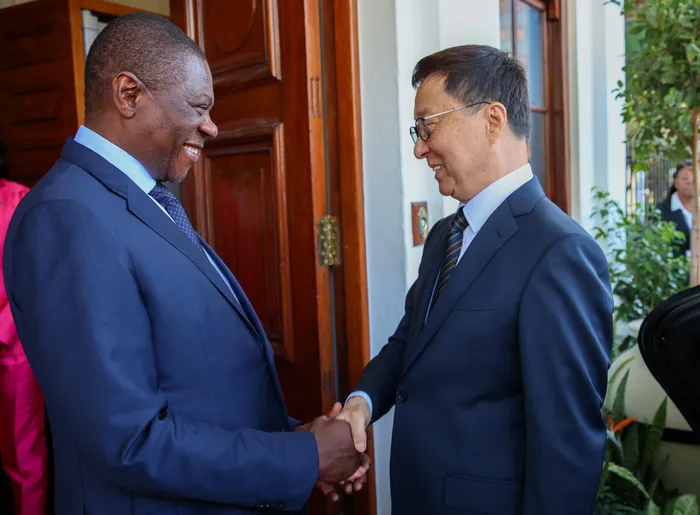
South Africa's Deputy President Paul Mashatile and the People’s Republic of China Vice President Han Zheng, at Tuynhuys, Cape Town on March 26. The two leaders will co-chaired the 9th South Africa-China Bi-National Commission (BNC).
Image: GCIS
Prof. David Monyae
The frequent exchange of high-level visits between China and South Africa continues as the two countries work to strengthen their thriving bilateral relationship.
In the latest round of high-level visits, the Chinese Vice President Han Zheng visited South Africa between 25 and 26 March. The visit came at a time when China and South Africa, led by Presidents Xi Jinping and Cyril Ramaphosa, declared an All-Round Strategic and Cooperative Partnership in the New Era, which sought to take the relationship between the two sides to a new level when they met in September 2024.
The signified the political commitment from the highest level to revitalise the bilateral relationship between two of the most important countries in the Global South. South Africa is China’s biggest trading partner in Africa, while China has been South Africa’s biggest bilateral trading partner for the last 16 years.
In 2025, bilateral trade between the two countries reached US$38.5 billion. This figure is set to increase significantly when the implementation of China’s zero-tariff policy for goods coming from 53 African countries with diplomatic relations with China kicks in this year.
China is also one of the biggest sources of foreign direct investment in South Africa, with its foreign direct investment stock reaching over US$5 billion, creating tens of thousands of jobs across various sectors, including mining, banking, media, manufacturing, and telecommunications, among others.
China and South Africa also share the same vision for the future of the global order, as they consistently adopt common positions on issues of global importance. The two sides have also intensified their people-to-people relations over the years through education, cultural activities and tourism.
As such, Vice President Zheng’s visit will only further strengthen this relationship. It represents a strong vote of confidence from the Chinese government on the trajectory and future prospects of the relationship.
During his visit, the Vice President met with President Cyril Ramaphosa, where he reiterated the strategic importance of South Africa to China, stressing the need to maintain the tradition of high-level visits, promoting party-level cooperation between the Communist Party of China (CPC) and the African National Congress (ANC), which leads the Government of National Unity in South Africa.
He also indicated that Chinese enterprises are more than willing to invest more in the South African economy if the government can create a stable and conducive business environment.
On his part, President Ramaphosa emphasised South Africa’s steady support for the One-China policy and expressed excitement about China’s zero-tariff policy, promising that South Africa will take full advantage of the new policy to increase exports to the Chinese market.
The new trade policy could not have come at a more opportune time, when Western countries are increasingly adopting protectionist policies and constraining developing countries’ access to their markets.
Through the zero-tariff policy, China is indicating its willingness to support South-South cooperation and the development of its fellow developing countries, especially the least developed countries (LDCs), in line with President Xi’s Global Development Initiative (GDI).
This policy will not only increase the quantity of Africa’s exports to the Chinese market but also the composition of the exports as well. We are likely to see more value-added goods being exported from Africa to China, which will have a positive impact on the continent’s economic transformation efforts.
Vice President Zheng also co-chaired the ninth plenary session of the China-South Africa Bi-National Commission (BNC) with his South African counterpart, Deputy President Paul Mashatile.
The BNC is a structured bilateral mechanism where the two countries conduct a high-level dialogue on issues of common interest. Since its inception in 2000, the BNC has served as a crucial platform driving the development of the Sino-South African relationship by promoting mutual trust at the highest level.
This year, the BNC was held under the theme of advancing shared modernisation.
In his remarks, Deputy President Mashatile underscored China’s importance to South Africa, stressing that the two countries “must respond to a rapidly changing global environment, while advancing inclusive growth, industrial development and technological progress”.
He reassured his Chinese counterpart that South Africa is “committed to ensuring that its partnership with China delivers practical outcomes that improve the lives of its people and contribute to sustainable development in both our countries.”
In his reflections, Vice President Zheng pointed out that the relationship between China and South Africa goes beyond the bilateral scope as it retains strategic and global influence. He called for the accelerated finalisation of the Early Harvest Agreement under the Framework Agreement on Economic Partnership for Shared Prosperity, signed by the South African and Chinese ministers of trade in February.
This agreement would pave the way for South Africa’s trade with China under the new zero-tariff policy. Both sides expressed satisfaction with the progress registered since the eighth plenary session in fields of education, science and technology, energy development, and minerals processing and beneficiation, among others.
South Africa and China are facing a global order that is full of uncertainty because of the actions of US President Donald Trump, whose decisions pose an unprecedented threat to multilateralism and global peace and security. It is especially important that, as leading countries in their respective regions, Africa and Asia, China and South Africa stand firm in defending the interests of the Global South countries and an equitable and just global order.
Vice President Zheng’s visit served to reaffirm the principles of practical cooperation, mutual benefit and win-win cooperation that have underpinned the growth of the bilateral relationship.
* Prof. David Monyae is the Director of the Centre for Africa – China Studies at the University of Johannesburg.
** The views expressed do not necessarily reflect the views of IOL or Independent Media.