Parliamentary Probe A Crucial Step for Criminal Justice Reform
AD HOC COMMITTEE REVIEW
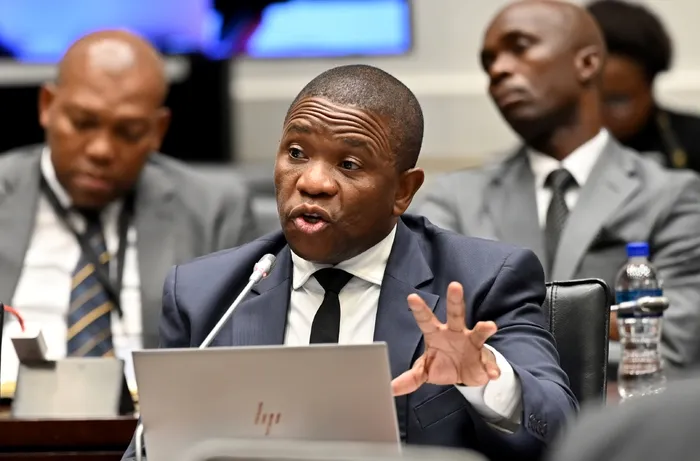
KwaZulu-Natal Police Commissioner Lt-Gen Nhlanhla Mkhwanazi testifying before Parliament's Ad Hoc Committee on March 18. Those who attempted to discredit Mkhwanazi’s testimony found themselves on the proverbial canvas, says the writer.
Image: Ayanda Ndamane/ Independent Newspapers
Prof. Sipho Seepe
PARLIAMENT'S Ad Hoc Committee established to investigate claims of criminal infiltration, political interference, and corruption within the criminal justice system owes its existence to the historic press conference held by KwaZulu-Natal Provincial Police Commissioner Lieutenant General Nhlanhla Mkhwanazi on 6 July 2026.
Many commentators were quick to dismiss Mkhwanazi’s intervention as a mere stunt or an act of bravado. Nothing could be further from the truth. Far from being an isolated escapade, this was a cry for help from within the system itself. As Mkhwanazi himself explained, he acted both as a member of the collective and as the person designated to deliver its message.
First, the press briefing was an act of profound patriotism. In Mkhwanazi’s words, it was “well considered by all concerned and was held to draw attention to critical matters of national concern and interest regarding the extent we, as SAPS, considered these concerns a real threat to the country’s criminal justice system and, by extension, the overall security of its citizens.”
Second, had Mkhwanazi and his colleagues not taken this unusual step, the deep rot afflicting the criminal justice system would have continued unchecked for far longer. By placing the entire system on trial, they have compelled the nation to confront uncomfortable truths and initiate the necessary reforms to prevent a recurrence.
Parliament deserves credit for moving with commendable speed to establish the Ad Hoc Committee. Mkhwanazi and his colleagues carefully narrowed their allegations to three core issues — criminal infiltration, political interference, and corruption — thereby providing a clear and focused mandate for both the parliamentary committee and the judicial commission chaired by former Acting Deputy Chief Justice Mbuyiseli Madlanga.
It must be stated plainly: without the seismic political shift brought about by the 2024 national general elections, this committee would never have seen the light of day. In the pre-2024 era, the ANC would almost certainly have used its majority to shield its leaders from scrutiny, just as it attempted with Phala Phala. The party would have argued that the judicial commission alone was sufficient and that any parliamentary inquiry would amount to unnecessary duplication.
As the Ad Hoc Committee concluded its work, it left the South African public with a clear impression: Lieutenant General Mkhwanazi’s allegations have been substantially sustained. Compelling evidence emerged that:
(1) The Minister’s disbandment of the Priority Crime Task Team was unlawful,
(2) Crime syndicates and drug cartels have infiltrated the criminal justice system,
(3) Political interference has seriously impeded the proper functioning of the police service, and
(4) Mkhwanazi’s claims of corruption involving police officers and politicians were far from mere hallucinations.
Those who attempted to discredit Mkhwanazi’s testimony found themselves on the proverbial canvas. Minister Senzo Mchunu’s first appearance before the committee was marked by bluster and overconfidence.
As the inquiry progressed, that façade crumbled. The same fate befell former National Director of Public Prosecutions Shamila Batohi, as well as long-time media favourites Mary de Haas and Paul O’Sullivan.
Batohi appeared to act as a ventriloquist for the late Minister Pravin Gordhan, repeatedly invoking “state capture” to mask her own department’s glaring incompetence. De Haas and O’Sullivan were stripped of their self-proclaimed expertise. De Haas, who had routinely relied on her association with the University of KwaZulu-Natal to bolster her credibility, was left reeling after the University of Kwa-Zulu-Natal publicly distanced itself from her.
O’Sullivan, long accepted by sections of the public and government as an authority despite possessing neither a university degree nor the postgraduate qualifications required for the senior positions he had occupied, was reduced to incoherent responses when pressed.
Far from the usual political grandstanding, the parties on the committee applied themselves to the task at hand. Members from ActionSA, the EFF, MK Party, and the Patriotic Alliance distinguished themselves with rigorous questioning, effectively displacing the DA from its traditional role as chief inquisitor.
The ANC played a constructive role overall, although its performance wavered noticeably when Minister Mchunu testified. Committee Chairperson Mr Soviet Lekganyane deserves particular praise for keeping the diverse group focused and united around its mandate. What emerged was a powerful demonstration that multi-party democracy can work.
The committee’s task has been considerably eased by President Cyril Ramaphosa’s written responses to the questions it submitted to him. In those replies, the President directly contradicted Minister Mchunu’s claim that he had received a go-ahead from the Presidency to disband the Priority Crime Task Team.
Ramaphosa stated that he had not only been consulted but had also expressed dissatisfaction with the decision. He further clarified that the power to disband such a unit rests with the National Commissioner, not the Minister.
Had the committee not taken the step of formally writing to the President, it is reasonable to assume this vital information would never have been shared with the public. Once again, President Ramaphosa chose not to take the nation into his confidence — this is vintage Ramaphosa behaviour.
As Moeletsi Mbeki once observed: “Cyril is not a leader really… he does not believe in anything. He goes with the flow. He wakes up in the morning and says which way is the wind blowing and I am going to go that way.”
The wind, it seems, is no longer blowing in Minister Mchunu’s favour. He could as well kiss his presidential ambitions goodbye.
After supporting him through thick and thin, Ramaphosa’s response must have felt like a stab in the back to Mchunu. It was a painful firsthand lesson in the harsh political truth: there are no permanent friends—only permanent interests.
Expediency, personal ambition, and betrayal are the real currencies of trade. Alliances shift with the political winds, and loyalties quickly dissolve when personal advantage calls.
* Professor Sipho P. Seepe is a Higher Education and Strategy Consultant.
** The views expressed do not necessarily reflect the views of IOL or Independent Media.