Trump's America First Strategy Undermining Africa's Sovereignty
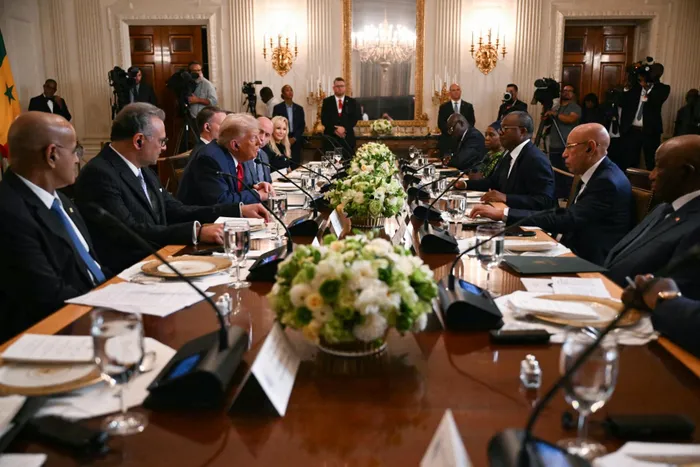
US President Donald Trump at a meeting with African Leaders from Senegal, Liberia, Guinea-Bissau, Mauritania and Gabon in the White House in Washington, DC, on July 9, 2025. The key focus of the Trump summit was to foster trade to counter the growing regional influence of Russia and China.
Image: AFP
Kim Heller
Despite being mired in warfare in the Middle East, the United States (U.S.) has not taken its eye off Africa, which it views as "the world's next great commercial opportunity".
By 2050, the purchasing power of the Continent is set to be in the region of 16 trillion dollars. Africa's critical minerals, including cobalt and copper, are vital to the strength and sustainability of key U.S. industries.
On 19 March 2026, Senior Bureau Official for African Affairs, Nick Checker, presented key insights into the "America First In Africa" strategy at the Powering Africa Summit. This recalibrated economic framework for U.S.-Africa relations is centred on renewed diplomacy, economic partnerships, and conflict management.
Although it is presented as a mutually beneficial partnership, the new deal is little more than another expression of the America First imperial thrust under the Trump administration. Its primary focus is to ensure that minerals flow to the United States in support of U.S. interests and industries.
The plurilateral Forum on Resource Geostrategic Engagement (FORGE) is set to align supply chains and develop pricing and trade agreements. Infrastructure development is expected to revolve around expanding the Lobito Corridor, a project that the U.S. has heavily invested in to enable efficient exports to Western markets.
The new Africa strategy is being presented as one that will "strengthen economic sovereignty" for the Continent. However, this is deceptive. In the economic warfare of U.S. global ambitions, African resources and production are being surgically extracted to meet American-specific industrial needs.
This is the antithesis of development and sovereignty in Africa. There is a feast of wordplay around Africa, gaining "a meaningful seat at the table" through this deal. However, it is unlikely that Africa will gain more than crumbs, albeit supersized ones, at the master's table. Trump's signature is clear; those African countries that align with U.S. geopolitical and economic priorities will be rewarded.
Sovereignty is respected only when it aligns with America's interests. For the U.S., Africa is a prize, not a partner.
Conflict management will focus on counterterrorism and migration control. This does not address the root causes of continental instability. It appears as if the stability the U.S. strives for in Africa enables optimal resource extraction rather than one that fosters genuine, sustainable peace and sovereignty.
In February 2026, Joseph Sany of the Institute for Security Studies (ISS) described the new U.S. strategy as "selective transactional engagement devoid of a comprehensive recognition of Africa's multifaceted challenges."
Washington's new approach effectively ends the illusion of U.S. benevolence. There is no longer any pretence of love or appreciation for Africa beyond what it can do for America. There is no ambiguity. In this new deal, emergency aid has been deprioritised. Grants are a relic of past strategies.
The tone is purely transactional and America-centric. Sovereignty built on partnerships where the terms and conditions are externally set can be rocky and unsteady. Sany has stated that the challenge for African policymakers is to expand, not reduce, opportunities to advance their interests.
In this respect, Africa's resources must serve African development first. Any deal or programme that does not honour compulsory domestic processing and beneficiation should be wholly rejected.
If African leaders are astute, they will infuse infrastructure investments with African agency and an unapologetic Africa-first focus. If this is not achieved, the Continent will continue to be little more than an ever-exploited enclave of extraction by others.
Large infrastructure projects, especially those involving transport corridors, can serve as key, much-needed drivers of enhanced regional economic development and cooperation. Trade corridors could help to unlock key bottlenecks and boost stronger local and international economic activity.
In recent years, China's Belt and Road Initiative (BRI) has undoubtedly improved Africa's infrastructure. However, in most instances, the Continent has gained little control over the processing and manufacturing value chains, keeping it dependent and debt-burdened rather than independent and prosperous.
The rulebook for economic partnerships, whether with Washington or Beijing, needs to be developed by African leaders. Industrial transformation without local processing and beneficiation is an empty win.
Without a bold Africa-first strategy, the Continent will remain trapped in a global economic system that continues to build economic wealth in foreign lands while depriving African nations.
Global economic engagement is necessary, but this requires a complete overhaul, not by foreign heads of state but by patriotic African leaders who are wedded to the decolonisation of global economic relations and imbalances, and industrial transformation that benefits ordinary citizens rather than elites.
The rules of the global game are continually shifting, yet Africa remains little more than a site of extraction rather than an epicentre of production.
The very premise that "America First" can be seamlessly aligned with "Africa First" should raise concerns. The new U.S. strategy for Africa is not a rupture. It is a new chapter in the never-ending story of colonial extraction in the new game of contemporary geopolitics.
The "America First in Africa" strategy shows that the U.S. approach to the Continent is guided more by interests rather than goodwill. Africa's leaders should be guided by the same philosophy: the paramount interests of their own people and the Continent's industrial promise and needs.
Until African leaders prioritise domestic development over the interests of competing global powerhouses, the Continent will remain trapped in an economic hierarchy that places it last. It is a sad irony that global superpowers have recognised Africa's immense potential, yet African nations and leaders are failing to do so.
* Kim Heller is a political analyst and author of No White Lies: Black Politics and White Power in South Africa.
** The views expressed do not necessarily reflect the views of IOL or Independent Media.