How US Trade Deals Threaten Zambia and Zimbabwe's Development Agenda
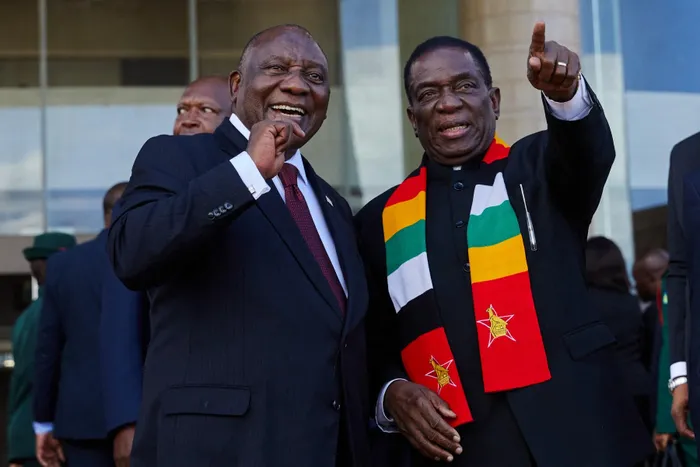
South African President Cyril Ramaphosa (left) and President of Zimbabwe and SADC Chairman Emmerson Mnangagwa at the Southern African Development Community (SADC) extraordinary summit in Harare on January 31, 2025. This year’s SADC summit in South Africa needs to prioritise fair trade and real WTO reform to protect African nations from exploitative FTAs with the US, says the writer.
Image: AFP
Ashraf Patel
African nations are currently facing a new triple blow to their development agenda – one more extractive and exploitative that straddles the entire economic value chain and social life of Africans- from minerals to digital data.
Despite the laudable communique of ‘Africa’s G20’ in 2025 on Sustainable AI and Green industrialisation et al, African nations face Ground zero in realpolitik with the extractive ‘Free Trade Agreements on steroids’ Trump administration in 2026.
The (mis) use of Section 301 trade tools against 60 countries is also in motion. The latest being the new US-Zambia and US-Zimbabwe trade deals, are attracting considerable pushback.
A leaked draft of a five-year memorandum of understanding (MOU) between the two countries, seen by the Guardian, reveals that Zambia may accept terms worse than health financing agreements the US has reached with 16 other African countries.
The terms include a commitment to give Washington access to its health data for 10 years – far longer than other countries have negotiated. Zambia’s deal also predicates any health financing on an even more covert basis.
According to Asia Russell, director of the HIV advocacy organisation Health Gap, “These terms are vastly worse than other deals. [The US] is conditioning life-saving health services on plundering the mineral wealth of the country.
“It’s shameless exploitation, which is immoral. It’s also dangerous – when health programmes are treated like a bargaining chip by a rapacious administration, everyone suffers,” (The Guardian, 19 March 2026)
The use and abuse of Open data science is undermining national health systems' new frontiers of exploitation – resource, knowledge and unequal trade-tariff negotiations akin to ‘economic gunboat diplomacy’
Zambia and Zimbabwe these days are meant to be gaining from the mining boom with a huge inflow of foreign reserves. Alas, they are dependent on foreign aid amidst high debt repayments. This bizarre contradiction is that Zambia, facing a mega copper boom, and Zimbabwe’s lithium opportunity will be undermined as both face a huge Debt crisis with the highest debt- to GDP ratios in decades.
Quite interesting is that Zambia is close to the US and an anchor of the US-led Lobito Corridor, for mineral extraction, but none of these geopolitical considerations seems to play any part in Trump's FTA agreements calculations.
Africa is once again seen from an old world's colonial gaze - one of vast geological resources with African citizens seen as mere customers for global Multinationals, and of course, African governments and legislators as the managerial class of global capital.
Other blocs such as the EU are too occupied with geopolitical disruptions, and Africa is now again seen from a colonial gaze- one where unbridled access to oil, gas, and hydrogen is the new model of EU- AU trade-investment agreements.
Furthermore, the Generative AI revolution era is moving at breakneck speed, and cloud computing consumption is growing exponentially. According to the Guardian
Even more concerning is that it’s only a few years on from the release of ChatGPT, but the race to plug artificial intelligence into everything has sparked a surge in datacentres, with escalating environmental costs. Globally, data centre power demand is growing four times faster than all other sectors, according to the International Energy Agency, and is on track to exceed Japan’s electricity use by 2030.
In the commercial domain, Big Tech’s extractive data via a monetisation model looms large. From workers in the global South, where Kenyan content moderators occupy the bottom of the value chain, earning below living wage levels, with work environments causing severe mental health issues.
Fintech models further extract forex from the financial ecosystem of African nations. In the absence of adequate consumer and privacy rights, most Africans are left to the Big Tech digital vulture value chain.
The same Big Pharma corporations that practised Covid nationalism and denied Africans access to vaccines are back to extract our health data for their own R&D and product development, which is then exported globally. COVID nationalism on steroids!
Another plank of the US FTA with Zambia et al. comes against the backdrop of the ending of the PEPFAR HIV and TB programs across the continent. Health data access as a new clause in US trade agreements undermines our sovereignty.
In this context, the unregulated access to African health and science data is a new frontier of this extractive model across industries.
They need this data as inputs for new generation vaccines and pharmaceutical R&D product development. Here again, African nations' data is monetised without any compensation. This goes against the grain of the WHO, WTO and WIPO IP guidelines of health equity.
Hence, it is no surprise that the Trump administration's disengagement from the WTO, its defunding of the WHO and UNESCO, key UN institutions that are crucial in safeguarding the UN SDG agenda, are actively being undermined.
The AU and regional groupings are too weak or donor-dependent to make any impact.
Every year, the SADC Summit circus comes to town with no real plan on dealing with the grave Polycrisis African citizens face. SADC Leadership has always been seen as that ‘big, slow, large elephant’ that tramples upon human rights across the region. It now needs to confront a new spectre - Donald Trump’s 2.0 new extractive and neo-imperialist world.
We have had SADC’s Indicative Industrialisation Plan RISDP – a vision on paper that has been talked about ad nauseam for well over a decade. SADC summits pay only lip service, with little implementation resources or gravitas.
For Africa to leverage its critical minerals and move towards green industrialisation, SADC leaders need a common integrated economic agenda. Civil society, economic justice networks and unions need to play a robust role in co-shaping a new southern African region and demanding real leadership for African interests.
This year’s SADC summit in South Africa needs to prioritise the following:
- Demand fair trade and real WTO reform to protect African nations from exploitative FTAs with the US et al;
- Demand a new Green Critical minerals for development treaty.
- A new Charter on Data sovereignty for Development in line with the UN
- Enhanced Youth and Gender program in the AI economy
For starters, the AU and SADC are donor-funded and hence have very little policy sovereignty. This time, African nations are caught between a new inter -imperial rivalry for critical minerals, raw extractives, as well as digital data extractives. Big Tech cloud centres are guzzling energy and devouring lithium and cobalt, copper of Africa.
The current global wars have seen food prices rocket to all-time highs, yet African nations are major agricultural exporters.
Is another SADC possible?
* Ashraf Patel is a Senior Research Associate at the Institute for Global Dialogue, UNISA.
** The views expressed do not necessarily reflect the views of IOL, Independent Media or The African.