China-SA Bi-National Commission: Strengthening Economic Ties Amid Global Challenges
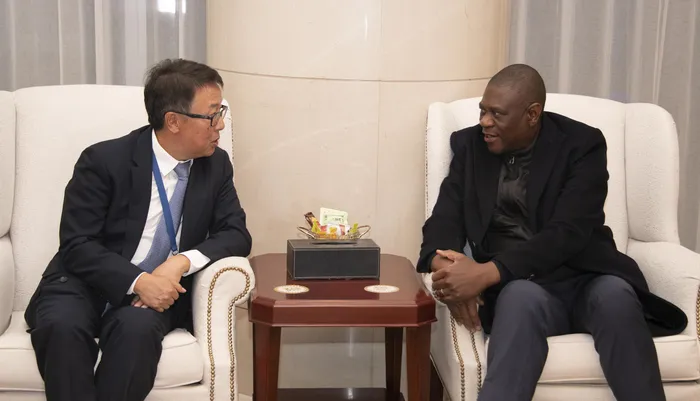
Deputy President Paul Mashatile (right) and Wu Peng, then Director General of African Affairs at China's Ministry of Foreign Affairs, in discussion ahead of the South Africa, China Bi-National Commission in Beijing on November 2, 2023. Mashatile co-chairs the BNC with Han Zheng Vice President of the People's Republic of China.
Image: GCIS
Dr Jaya Josie
The 9th China-South Africa Bi-National Commission meeting between the two countries is taking place in Cape Town on Thursday, 26 March, amidst global trade and energy supply chain disruption.
On November 23 last year, South Africa’s Vice-President Paul Mashatile met with China’s Premier Li Qiang and expressed South Africa’s readiness to expand all-round value-added exports and attract greater Chinese investment in beneficiation, renewable energy, manufacturing and digital technology.
The 9th Bi-National Commission this Thursday could not have come at a more pivotal moment, as the war in the Middle East is disrupting energy supplies globally, placing South Africa’s emerging economy at grave and serious risk as it tries to reshape and rebalance its economic and development strategies.
Reshaping and rebalancing is a strategic move that has been reinforced by China’s recent announcement that it will implement zero-tariff treatment for imports from 53 African countries with which it has diplomatic relations.
For South Africa, this is an amazing coincidence coming so soon after the 30% tariff imposed on South Africa’s exports to the US market and the uncertainty associated with South Africa’s long-term access to the US African Growth and Opportunity Act (AGOA) program.
According to the 25 February 2026 South African cabinet statement, Thursday’s BNC meeting, co-chaired by the country's two vice-presidents, will review and advance the strategic bilateral cooperation, align priority sectors, and deepen political, economic and technical collaboration between the two countries.
The expected focus areas for BNC are clearly synchronised by the two countries in their recent internal discussions on national priorities. For China, the BNC comes almost immediately after its 5 March 2026 Two Sessions meeting of the National People’s Congress (NPC) and the Chinese People’s Political Consultative Conference (CPPCC), which met to draft an outline of the 15th Five-Year Plan.
At the two sessions, the NPC set the policy direction, growth targets and reform priorities for China’s next stage of development. Key among the priorities were China’s commitment to a high standard of opening up, an emphasis on cooperation with countries from the Global South, and the possible impact of China’s stability in the current global climate of uncertainty.
Based on South Africa’s recent cabinet statement and the President’s State of the Nation address to Parliament in February 2026 and the country’s Medium -Term Development Plan (2024-2029) three main overarching priorities for South Africa emerge; drive inclusive economic growth and job creation, reduce poverty and tackle the high cost of living and, build a capable, ethical and developmental state.
At recent meetings, the South African Government detailed its priority area for inclusive growth and job creation, highlighting that investment and trade expansion will be key to achieving this goal.
The plan is to host a South Africa Investment Conference in March 2026; advance regional integration by strengthening the Southern Africa Customs Union (SACU) and the Southern African Development Community trade frameworks to position African markets.
It also deepens the partnership with China by implementing the SACU-China Economic Partnership Agreement (CAEPA), alongside China’s announcement that, from 1 May 2026, it will implement zero-tariff treatment for imports from 53 African countries with which it has diplomatic relations.
Against this backdrop, the BNC is expected to build on the recently signed South Africa-China Economic Partnership Agreement (CAEPA) for shared prosperity, including ongoing negotiations on an Early Harvest Agreement aimed at expanding duty-free market access for African countries that have diplomatic relations with China.
Green growth and renewable energy for expanding cooperation in the clean energy transition for climate action is perhaps another area for discussion. Attracting Chinese investment in value-added manufacturing and mineral processing for industrialisation and beneficiation is likely to be top of the agenda.
Other focus areas that may be discussed are the digital economy and innovation for integrating South African firms into Chinese and global value chains. People-to-People exchanges and multilateral coordination in international fora will also most likely be discussed at the 9th BNC.
The 9th BNC discussion on the SACU-CAEPA on China’s new tariff-free program will be a catalyst for addressing South Africa’s problem in dealing with the issue of imposed trade tariffs by other trading partners.
For South Africa and Southern Africa, the program will stimulate industrialisation, moving away from exporting only raw materials. In particular, it will boost job creation and economic multipliers as production and forex earnings will increase. It will further provide a foundation for Southern Africa’s integration into China’s green supply chain industry for critical minerals such as lithium, cobalt and manganese.
Such integration will potentially allow the region to leapfrog into midstream processing for the global green energy transition. If China’s tariff-free policy includes a trade plus infrastructure program and is paired with trade preferences and investment in Special Economic Zones and Industrial Parks, this could provide the physical infrastructure that will help Southern African producers to use market access for exports to China.
While the 9th BNC meeting is expected to focus on South Africa and, perhaps, the SACU, African economies will benefit from China’s tariff-free program. Some key benefits for Africa in general will be enhanced competitiveness, as it will reduce costs for African exporters in agriculture, textiles and light-manufactured goods.
For South Africa, there are likely to be very specific benefits such as agricultural duty-free export opportunities and gains for producers of citrus, wine, avocados, beef and other fruit. It will also boost the country’s position as a manufacturing hub for Chinese companies seeking market entry into Africa with access to China’s resources and technology.
Under the new tariff-free policy, South Africa is explicitly granted Non-Reciprocal Access, and China will no longer demand reciprocal tariff cuts from South Africa under the China-Africa Economic Partnership Agreement (CAEPA).
The 9th BNC, coming at this most critical geopolitical juncture, is an opportunity for China and South Africa to consolidate and implement their previous resolutions and take them beyond a symbolic significance.
If the 9th Bi-National Commission meeting follows through with implementing just the tariff-free policy for SACU and South Africa in particular, it will send an important message to Africa, the BRICS block of countries and the Global South.
The message will underscore that cooperation across developing and emerging economies within BRICS can only enhance the collective bargaining power of the Global South, especially in times of trade uncertainty and international instability.
The war in the Middle East has exposed African and Global South countries to geopolitical vulnerabilities and risks for the supply of energy and fertiliser for increased productive capacity, as the rise in fuel and fertiliser prices seems imminent.
Countries that can mobilise capacity faster are more likely to benefit than countries unable to upgrade their logistic and production capacity. The benefits applicable to Africa may also be true for BRICS and other emerging developing economies.
* Dr Jaya Josie, Adjunct Professor, University of the Western Cape (UWC)
** The views expressed do not necessarily reflect the views of IOL or Independent Media.