Decolonising Justice in Africa Remains Unfinished Business
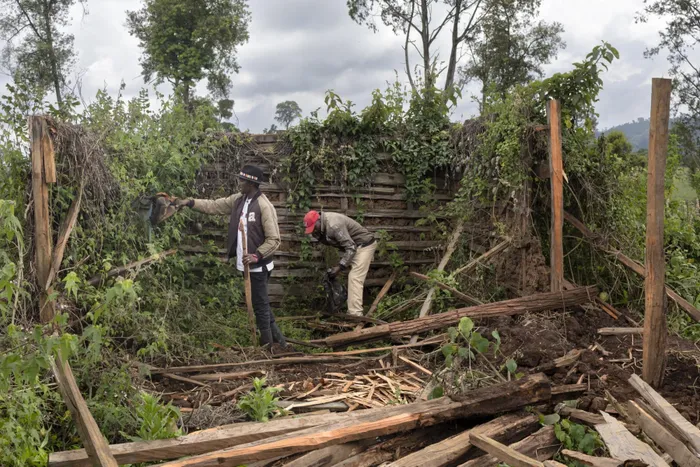
Human Rights activist from the Ogiek community Fred Ngusilo (left) surveys the ruins of his grandfather's house in the Mau Forest, one of several destroyed homes at the site of their former village in the forest in Narok County, on August 16, 2025. The African Court on Human and Peoples' Rights (AfCHPR) ruled in 2017 and 2022 that the evictions were illegal.
Image: AFP
Kim Heller
When the African Court on Human and Peoples' Rights was established in 2006, there was an enormous well of hope that this would be a critical milestone in the long journey towards decolonisation and legal sovereignty on the Continent.
Justice in Africa can never flourish on the exploitative architecture of colonialism or on Western-imposed legal frameworks. Legal scholars across the Continent have emphasised the importance of reimagining African jurisprudence.
African wisdom, value systems, the lived experiences of ordinary citizens and accountability by post-independent nations need to be key building blocks. If these are absent, the rule of law will continue to conflict rather than intersect with justice.
Kenya's constitutional law expert, Yash Ghai, has strongly advocated for legal frameworks that transcend colonial legacies and give pride of place to social justice, democratic participation, and collective dignity.
Tshepo Madlingozi, a well-known law academic and activist in South Africa, has called for an epistemic shift that centres African knowledge in the interpretation and practice of law. Western legal influences and systems have long been depicted as the saviours rather than the enslavers of Africa.
Scholars such as Kenyan Professor Makau Mutua have written about this misrepresentation. The African Court was a perfect instrument to shift this framing. The Court was intended to enforce the African Charter on Human and Peoples' Rights, which was adopted in 1981. The Charter recognises collective rights alongside individual rights.
This includes people’s rights to self-determination, control over natural resources and development. The acknowledgement of collective dignity is immeasurably important for a continent crushed by colonisation and economic and cultural dispossession. The Charter and Court, if effectively implemented, should have helped to pave a pathway to meaningful justice and sovereignty.
The Court has delivered many landmark rulings over the last two decades.
In the 2017 African Commission on Human and Peoples' Rights vs Kenya case, the Court recognised the land rights of the Ogiek people. It ruled that their banishment from the Mau Forest infringed several provisions of the African Charter. What is praiseworthy in this important case is the affirmation of indigenous peoples' rights to their land and cultural heritage.
This is a crucial antidote to the widespread displacement of communities across much of Africa, as a result of colonial seizures and land thievery.
The 2013 Mtikila & Others vs Tanzania court case was a triumph of democracy over tyranny. The Court ruled that Tanzania's ban on independent political candidates disregarded citizens' constitutional rights to political participation.
In another important case in 2014, the Court issued a judgment declaring the imprisonment of journalists for defaming politicians and government in Burkina Faso a violation of freedom of expression.
In 2019, in the matter of Ally Rajabu & Others vs Tanzania, the Court ruled that compulsory death sentences transgressed the rights to a fair trial and protection against inhumane sentences. The African Court has demonstrated that it is clearly able and willing to tackle structural injustice, human rights issues, and governance transgressions.
The greatest hindrance for the African Court has been the lack of political will by many African governments. Only thirty-four of the African Union's 55 member states have endorsed the Court's founding protocol. What is even more concerning is the limited access to the Court. Only a small number of African countries have allowed individuals and non-governmental organisations to bring cases directly before the Court.
In 2019, Tanzania withdrew individual access to the African Court, following several judgments that were issued on political rights. Rwanda had withdrawn its declaration three years earlier. This came after several politically sensitive cases were presented to the Court by the ruling party’s political opponents. Tunisia has now withdrawn individual access, effective from March 2026.
While many African leaders scorn the International Criminal Court for ignoring human rights violations, the same leaders are mute on how ordinary citizens are denied access to the African Court. It is both alarming and hypocritical.
Another challenge the African Court has faced is that, despite its high-level rulings, compliance has been poor. It does not help that the African Union's enforcement mechanisms are limited and largely ineffective.
The African Court has flexed its legal muscle and judicial boldness, only to find its authority restricted by the very African countries it serves. The Court's twentieth anniversary was commemorated earlier this month, under the theme "20 Years of Service in Protecting Human and Peoples' Rights."
Guest of honour, John Dramani Mahama, the President of Ghana, urged African nations that have not yet ratified the Court's protocol to do so without delay and implored governments to implement the Court’s judgments.
He said, "There is nothing to fear in appearing before it.” Mahama emphasised that the Court exists to protect the rights of African citizens. Other speakers echoed his sentiments. Selma Malika Haddadi, the Deputy Chairperson of the African Union Commission, described the Court as an essential instrument of justice on the Continent.
If Africa is serious about decolonised justice and legal sovereignty, it must commit to strengthening and supporting its own legal principles and institutions without fear or favour.
At the very least, there should be widespread ratification of the Court's authority, the restoration of access for citizens to the Court and more vigorous enforcement of judgments.
For now, the pursuit of a decolonised legal framework is the unfinished business of African jurisprudence. The sad reality is that legal sovereignty is being undermined rather than driven by many African governments. This is a great injustice to the people of Africa.
* Kim Heller is a political analyst and author of No White Lies: Black Politics and White Power in South Africa.
** The views expressed do not necessarily reflect the views of IOL or Independent Media.