The SANDF's Deployment No Solution to Fighting Rampant Crime
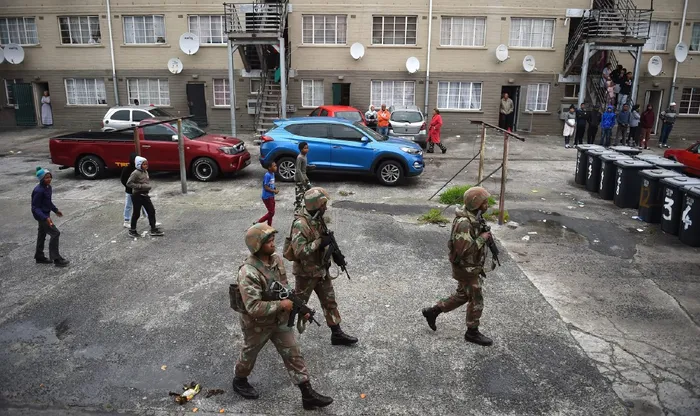
Members of the SANDF on patrol in the Cape Flats during a previous deployment. Is the latest SANDF deployment an admission that the country’s SAPS has failed to execute its constitutional mandate?, asks the writer.
Image: Henk Kruger/Independent Media
Prof. Bheki Mngomezulu
During his 2026 State of the Nation Address (SONA), President Cyril Ramaphosa announced that members of the South African National Défense Force (SANDF) will be deployed in different provinces across the country to curb crime, gangsterism in the Western and Eastern Cape provinces, and illicit mining activities in Gauteng and the North-West.
Initially, the Western Cape, Gauteng and North-West provinces were targeted. When Minister of the South African Police Service (SAPS) Prof. Firoz Cachalia addressed the public, he stated that the president had added the Eastern Cape province to this list.
According to the announced plan, this is a temporary arrangement that is expected to last for one year until March 2027. It is estimated that around R800 million will be spent on this project. The president had to make this public announcement in his capacity as the Commander-in-Chief of the country’s armed forces. Therefore, the decision was constitutionally sound.
But while this decision passes the constitutional litmus test, it raises very critical questions that deserve answers. The first potential question about the duration of the deployment has already been answered. The project will last for one year, making it a temporary solution to the endemic challenges enumerated above. Once SANDF leaves, what will happen? Other questions remain unanswered.
Firstly, is this SANDF deployment an admission that the country’s SAPS has failed to execute its constitutional mandate? If SAPS’ failure is due to financial challenges, would it not make sense to use the estimated R800 million to capacitate and resource SAPS instead of deploying soldiers?
This invokes the second question: What is the SANDF trained to do? Is their training the same as that of SAPS members? My layman’s understanding of SANDF’s training is that they are mentally prepared for two things: to kill or get killed. Even when they are deployed to assist in peace-keeping missions under various multilateral bodies, they still expect that they may be forced to kill if attacked or succumb to hostile fire.
Now, if we expect the SANDF to do the job of the police – even if in a supporting capacity – what do we expect them to do? The pre-deployment training of the SANDF announced by Ramaphosa in February and reiterated by Minister Cachalia in March creates the impression that these soldiers will be re-purposed, albeit temporarily.
But will such pre-deployment training be enough to enable them to operate differently from what they were originally trained to do? If they unwittingly violate human rights out of ignorance, will they be pardoned, or will the law be expected to grind as it should be the case? In such cases, should they shoulder the blame, or should the blame be apportioned to those who deployed them in the first place?
These questions are important because we have experienced this situation recently during COVID-19. On March 15, 2020, the Disaster Management Act was invoked by the South African Cabinet to contain the pandemic. It lasted for the next 750 days.
During this national state of disaster, President Ramaphosa used his constitutional powers to deploy soldiers so that they could assist SAPS in enforcing disaster regulations. While this was done with good intentions, it soon emerged that SANDF members were operating in a strange environment. Some of their actions were in contravention of the law. They infringed on the human rights of many South Africans. Some carried out these atrocities out of ignorance. Others were excited about their new role and wanted to prove a point.
Surely, COVID-19 was a terrible global phenomenon. But what did South Africa learn from it? If we realised that our SAPS members are either not enough or properly capacitated and adequately resourced to execute their constitutional mandate, what did we do to avert a similar situation from happening again? Had we drawn lessons and acted accordingly, would there be a need to redeploy soldiers to assist SAPS in dealing with crime in the country?
There is a broader societal issue that needs to be addressed instead of coming up with short-term solutions to endemic national challenges. Failure by the post-apartheid government to integrate South African townships into the cities and to address the racial divide has contributed to the challenges the country is wrestling with.
The tale of two cities remains evident. Almost all the challenges SANDF members are called upon to address have a racial element. Most of the people who engage in criminal activities, such as the ones listed at the beginning of this article, are mainly from previously disadvantaged communities.
Another equally important issue is the state of our justice system. Criminals go scot-free due to weaknesses in the justice system. Evidence is tampered with, some collude with criminal syndicates, and others succumb to bribery and fail to protect the human rights of innocent citizens who are law-abiding.
The political elite contribute to the current situation the country finds itself in. Some of them are not good role models. When those in power engage in corruption and other criminal activities, this is used as a reference point by ordinary South Africans who commit the offences listed in this article.
The points discussed above do not disregard the reality of the high unemployment rate in the country. But this cannot be used as an excuse for most of the crimes committed across South Africa. It is very rare for the political elite to be subjected to crime because they have 24/7 protection. This results in the needy robbing and even killing other needy people.
This does not make sense. At least unemployment can be used to justify illicit mining. While this practice is illegal, Zama Zamas try to eke a living by working. Their mistake is to terrorise local communities.
The issues discussed in this article lead to the conclusion that there is no panacea for the country’s challenges. SANDF deployment only addresses the symptom, not the real problem. To take the country out of this quagmire needs concerted efforts by everyone.
* Prof. Bheki Mngomezulu is Director of the Centre for the Advancement of Non-Racialism and Democracy at Nelson Mandela University.
** The views expressed do not necessarily reflect the views of IOL or Independent Media.