Navigating Political Uncertainty: The ANC's Leadership Challenges and Patrice Motsepe
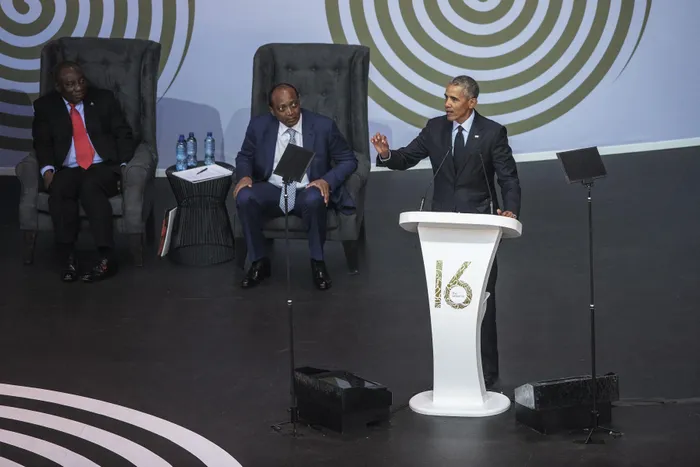
President Cyril Ramaphosa (left), business mogul Patrice Motsepe (centre) and former US President Barack Obama during the 2018 Nelson Mandela Annual Lecture at the Wanderers cricket stadium in Johannesburg on July 17, 2018. The current debate regarding the perceived suitability or possible candidature of Dr Patrice Motsepe must be located within a sobering political reality confronting the African National Congress, says the writer.
Image: AFP
Zamikhaya Maseti
South African politics is a fascinating terrain. As a nation, we are almost perpetually in what one might metaphorically describe as a rainy political season.
Our political landscape, expressed in agricultural terms, resembles a tropical climate in which debates, contestations, ambitions and ideas germinate throughout the year. This, in many ways, is the enduring beauty of the South African milieu. We are indeed a nation of diversity where differences are expressed openly and robustly, yet without the paralysing fear that disagreement must necessarily lead to permanent rupture.
Within this vibrant democratic environment, the discussion around the possible 2027 presidential ambitions of Dr Patrice Motsepe has surfaced, notwithstanding his public denials of campaigning. Yet if one follows the logic of unfolding political signals, it would appear that what he describes as a non-campaign machinery continues to operate with visible momentum.
Moments such as these often compel those of us who participate in public discourse to reflect carefully on the responsibility of the intellectual in times of political uncertainty.
It is precisely for this reason that my intervention in this debate is informed by the intellectual tradition articulated by Edward Said in his seminal work Representations of the Intellectual. Said conceives the intellectual as a worldly figure whose responsibility is to unsettle complacency and provoke honest reflection within society.
I therefore proceed in that spirit, conscious that my intervention should not be misconstrued as factional positioning or the promotion of one individual over another, but rather as a contribution to sober reflection within the movement that shaped many of us, the African National Congress.
In view of the foregoing context, let me proceed with the deliberate unsettling of complacency. The current debate regarding the perceived suitability or possible candidature of Dr Patrice Motsepe must be located within a sobering political reality confronting the African National Congress.
The movement’s electoral trajectory has, over the past decade, demonstrated a steady downward swing, with some polling houses and political commentators projecting that its national support could fall below the forty per cent threshold, with the more pessimistic estimates suggesting figures as low as thirty-two per cent. Such projections understandably generate anxiety within sections of the movement and its broader support base.
It is within this climate of apprehension that the Savumelana Brigade, although unmandated and operating outside the established organisational rules, traditions and protocols of the African National Congress, appears to have found political expression. Their activism seems animated by a palpable anxiety about the movement’s electoral trajectory and the uncertain political horizon that confronts it.
Whether justified or not, this activism appears driven by fear of a looming electoral moment in which the African National Congress could enter the 2029 National General Elections significantly weakened, particularly in the aftermath of the 2026 Local Government Elections, which will serve as an early barometer of the political mood and a rehearsal of the electoral realities likely to confront the movement in 2029.
If the activism of the Savumelana Brigade is indeed informed by this objective reality, an important question inevitably arises. Is it politically correct and organisationally justifiable for such a formation to define itself and act outside the established processes of the African National Congress, particularly when the organisation’s leadership has been clear about the immediate political priorities before it?
The Secretary General of the African National Congress has stated unambiguously that the movement is not yet seized with the question of future presidential candidacies and that its current focus remains firmly on the forthcoming Local Government Elections.
In that context, any mobilisation that appears to preempt organisational processes risks creating the impression of acting in defiance of collective discipline. Such conduct raises deeper questions about the erosion of one of the foundational organisational principles upon which the African National Congress has historically functioned, namely, democratic centralism.
Properly understood democratic centralism allows for robust internal debate and contestation within the structures of the organisation. Once the organisation has spoken through its legitimate leadership structures, unity of purpose and disciplined action become indispensable.
When individuals or informal formations begin to operate outside that framework, even when animated by what they may believe to be noble intentions, the unintended consequence is the gradual weakening of organisational coherence. This is the danger that the entire membership of the African National Congress must guard against.
History reminds us that once a revolutionary movement begins to lose its ideological compass and organisational discipline, the process of internal fragmentation often begins quietly before eventually manifesting itself in ways that threaten the cohesion of the movement.
The immediate task before the African National Congress is therefore clear. It must push back the frontiers of fragmentation and arrest the visible electoral decline that has gradually eroded its once commanding political position.
In due course, the organisation will inevitably have to confront deeper strategic questions regarding the kind of leadership required to guide the movement in this particular historical epoch. This is not merely a question of personalities. It is fundamentally a question about the political and ideological outlook of the leadership collective required to reposition the movement within a rapidly changing social and political environment.
History itself provides instructive precedents. The newly formed African National Congress of 1912 required the moral authority and principled leadership of Chief Albert Luthuli. The exiled movement, navigating the harsh conditions of repression and international struggle, required the organisational brilliance and diplomatic acumen of Oliver Tambo.
The dawn of a democratic South Africa required the reconciliatory statesmanship and historical stature of Nelson Mandela. Each historical moment produced its own leadership necessity shaped by the demands of the epoch.
It is therefore incumbent upon the membership of the African National Congress to collectively ask and answer the question regarding the kind of leadership required to guide the movement out of the political morass that followed the electoral setback of 29 May 2024.
The membership must arrive at a sober and unified understanding of the real meaning of that electoral outcome. In revolutionary terms, the results of the 29 May 2024 General Elections represent nothing less than a moment of regression and derailment in the long historical march of the National Democratic Revolution. Nothing more and nothing less.
In conclusion, the most pertinent question that the membership of the African National Congress must confront is whether the movement is prepared to depart from its long-established leadership succession convention in which the Deputy President steps forward when the President’s term reaches its natural conclusion.
These may be uncomfortable and unpalatable questions, yet they are precisely the questions that must be confronted if unity rather than division is to prevail within the movement.
At this delicate moment in its history, the African National Congress must therefore approach these debates with political maturity, revolutionary discipline and a sober appreciation of the stakes involved. The opposition parties are watching attentively, hovering over what they perceive to be an ailing and bleeding organisation ready to devour every sign of internal disunity for breakfast lunch and dinner.
The responsibility that rests upon the shoulders of the membership of the African National Congress is therefore profound: to ensure that internal debates about leadership renewal strengthen unity, discipline, and the historical mission of the movement rather than inadvertently accelerating the forces of fragmentation that seek to weaken it.
* Zamikhaya Maseti is a political economy analyst and holds a Magister Philosophae in South African Politics and Political Economy from the erstwhile University of Port Elizabeth, now Nelson Mandela University.
** The views expressed in this article do not necessarily reflect the views of IOL or Independent Media.