The Limits of Diplomacy: Ramaphosa's Appeal for Restraint Amid Geopolitical Tensions
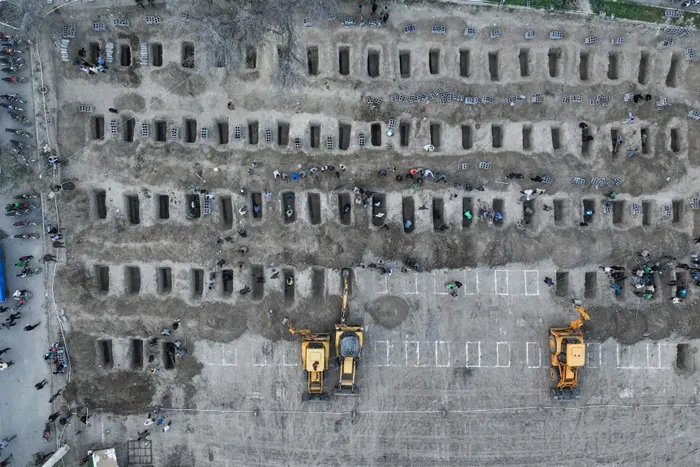
In this aerial handout picture released by the Iranian Press Center, mourners dig graves during the funeral for children killed in a reported strike on a primary school in Iran’s Hormozgan province in Minab on March 3, 2026. Iran has accused Israel and the United States of conducting a strike on an elementary school in the southern city of Minab, which it said killed more than 150 people.
Image: IRANIAN PRESS CENTRE/AFP
Dr. Clyde N.S. Ramalaine
In international diplomacy, the value of a call for peace is measured not merely by the virtue of the appeal but by the credibility of the voice making it.
When President Cyril Ramaphosa recently called for an end to tensions involving Israel, its biggest ally, the United States, and Iran, the statement entered the global arena less as a diplomatic intervention and more as a familiar exercise in performative politics.
The difficulty is not the sentiment. Few would dispute that calls for de-escalation in the Middle East are welcome. The problem lies in the context from which the appeal emerges, a context that significantly limits the moral and diplomatic traction such a call can realistically achieve.
In his statement, Ramaphosa urged “all parties to exercise maximum restraint” and to act in accordance with international law and the principles of the United Nations Charter. He further insisted that “there can be no military solution to fundamentally political problems that can and should be resolved diplomatically,” and called on the international community to “redouble efforts aimed at promoting mediation and peaceful resolution.”
These are words few diplomats would contest. The language is familiar, measured, and morally unobjectionable. Yet diplomacy is not judged solely by the elegance of its phrasing. It is judged by the credibility of the speaker and the geopolitical context in which the message is delivered.
South Africa’s relationship with Israel has, particularly under Ramaphosa’s leadership, moved from strained to openly adversarial. The government of the African National Congress has positioned itself as one of the most vocal critics of Israeli policy toward the Palestinians, regularly condemning Israeli military actions and downgrading diplomatic engagement with Jerusalem.
This posture culminated in Pretoria’s decision in 2023 to bring a case against Israel before the International Court of Justice, alleging violations of international law in Gaza. While the move was framed domestically as a principled defence of international humanitarian law, it carried wider diplomatic consequences.
In both Israel and the United States, the action was interpreted less as neutral legal advocacy and more as a political alignment within one of the most polarised geopolitical disputes of the modern era.
Washington, long Israel’s principal strategic ally, has increasingly viewed Pretoria’s Middle East posture alongside a broader pattern of diplomatic friction, including disagreements over global alignments, South Africa’s tensions surrounding Pretoria’s position on the war in Ukraine, its recent participation in naval drill exercises with Russia, China and Iran, notwithstanding last minute efforts from Ramaphosa to have Iran not participate make up the current reality explaining relations between SA Israel and Washington.
While such naval drill exercises are not unusual for sovereign states, they contribute to a broader narrative in which South Africa’s foreign policy appears increasingly ideological rather than strategically balanced. In that environment, South Africa’s claim to act as a neutral or mediating voice in Middle Eastern affairs has become increasingly difficult to sustain.
Whether one agrees with the legal merits of that case or not is beside the point. In diplomatic terms, the move placed South Africa firmly on one side of an already polarised geopolitical divide. In Jerusalem and Washington, the perception hardened that Pretoria had ceased to function as a neutral voice in Middle Eastern affairs.
Compounding this perception have been persistent allegations that Iran may have played some role in encouraging or supporting South Africa’s legal action. These claims have circulated on various platforms, including diplomatic and intelligence circles.
Significantly, the Iranian ambassador to South Africa recently issued a public denial of any Iranian sponsorship of the African National Congress or of the legal case itself. Such denials, while diplomatically necessary, also reveal the degree to which suspicion has already taken hold. When a denial must be issued, it is because the narrative already exists.
Against this backdrop, Ramaphosa’s appeal for peace risks sounding less like principled mediation and more like rhetorical positioning within an already declared alignment.
Ramaphosa himself reinforced this aspiration when he remarked that “South Africa is always ready to play a contributing role, either in mediation or whatever.” Yet mediation requires more than willingness. It requires trust.
In such an environment, a call by Ramaphosa for Israel and the United States to de-escalate tensions with Iran does not land as the voice of an impartial mediator. In the corridors of Washington or Jerusalem, it is far more likely to be interpreted as the statement of a government already perceived as politically aligned against them. This is where the distinction between diplomacy and performance becomes important.
Effective diplomacy requires standing in the room where decisions are being made. It requires credibility with the actors involved, channels of communication that are respected, and a history of engagement that allows one’s voice to carry weight.
Today, when Ramaphosa calls for peace in this particular setting, the statement travels outward from a country whose relations with Israel are deeply strained, whose ties with Washington have grown increasingly complicated, and whose proximity to Iranian narratives is under constant scrutiny. It thus rings hollow in impact and irrelevant in meaning.
The contrast becomes even more pronounced when one considers the response unfolding across much of the Western alliance. While President Cyril Ramaphosa calls for restraint and mediation, several states are moving in the opposite operational direction. Countries such as France, the United Kingdom, Ukraine and even geographically distant Australia have signalled varying degrees of readiness to assist in defensive efforts aimed at intercepting Iranian missiles and drones.
The approach reflects a strategic doctrine that has become increasingly familiar since the coordinated interception of Iranian projectiles during earlier regional escalations: integrated air-defence cooperation, intelligence sharing, and the rapid deployment of naval and aerial interception capabilities designed to contain escalation in real time. In this environment, Ramaphosa’s appeal for restraint appears detached from the operational realities shaping the conflict.
While NATO-based governments are preparing to deploy radar systems, missile defence platforms and surveillance assets to physically intercept incoming threats, Pretoria’s intervention remains confined to the language of diplomatic principle. The moment thus exposes a widening divide between those participating directly in the security architecture of the conflict and those offering commentary from its diplomatic margins.
In such circumstances, the appeal begins to resemble what might be called diplomacy at a distance, a moral declaration issued into a conflict in which the speaker possesses little practical leverage.
To be clear, there is nothing inherently wrong with advocating for peace. But in the hard calculus of international politics, not every voice carries equal weight. Some appeals move the machinery of diplomacy; others simply circulate through the news cycle before fading from view. Ramaphosa’s intervention risks falling into the latter category.
In this instance, as in all others, credibility is not granted by virtue of a message alone. It is determined by the history and posture of the messenger. And in that ledger, Pretoria now finds itself speaking loudly in a room where its voice is no longer regarded as neutral.
* Dr Clyde N.S. Ramalaine is a political scientist and analyst whose work interrogates governance, political economy, international affairs, and the intersections of theology, social justice, and state power.
** The views expressed do not necessarily reflect the views of IOL or Independent Media.