Trump and the Crisis of Multilateralism: A New Era of Unilateral Power
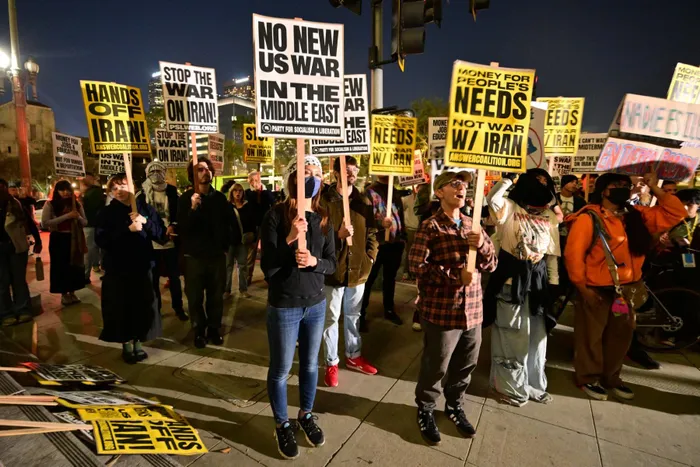
Demonstrators hold placards as they rally during a protest against military action in Iran outside of City Hall in Los Angeles, California, on March 2, 2026.
Image: AFP
Zamikhaya Maseti
The invasion of the Islamic Republic of Iran and the ultimate killing of its Supreme Leader, Ali Khamenei, is a clear confirmation that Donald Trump’s Conservative Republicanism knows no boundaries and is mutating with no quarantine measures in place.
The deliberate decapitation of a sitting head of a sovereign state, undertaken outside the authority of the United Nations Security Council, marks a profound rupture in the normative architecture of international relations. This aggression renders multilateral institutions, particularly the United Nations Security Council, structurally impotent.
These institutions now appear, collectively and individually, to be in a state of permanent paralysis. It is not merely an episode of military escalation. It is a moment of doctrinal revelation.
The post-1945 order, constructed in the aftermath of World War II, placed the United Nations at the centre of global governance. The Security Council was entrusted with maintaining international peace and security.
Yet embedded within its architecture was hierarchy. The five permanent members, the United States, Russia, China, France and the United Kingdom, were granted veto authority. This arrangement stabilised great power participation, but it also institutionalised inequality. The custodians of order were never subject to the discipline they imposed on others.
Trump’s Conservative Republicanism must therefore be read not as a historical deviation, but as the unmasked expression of an enduring structural logic. His doctrine of America First embodies what Marxist-Leninist Theory identifies as contemporary imperialism, the projection of state power in defence of monopoly capital and strategic accumulation.
Multilateralism is tolerated only when it facilitates accumulation. When it constrains it, it is marginalised.
The killing of Khamenei crystallises this logic. The removal of a sovereign leader without multilateral authorisation signals the subordination of international law to imperial calculus. It affirms that power, not procedure, is the final arbiter of legitimacy. In doing so, it exposes the fragility of the rules-based order.
Lenin described imperialism as the highest stage of capitalism, characterised by the fusion of industrial, financial and state power. In contemporary form, this fusion manifests as the war economy. Defence industrial capital, advanced weapons manufacturers and strategic technology firms form a decisive bloc within the American political economy.
Military expenditure, justified through security rhetoric, simultaneously functions as a mechanism of capital circulation and accumulation. War preparation becomes geopolitical posture and economic stimulus.
Under this configuration, conflict zones become theatres of technological validation. Advanced missile systems, cyber warfare platforms and surveillance architectures require operational testing.
Peripheral states risk becoming laboratories in which military capability is demonstrated and geopolitical signalling performed. The logic is structural. The war economy does not merely respond to crises; it depends on them.
From a theoretical perspective, the present moment resembles what Antonio Gramsci described as an interregnum. The old order is struggling to retain coherence while the new order has yet to assume institutional form.
What is particularly disturbing is the naked absence of a counterveiling force capable of repelling and pushing back the torrential and destructive waves of Trump’s Conservative Republicanism. In this geopolitical continuum, where the old refuses to die, and the new cannot yet be born, much is at stake.
The disruption is not confined to military theatres. It reverberates through the global economic order. Supply chains are under strain. Oil prices rise sharply, transmitting inflationary pressures across continents. In South Africa, fuel price increases compound domestic vulnerability.
The aviation sector experiences turbulence as airspace closures ripple across the Middle East. Energy costs migrate into food production, transport logistics and manufacturing inputs. The inflationary impulse intensifies.
For developing economies already grappling with structural unemployment and constrained fiscal space, such shocks are destabilising. Currency volatility increases. Borrowing costs rise. Central banks are forced into defensive postures even where growth remains fragile. The spectre of stagflation reemerges. What appears as a regional conflict becomes a global economic tremor.
This tremor spills into the sphere of financial governance. Institutions such as the International Monetary Fund and the World Bank depend upon cooperation among major powers to stabilise markets. In an era of intensifying rivalry, coordination weakens. Liquidity provision becomes politicised. Sanctions distort capital flows.
Development finance is securitised and strategically conditioned. The global monetary system, long anchored by the United States dollar, faces renewed debate about diversification and realignment. Payment systems fragment. Financial infrastructure becomes entangled in geopolitical contestation.
Sadly, this disruption persists because no consolidated counterveiling force is prepared to restrain it. China and Russia, often presumed to constitute strategic counterweights, appear constrained by internal economic recalibration and security imperatives.
In such a configuration, the international system is not merely unbalanced; it is structurally vulnerable to the unchecked projection of unilateral power.
The paralysis of the Security Council is therefore not an administrative weakness. It is the institutional reflection of a deeper contradiction within global capitalism. Multilateralism depends on hegemonic consent. When the dominant power privileges unilateral assertion over collective restraint, the architecture of governance reveals its dependence on power rather than principle.
The Iranian episode stands as a signal event in this trajectory. It confirms that Trump’s Conservative Republicanism is not simply a domestic ideological orientation. It is a recalibration of the United States’ relationship with global governance, accumulation and force. It demonstrates that the post-1945 settlement, sustained by consent and coercion, is entering a period of profound strain.
The question confronting the international community is whether a new equilibrium can emerge that reconciles power with law and accumulation with restraint. If recalibration fails, the interregnum may solidify into a prolonged era of volatility in which the logic of force displaces the language of multilateral order. In that scenario, the institutions created to prevent systemic war risk become spectators to its resurgence.
* Zamikhaya Maseti is a political economy analyst.
** The views expressed do not necessarily reflect the views of IOL, Independent Media or The African.