Mosiuoa 'Terror' Lekota: A Courageous Leader Who Spoke Truth to Power
TRIBUTE
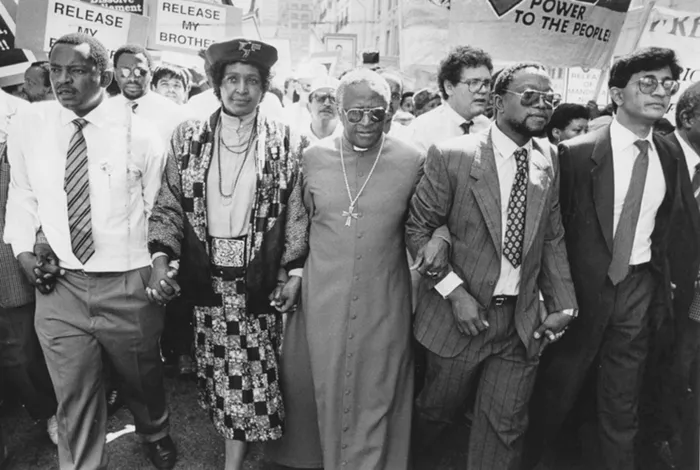
(From left) Mosiuoa 'Terror' Lekota, Winnie Madikizela-Mandela, Archbishop Desmond Tutu, Popo Molefe and Mohammed Valli Moosa lead a march in support of the UDF's "Free All Political Prisoners' campaign" in the late 1980s. In a world marked by division and inequality, Lekota’s life demonstrates how centring compassion in activism and leadership can create real change, says the writer.
Image: Independent Media Archives
In South African history, few figures embody the intersection of personal sacrifice, compassion and the pursuit of societal betterment as Mosiuoa Patrick Lekota.
Born on 13 August 1948 in Kroonstad, Free State, and passing away on 4 March 2026 at 77 after a prolonged illness, Lekota leaves a legacy that transcends political affiliations and ideological divides.
Known affectionately as "Terror" for his formidable prowess on the football field, his life was a testament to activism driven by love. From his early days as a radical student to his roles in government and opposition, Lekota's journey was propelled by deep compassion for the marginalised and a commitment to uplifting lives. This fuelled his emergence as a leader for enduring change.
Lekota's formative years were marked by the harsh realities of apartheid, a system that denied dignity and opportunity to the majority of South Africans. Educated at Susanna Farm School, then at Mariazell High School and St. Francis College, he matriculated in 1969 and pursued a degree in social science at the University of the North.
There, amid the ferment of student politics, his compassion for the oppressed crystallised into action. His engagement with the South African Students' Organisation and the broader Black Consciousness Movement led to his expulsion in 1972 for vocal advocacy against racial injustice. This expulsion did not deter him; it ignited a lifelong dedication to challenging oppression and a commitment to principle over personal comfort.
As a full-time organiser for SASO in 1974, he helped organise victory celebrations marking Mozambique's independence. His actions reflected an innate empathy for those suffering under colonial and apartheid regimes, driving him to risk personal freedom for collective advancement.
This drive for justice led to his arrest under the Terrorism Act. He received a six-year sentence on Robben Island from 1974 to 1982. Sharing cells with icons like Nelson Mandela broadened his perspective from Black Consciousness to non-racialism. He recognised that championing equality, justice and the franchise for all required participation across apartheid-generated racial divides.
This desire for a better South Africa is reflected in a letter to his daughter, Masetjhaba: "Above all then, my dear, I am in prison for the sake of peace for our country and the world. I am in prison so that our generation may leave to yours and later generations a country and a world that has the greatest potential for progress".
In these words, we see the heartbeat of a true activist. The personal tragedy he endured when she died in 1996 would have broken a lesser spirit, yet it seemed to deepen his resolve.
Upon release, he joined the United Democratic Front in 1983, serving as publicity secretary. This broad coalition of sectors, which included civic organisations, trade unions, youth formations and religious groups, united diverse communities against apartheid. His work embodied the belief that the struggle for freedom should not be driven solely by political leaders but by communities determined to shape their own future.
Mosiuoa Patrick Lekota was among the prominent anti-apartheid activists charged in the Delmas Treason Trial in 1985. Alongside fellow leaders of the United Democratic Front, he faced accusations of treason, terrorism and murder following the 1984 Vaal Uprising.
These false charges sought to criminalise the voices of those calling for justice and equality. The long years of court proceedings and the threat of imprisonment tested his resilience, yet they also revealed his quiet courage and deep commitment to the struggle for a democratic South Africa. He was released in 1989 after a successful appeal.
Lekota turned his revolutionary ideals into governmental action in the first democratic government. As the first Premier of the Free State from 1994, he prioritised stabilising a province ravaged by inequality, focusing on service delivery and reconciliation to foster inclusive growth.
Subsequently, as Chairperson of the National Council of Provinces from 1997 to 1999, he advocated for rural and marginalised groups, ensuring that national policy met their needs and aspirations.
Later, as Minister of Defence from 1999 to 2008, he oversaw the integration of former apartheid forces and liberation armies into a unified, democratic defence force. Through principled leadership, Lekota helped transform the military from a resented institution into one that served all South Africans.
In all his roles, Lekota stayed true to his values. He always put people's well-being before his own interests. He opposed corruption and threats to democracy, even when ridiculed. The abrupt removal of Mbeki and his replacement by Zuma led Lekota to resign from the African National Congress.
He then formed the Congress of the People. COPE reflected his belief in accountable leadership, unity and better service. Even when the party faced difficulties, Lekota embodied authentic leadership that put the common good first.
Lekota’s legacy is more than his political roles or historical significance. It is the example he set. While he occasionally made errors in judgment, he showed that leadership is not gauged by titles. Instead, it is measured by the compassion to serve others with honesty and selflessness. He challenged those around him and those who came after to live with integrity. He urged others to defend equality and act with humanity in every sphere of life.
In a world marked by division and inequality, Lekota’s life demonstrates how centring compassion in activism and leadership can create real change. His example encourages each citizen to take practical steps toward building a society where justice and dignity are truly experienced by all.
The lessons of his life cut to the heart of meaningful political engagement. They reveal that compassion is not a passive virtue. Instead, it is a necessary foundation for any genuine challenge to injustice.
Compassion connects individual suffering to collective action. His life shows that service to others is not about patronage. It is about establishing the trust and solidarity that hold communities together against external pressures. He demonstrated the courage to speak truth to power, to resist conformity and to stand on principle. Such courage breaks deep-rooted systems.
As South Africa mourns, it also celebrates a life devoted not to personal advancement but to the service of others. Mosiuoa Patrick Lekota’s journey reminds us that compassion, when paired with courage and principle, can reshape societies and challenge even the most entrenched injustices.
His life stands as a quiet yet powerful call to each generation to reject indifference and to choose solidarity with those who suffer. In remembering him, we are reminded that the struggle for dignity, equality and justice is never the work of one era alone but a responsibility passed from one generation to the next.
Dr Reneva Fourie is a policy analyst specialising in governance, development and security.
Image: IOL
* Dr Reneva Fourie is a policy analyst specialising in governance, development and security.
** The views expressed do not necessarily reflect the views of IOL, Independent Media or The African.