The 2026 Budget: A Missed Opportunity for South Africa's Poor
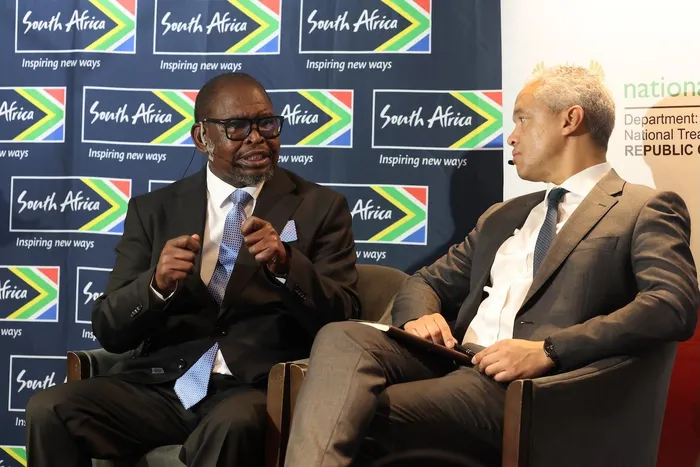
Finance Minister Enoch Godongwana (left) and National Treasury Director General Dr Duncan Pieterse in discussion at a post-budget breakfast held in Cape Town on February 2026. The Minister has missed an opportunity to adopt a national emergency response to food insecurity, high inequality, and unemployment, says the writers.
Image: GCIS
Liso Mdutyana and Dr Gilad Isaacs
Although the 2026 Budget was an opportunity for the Minister of Finance to reverse a decade of ill-informed austerity and steer the country towards transformative growth, Minister Gondongwana has opted to maintain the status quo.
The 2026 Budget fails to reverse the expenditure cuts proposed in the 2025 Medium Term Budget Policy Statement (MTBPS) and enacted over the past decade. Despite the improved economic environment, the Minister of Finance reduced non-interest spending by R5.2 billion in 2026/27 and by R14.2 billion in 2027/28, compared to the 2025 National Budget. This starves the country of resources needed for service delivery.
The Minister’s premature celebration of a declining debt level and widening primary budget surplus exposes a government that is not attuned to the appalling realities of many South Africans.
The Minister has missed an opportunity to adopt a national emergency response to food insecurity, high inequality, and unemployment. Instead, the increased fiscal space, contrary to the promises of the National Treasury’s Director-General, has been used for tax relief skewed towards the relatively well-off and to reduce further borrowing.
Public spending, excluding debt repayment, and taking into account the effect of inflation, slows and declines over the next three years. Spending cuts are concentrated in public services and the provision of social protection.
Meanwhile, allocations for infrastructure remain too little to achieve NDP or JETP goals and reverse the crises we see in water, transport, electricity, sanitation, and housing.
In developmental terms, the National Budget is an utter failure, with economic growth only projected to average 1.8%. That rate of growth is nowhere near the level required to keep pace with the average yearly growth of the labour force (at 2% between 2015 and 2025), and give the fiscus the resources necessary to invest in infrastructure, climate goals, and eradicate poverty.
National Treasury’s acknowledgement that the current approach to managing the economy is only able to produce, on average, 1.8% growth reinforces the arguments the IEJ made in our pre-budget briefing note, that ‘business as usual’ policies are keeping the country trapped in a sub-3% growth trajectory.
South Africa’s growth model resides in a fictional world where allowing corporations and rich people to have an increasingly larger share of the value created by all of society will somehow propel them to invest more in the real economy, despite extensive research which shows that their propensity to invest, particularly in longer-term fixed capital, is low.
Indeed, research shows that nowhere in the world has this version of ‘trickle-down economics’ created conditions for sustained economic growth.
Meanwhile, the channels that offer better prospects for (re)igniting private investment, such as massively increasing public investment, high domestic consumer demand, an appropriately skilled workforce, and reliable and cheap infrastructure, are either ignored or underfunded.
Instead of taking advantage of the improved economic environment to bolster revenue mobilisation and channel it to pro-poor and developmental spending, the Minister of Finance opted to grant relief to higher-income earners and businesses.
The 2026 Budget’s tax proposals raise no additional revenue over the medium-term, and revenue projections are lower in real terms than those contained in the 2025 MTBPS. The R20 billion tax increase committed to in the 2025 National Budget is withdrawn, and personal income tax brackets and medical tax credits are fully adjusted for inflation, sacrificing revenue that could have been directed elsewhere.
A pro-poor approach to public spending would prioritise the earmarking of medical aid tax credits for the expansion of the public healthcare system through, for instance, hiring more nurses and doctors, building more clinics, and ensuring that medicines are available. Thus, the government foregoes revenue (last estimated at R37 billion in 2023/24) to subsidise middle and upper-class households.
The focus on increasing savings is also based on the fallacious assumption that what constrains South Africa’s growth is low savings, rather than a lack of investment. Essentially, the National Budget prioritises putting money back in the pockets of the top earning 30% in the country (fueling fragile consumption-driven growth) and increasing the savings of the wealthy (fuelling inequality), while starving the fiscus of the funds needed to drive public investment.
On the debt side, the failure to raise economic growth to adequate levels continues to frustrate the National Treasury’s efforts to contain the debt-to-GDP ratio. Consequently, once again, the public is forced to bear the brunt of the consolidation.
Despite new budget cuts, the debt-to-GDP ratio is expected to peak at a higher level (78.9%) than was anticipated in the 2025 National Budget (77.3%).
This is because nominal GDP grew at a slower pace than expected. Despite clear evidence, the National Treasury remains too stubborn to acknowledge that spending cuts, which reduce aggregate demand, have a negative impact on GDP growth.
Therefore, even when debt is accumulated at a slightly slower pace, it will leave the debt-to-GDP level unchanged or higher. To counter this trend, the 2026 National Budget proposes to increase the primary surplus by 0.7 percentage points, equivalent to R59.5 billion, between 2025/26 and 2026/27, which in essence means failing to make use of the increased revenue collection for critical social needs.
For instance, this could have been used to boost the paltry increases to social grants in a manner that is responsive to the high food inflation the country has faced in recent years.
The 2026 National Budget also includes the second Gender Budget Statement (GBS), first introduced in 2025, as part of the gender-responsive budgeting (GRB) initiative. This year’s GBS features a watered-down conception of gender equity that essentially treats women as an untapped economic instrument.
Departmental interventions do not show how they will materially address women’s conditions of economic and social vulnerability. Moreover, the GBS is lacking political will and a sustained focus on core issues such as energy access, income security, unpaid care burdens, food insecurity, and unemployment.
A credible GBS would centre the most marginalised people. These include rural and unemployed women, persons with disabilities, the LGBTQIA+ community, and people living with illness or addiction.
Overall, the 2026 Budget reflects a government divorced from the realities of most South Africans. Achieving fiscal targets is becoming an end in itself, rather than being used as a launchpad for greater public investment in people and infrastructure. Unemployment, which holds millions of people back from living a dignified life, was only mentioned once, in the conclusion of the budget speech.
There is no plan to align macroeconomic policy with the need for re-industrialisation and to use fiscal policy as a transformative tool for higher employment growth. The government needs to nest fiscal policy within a developmental macroeconomic framework that prioritises labour-intensive growth, industrialisation, redistribution, social protection, and the public financing of the climate transition.
* The writers are based at the Institute for Economic Justice (IEJ).
** The views expressed do not necessarily reflect the views of IOL, Independent Media or The African.