Shifting U.S. Perspectives on China: From Engagement to Managing Competition
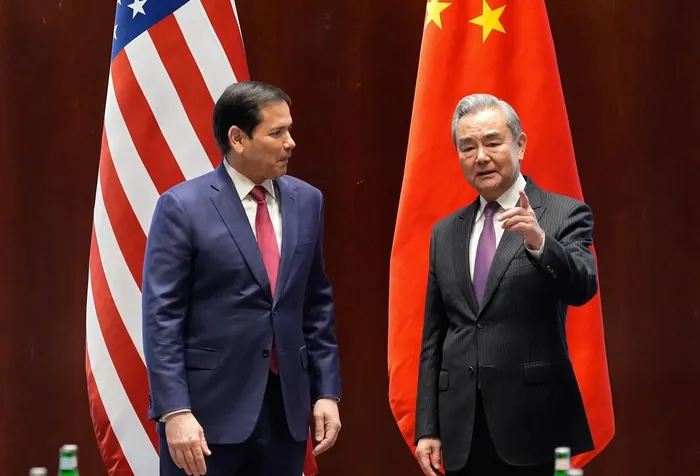
US Secretary of State Marco Rubio (left) and China's Foreign Minister Wang Yi on the sidelines of the Munich Security Conference in Munich, on February 12, 2026.
Image: AFP
Prof. David Monyae and Prof. Victor Qin
Marco Rubio’s 2023 Senate speech declaring “Capitalism did not change China. China changed capitalism” and his recent acknowledgement that “it is neither realistic nor responsible to avoid contact with” Beijing mark a seismic shift in U.S. strategic thinking on China.
For more than three decades, U.S. policy toward China has evolved through a clear three-stage trajectory, from the idealistic push to “change China” via globalisation, to a period of fraught strategic competition and confrontation, and now to a pragmatic focus on “managing competition” amid unavoidable contact.
This evolution is not just the shift of one prominent Republican China hawk’s views—it is a bipartisan reckoning with the limits of U.S. power and the realities of China’s rise as a global manufacturing giant and nuclear-armed state.
The first era, spanning the 1990s to 2016, was defined by a bipartisan consensus rooted in engagement and transformation. In the aftermath of the Cold War, Washington’s core strategic assumption was unshakable: economic globalisation and institutional integration would bring China into the U.S.-led international order, and over time, Beijing would converge with Western political and economic institutions.
China’s accession to the World Trade Organisation was the crown jewel of this strategy, seen as the pivotal moment that would bind China to global norms. Trade and investment were never merely economic acts; they were tools of statecraft, designed to foster a Chinese middle class that Washington believed would demand political opening and democratisation. Marketisation, the thinking went, would inevitably lead to liberalisation.
Rubio’s 2023 speech formally buried that assumption, delivering a blistering indictment of decades of bipartisan strategic misjudgment. China, he argued, had achieved an extraordinary economic rise by embracing globalisation—but it had not evolved politically in the direction the West had hoped.
Instead of altering China’s institutional logic, globalisation strengthened Beijing’s state capacity and industrial might. China opened its doors to U.S. investment, technology, and industry, Rubio noted, but this openness did not yield political liberalisation.
Tens of thousands of American manufacturing jobs and factories relocated to China, yet the promised quid pro quo, a thriving Chinese middle class driving U.S. exports and demanding democratic reform, never materialised.
Instead, Rubio contended, Beijing leveraged this engagement to grow its domestic firms, master critical technologies, and accelerate its rise, in part through practices the U.S. decries as unfair: forced joint ventures, coercive technology transfer, and intellectual property theft.
China’s ascent to great power status was inevitable, he acknowledged, but its rapid rise to a potential superpower was enabled by vulnerabilities in the U.S. system and the flawed assumptions of Washington’s engagement strategy.
“That era must end,” Rubio declared. “We must redefine our economic and strategic priorities.” His speech was more than a rhetorical salvo; it was a turning point in how Washington viewed its decades-long experiment with integrating China into the global economy.
The second phase, from 2017 to 2025, brought a sharp pivot to strategic competition and confrontation, a shift that quickly became a new bipartisan consensus. The policy lexicon in Washington was remade, with terms like “decoupling,” “supply chain security,” and “critical technology containment” moving from fringe debate to mainstream policy.
The U.S. formally designated China a “strategic competitor,” securitised economic and trade issues, and wove technology, industry, and geopolitics into a single, unified framework for competition.
For nearly a decade, Washington pursued policies aimed at curbing China’s technological advance and reducing economic interdependence, driven by the belief that unconstrained engagement had left the U.S. vulnerable.
Yet this era of confrontation laid bare an unassailable reality: the U.S. and Chinese economies are so deeply intertwined that full decoupling is not just extremely difficult—it is systemically risky. Efforts to sever supply chains, restrict investment, and block technology transfers faced pushback from U.S. businesses, which rely on China’s manufacturing base and consumer market, and revealed the costs of disengagement for American industries and consumers.
The dream of a clean break with China proved unachievable, even as competition in technology, semiconductors, and geopolitics intensified.
It is against this backdrop that Rubio’s recent remarks have emerged as the defining statement of a third, new phase: contact amid competition, which began in 2025. Acknowledging China as the world’s leading manufacturing power and a nuclear-armed state, Rubio argued that avoiding contact is neither realistic nor responsible—a far cry from the hawkish rhetoric of the decoupling era.
This is not a return to the naive engagement of the 1990s and 2000s. Instead, it is a pragmatic conclusion drawn from two immutable facts: China’s central role in the global economy is unreplaceable in the short term, and the nuclear deterrence between the U.S. and China raises the cost of strategic miscalculation to catastrophic levels.
The core logic of this new “managing competition” approach is clear and unflinching in its realism. First, Washington has abandoned all hope of institutional convergence with China; the idea that economic integration will reshape Beijing’s political system is no longer part of U.S. strategic thinking.
Second, it acknowledges that U.S.-China competition will be long-term, spanning decades and playing out across every domain—economy, technology, geopolitics, and soft power.
Third, the U.S. will maintain limited, purposeful contact with China within a competitive framework, preserving communication channels on issues ranging from climate change to nuclear nonproliferation.
Fourth, and most critically, the primary policy goal is risk control: preventing competition from spiralling into conflict, accidental or otherwise.
This model of contact amid competition is a middle path, rejecting both the Cold War-style total confrontation some hawks have called for and the uncritical integration of the globalisation era. It is a recognition that supply chain restructuring takes time and enormous cost, and that China’s position as the world’s factory floor cannot be replicated overnight.
It is also an acknowledgement that nuclear powers cannot afford to cut off all communication; minimum dialogue mechanisms are a necessity, not a choice, to avoid missteps that could lead to catastrophic conflict. For Washington, the options are no longer full integration or full decoupling, they are managing competition with clear boundaries, guardrails, and a focus on mitigating risk.
The evolution of Marco Rubio’s thinking is a microcosm of a broader shift in American strategic culture: a move from idealism to realism. For decades, the U.S. believed it could use its economic power to reshape other nations in its own image, a grand strategy that defined its approach to China for a generation.
Today, Washington is coming to terms with a humbling truth: it can neither change China nor completely cut ties with it. The only viable path is to manage the relationship.
This does not mean competition is weakening. If anything, U.S.-China competition is set to become more long-term and institutionalised, with both sides hardening their positions on technology, trade, and geopolitics.
But the policy goal has shifted dramatically: from seeking a “decisive victory” over China to simply controlling the risks of competition. The era of trying to change China is over. The era of managing competition, with all its complexities, trade-offs, and uncertainties, has arrived.
For the U.S., this shift demands a new kind of strategic discipline: one that balances competition with caution, assertiveness with prudence, and the need to protect U.S. interests with the imperative to avoid conflict.
It is a strategy rooted not in hope, but in reality—a reality that Rubio, once a vocal proponent of confrontation, has now articulated clearly. Capitalism did not change China. China changed capitalism, and in the process, it changed how the United States sees the world—and its place in it.
* David Monyae, Director of the Research on Chinese Modernisation Think Tank at the University of Johannesburg, and Victor Qin, Professor of the Political Science Department, SunYat-sen University, China.
** The views expressed do not necessarily reflect the views of IOL, Independent Media or The African.