BRICS and the Global South: Convergence, Contradictions, and Future Directions
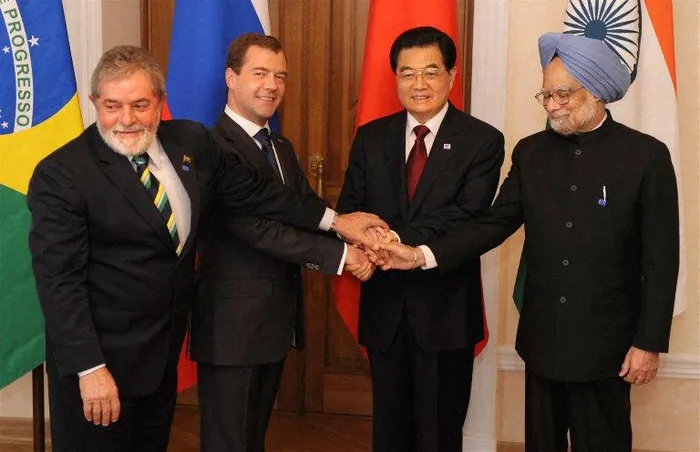
(From left) Presidents Luiz Inacio Lula da Silva of Brazil, Dmitry Medvedev of Russia, Hu Jintao of China, and Indian Prime Minister Manmohan Singh during a group picture shoot in Yekaterinburg on June 16, 2009 at the BRIC (Brazil, Russia, India, China) leaders summit. Leaders from the world's top emerging economic powers met for their first summit to plot a strategy to increase their clout amid the global crisis.
Image: AFP
Ashraf Patel
When Goldman Sachs’ Jim O Neil coined the term BRIC in 2009, his frame of reference was emerging market destinations that were attractive for global capital investment from the North.
In 2009, Brazil, Russia, India and China hosted an inaugural summit where the acronym BRIC was adopted. South Africa joined the organisation in September 2010, and the bloc was renamed BRICS.
Today, these nations are co-shaping geoeconomics, globalisation and geopolitics. At the time, China was a regional power; today, it is the largest economy and exporter in the world, with a GDP larger than the combined economies of the BRICS core nations.
Above all, the story of BRICS is the story of Global South nations whose aspirations date back to the Non-Aligned Movement (NAM) and G77 in the early days of Decolonisation. The New International Economic Order (NIEO) articulated an alternative model of development oriented toward transforming the colonial division of labour through industrialisation, productive diversification, economic sovereignty, and practices of restitution for centuries of colonial exploitation and resource drain.
The BRICS main purpose is to promote the transformation of the global governance system established after World War II through the reform of traditional financial institutions such as the International Monetary Fund (IMF) and the World Bank.
It also seeks to contribute to the construction of a multipolar order that reflects the distribution of power in the twenty-first century and offers greater decision-making power to countries.
This moment of multipolarity has generated new IR concepts - Multilateralism, Non-Alignment, ‘Middle Powerdom’, and Strategic Autonomy. But make no mistake, beyond these postures, it is ‘core national interests’ that drives nations states engagement in international relations.
Brazil’s 2025 BRICS Chairmanship put much emphasis on developing common approaches. In a period of rapid transformation of the world order, this is one of the most important tasks.
During Brazil’s chairmanship, the member countries managed to agree and form a common position on a wide range of issues: from the development of cross-border payment systems to combating the consequences of climate change and global governance of artificial intelligence. However, the path to common approaches was not without challenges.
Here, China is the outlier as it has successfully established the Development State model - aka the Beijing Consensus, which has trumped the Washington Consensus. Backed by technology and investment, its 5-year plan iterations have seen the most remarkable growth and development, uplifting 600 million out of poverty into middle-class status.
By contrast, all other BRICS nations had effectively adopted neo liberal policies in the 1990s as prescribed by the WTO. Subsequently, they become net importers of FDI from the G7 core. This model of extractive FDI and IP-driven MNC investments has drained flows from BRICS and G77 towards the North.
Ironically, Russia’s resurgence and contest with the West has seen sanctions, and with the Ukraine war has pushed it to adopt a national development pathway delinked from globalisation. Today, its currency is stabilised, and it has generated significant surpluses.
Contradictions or Convergence
The current escalation and contest in the Middle East between the UAE and Saudi Arabia is an example of divergence on key issues. UAE’s intervention in Sudan violates the UN and AU's Silencing the Guns initiative, yet it was invited to South Africa’s G20 summit in 2025.
India’s embracing of Israel as an ally is generally opposed by the Non-Aligned Movement NAM) and Hague Groups consensus on Palestine and Western Sahara solidarity, of which South Africa is a key player.
Martha Fernanzdez of IPEA Brazil, a leading think tank in Brazil, says:
For example, Brazil has consistently called for the democratisation of the Security Council and has pressed for the inclusion of the issue in BRICS declarations. However, when the time came to expand the number of full BRICS members beyond the original five, Brazilian diplomacy showed hesitation, fearing that expansion could transform BRICS into a new G77, create coordination problems, hinder consensus, and reduce Brazil’s influence within the grouping. ( February 2026)
A bridge between G20 and G77 or a bridge too far?
In an era of deepening multilateralism and multipolarity and the rise of Trumpism and narrow nationalism in the North, the BRICS nations’ institutional capacity and geopolitical influence have seen the bloc moving towards a position of equivalence within the G20. BRICS nations have been co-shaping the G20 core agenda for several years.
Many of the themes from the G20 are similar to the BRICS agenda, with Brazil’s leadership at UN COP 30 in Belen and South Africa's G20’s sustainability, solidarity and inclusion agenda are examples of BRICS anchoring the UN Pact for the Future agenda.
The G77 demanded equity in international trade rules, resulting in the inclusion of Special and Differential Treatment (SDT) in their constitutive agreements. SDT constituted an important victory for these countries, as it recognised that the post-war order was asymmetric, requiring greater flexibility, time, technical support, and capacity-building for developing countries to implement trade agreements. Notions of NDCs at UN COP processes are another.
The big challenge is how BRICS will use geopolitical weight to ensure the masses of G77 - and humanity to have a fighting chance for a fairer world order. Herein lies the biggest challenge for genuine multilateralism.
While the G7, G20 and BRICS are the apex of international institutions co-shaping the UN, they dominate a plethora of regional forums that shape global norms, the bottom billions of the G77 bear the real brunt of trade wars, climate risk, war, civil wars, youth unemployment, AI risks, and health pandemics.
In the midst of Trump 2.0 trade wars in 2025, BRICS nations have acted individually rather than as a bloc, each nation-state negotiating individually. Sigh. For instance, India has opted for a mega India EU free trade agreement, while the Chinese approach has been strategic trade deals per G7 country, as French, Canadian, UK and German leaders visiting China in the past several weeks.
This mega Chinese market offers a massive opportunity for all nations to export, and this ‘holy grail of international trade’ is being unlocked. Fortunately, China has agreed to duty-free access to all African nations, a huge boost.
Martha Fernandez further unpacks:
Ironically, today BRICS has become one of the main defenders of a rules-based international order—albeit one that is qualified, reformed, and democratised. In BRICS declarations, we find support for sovereignty and territorial integrity, multilateralism, the centrality of the United Nations, and a rule-based multilateral trading system.
Whither the WTO or new green shoots?
If BRICS nations are now engaging in a myriad of free trade agreements, what does this fact mean for the WTO? It should be noted that the decline of the G77's influence goes back to the ill-fated Doha Development Round of 2004, which failed, and since then, the G77 has been in limbo.
Will BRICS nations ensure the Doha round is maintained and the core issues of trade, agriculture, and digital economy are developed in line with the UNCTAD agenda of equity, fairness, justice and emancipation?
And as BRICS core nations gains more currency, quotas and votes in the IMF and World Bank, what does that mean for the alternative world economic order? Would it mean a converging capitalist consensus within the G20 (G7, EU and BRICS)? Or will BRICS genuinely transform these institutions and revert to its original mission to serve the broader G77 and core Global South agenda as envisaged by the founding fathers and mothers of NAM and UNCTAD in the 1960s?
As famous development economist Ha Joo Chung observes - Kicking down the Ladder or pulling up the Ladder for the Global South? Will the BRICS bloc step up to this monumental historical task?
* Ashraf Patel is a Senior Research Associate at the Institute for Global Dialogue, UNISA.
** The views expressed do not necessarily reflect the views of IOL, Independent Media or The African.