Renaming the University of the Western Cape: The Case for Allan Boesak University
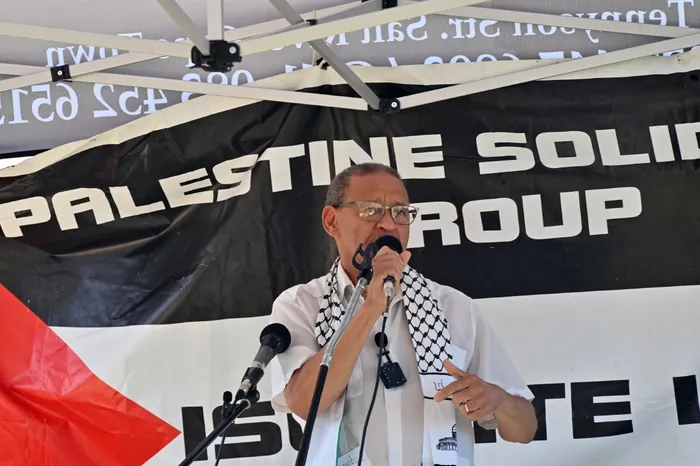
Cleric and anti-apartheid activist Dr. Allan Boesak addressing a Palestine solidarity rally in Salt River, Cape Town on October 22, 2025. To rename UWC the Allan Boesak University is to affirm prophetic courage, intellectual integrity, gender justice, and transformative imagination, says the writer.
Image: Ayanda Ndamane/ Independent Newspaper
Dr Clyde N.S. Ramalaine
History does not permit stillness. It unsettles, disrupts, reforms, and renews. Change is not merely an accident of time; it is the architecture of existence. Institutions, like nations and persons, are compelled to evolve or risk irrelevance.
Within this philosophical, historical, and ethical consciousness, The Thinking Masses South Africa Foundation (TMoSAF), which I was privileged to found and lead, advances a coherent argument for renaming the University of the Western Cape (UWC) in honour of Dr Allan A. Boesak.
This proposal is neither emotional indulgence nor symbolic opportunism. It rests upon a deeper claim: change is not only inevitable but constitutive of institutional legitimacy. It is the grammar of both being and becoming.
Change as Ontological and Institutional Reality
From ancient metaphysics to contemporary critical theory, permanence is an illusion. Institutions are historical processes; their legitimacy lies in reflexivity and ethical renewal. Universities, claiming intellectual leadership, must embody this principle rigorously.
To refuse transformation is complicity in inherited injustice. South Africa’s unfinished democratic project compels institutional interrogation. Names, symbols, and identities are not cosmetic; they function as repositories of power, belonging, exclusion, and memory. They shape epistemic horizons, determining whose knowledge is legitimised and whose histories are marginalised.
The question before UWC is not whether change will occur, but whether it will be reactive or intentional, imposed or ethically chosen, superficial or transformative. Leadership must interrogate the moral, social, and political semiotics embedded in the university’s very name.
UWC: A Chronology of Transformation and Intellectual Self-Interrogation
UWC has never been static. Founded in the 1960s as a “Bush College,” it served those racially classified under apartheid laws. Its birth was explicitly political, constructed to stabilise racial hierarchy and epistemic control. From inception, the institution existed within a field of power rather than academic neutrality.
The 1970s brought rupture. Influenced by Steve Biko and the Black Consciousness Movement, students and scholars rejected apartheid’s racial taxonomy. Identity was reconstituted through solidarity; knowledge was reoriented toward liberation. Professor Richard Ernest van der Ross, affectionately “Dickie,” became UWC’s first Black Vice-Chancellor (1975–1986), guiding the institution through transformative resistance.
Professor Jaap Durand, Vice Rector from 1981, contributed to academic and physical planning during the turbulent 1980s, a period when UWC deepened its opposition to apartheid.
Under Professor Jakes Gerwel, UWC became the “intellectual home of the Left,” shaping discourse and resistance. Its contribution to the democratic transition was not limited to activism but extended to epistemic resistance.
The democratic era saw infrastructural expansion and global repositioning under Professor Brian O'Connell. Subsequent leaders, including Professor Tyrone Pretorius and Professor Robert Balfour, consolidated governance and academic excellence.
This chronology demonstrates that transformation is not episodic but embedded in UWC’s structural DNA. Renaming the institution would continue, rather than rupture, its ethical trajectory.
The Myth of Neutrality: The Political Grammar of “Western Cape”
The name University of the Western Cape appears geographical, yet geography in South Africa is never neutral. Provinces are constructed narratives embedded in political power.
The Western Cape is framed through a discourse of exceptionalism under Democratic Alliance governance, portraying administrative and economic superiority. Yet inequality persists. Townships and working-class communities remain excluded from prosperity.
Coalition politics by the African National Congress further complicates this terrain. Elite mobility, investment, and political behaviour contribute to the perception that the Western Cape represents an alternative national imagination.
UWC, bearing this name, cannot remain silent. Silence tacitly endorses narratives that risk fragmenting national consciousness. Leadership must articulate what “Western Cape” signifies in this contested socio-political discourse.
The Gendered Anomaly: Patriarchal Continuities in a Progressive Institution
Despite its progressive ethos, UWC has never had a woman Vice-Chancellor. This absence is structural, revealing that even spaces committed to transformation reproduce patriarchal authority. Women’s empowerment appears conditional, mediated through male-dominated structures.
This reflects a broader paradox in post-apartheid institutions: equality rhetoric often masks persistent hierarchies. Intersectionality demands that race and class analysis be accompanied by gender critique. Without it, transformation remains incomplete.
Renaming UWC in honour of Allan Boesak must coincide with renewed commitment to gender justice. Ethical continuity requires both symbolic and practical institutional transformation.
The Theological Anomaly: The Loss of the Faculty
UWC’s Theological faculty migrated to Stellenbosch University, a shift with deeper significance. Theology at UWC was historically radical, embodying liberation, critical consciousness, and public ethics. It shaped anti-apartheid discourse and the intellectual foundations of democratic South Africa.
The relocation raises questions: does it signal domestication of the institution’s intellectual tradition or dispersion of its moral voice? This anomaly underscores that renaming is not merely symbolic but part of a broader ethical reclamation restoring prophetic imagination to UWC’s identity.
Not a Contestation of Names and Affirming Collective Contribution
TMoSAF’s proposal is not a contestation of names nor an opportunistic retrospective nomination. Its intent is ethical clarity, not competitive symbolism.
The proposal does not negate the contributions of all who have shaped UWC, from cleaners and administrators to scholars and the Vice-Chancellor’s office. Institutional honouring is not zero-sum; it recognises collective labour, sacrifice, and belonging.
Proposal for Renaming UWC to Allan Boesak University
The proposal coincides with Dr Boesak’s 80th birthday, offering UWC an opportunity to honour a living scholar-activist whose influence shaped the institution and South African society.
Dr Boesak’s engagement with UWC spans decades, influencing generations of students, faculty, and civic leaders. During the critical resistance years of the 1980s, his work helped consolidate UWC as a centre of academic excellence, critical consciousness, and social justice activism.
Internationally, Dr Boesak’s leadership as President of the World Alliance of Reformed Churches positioned him as a global voice in liberation theology, human rights, and faith-based advocacy. Recognition carries national and global significance.
Renaming the University would be a principled, historically grounded acknowledgement of measurable contributions: intellectual mentorship, ethical leadership, social justice scholarship, and sustained civic engagement. Such recognition strengthens UWC’s reputation as an institution enshrining living legacies of justice, linking liberation struggle ethos to ongoing knowledge production and ethical leadership.
Renaming to Allan Boesak University enshrines ethical continuity. His name represents justice, inclusion, intellectual courage, and global relevance. From apartheid creation to liberation, from resistance to excellence, UWC has always transformed. This renaming represents the next stage in that continuum, aligned with institutional responsibility to interrogate its name and context.
A Moment of Ethical and Institutional Courage
UWC stands at a decisive historical moment. Its past demands courage; its present demands clarity; its future demands vision.
The proposal addresses political identity, gender justice, intellectual heritage, and moral continuity. It challenges the University to embody its proclaimed values. Leadership must articulate what “Western Cape” signifies in a space where narratives of exceptionalism and division threaten national discourse. Silence or presumed neutrality is no longer acceptable; ethical responsibility compels active articulation.
Change is inevitable. History confirms it. Ethics requires it. UWC has never been static. Today, it faces another moment of renewal. To rename the institution Allan Boesak University is to affirm prophetic courage, intellectual integrity, gender justice, and transformative imagination.
The time has come. Change is inevitable, but moral clarity is intentional. UWC leadership owes it to history, students, and the nation to explain what the name “Western Cape” means in this epoch. Silence is no longer an option.
* Dr Clyde N.S. Ramalaine is the Founder and Project Leader for the UWC Name Change to Allan Boesak University Campaign.
** The views expressed do not necessarily reflect the views of IOL, Independent Media or The African.