Godongwana's Moment of Reckoning In Reversing Economic Fragility
BUDGET 2026 PREVIEW
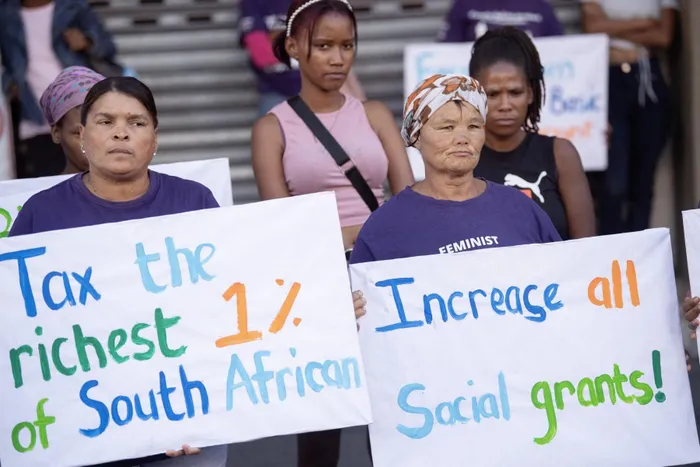
Activists from unions, farmworker associations, gender organisations and other civil society groups protest outside Parliament ahead of Finance Minnister Enoch Godongwana's budget speech on March 12, 2025. The Budget must function as a decisive instrument for restoring public confidence and strengthening institutional performance, says the writer.
Image: AFP
Zamikhaya Maseti
The Minister of Finance, Enoch “Madiba” Godongwana, will deliver the 2026 Budget Speech on Wednesday, February 25. Traditionally, the Budget Vote follows the President’s State of the Nation Address.
It is through this constitutional instrument that the strategic priorities articulated by the President assume material and financial expression. The Budget therefore stands as the most concrete expression of the democratic State’s strategic intent, revealing whether government possesses both the will and institutional capacity to mobilise national resources toward economic expansion, social stability, and the advancement of the material conditions of the South African people.
Madiba rises to deliver this Budget at a moment defined by both fragility and possibility. Statistics South Africa has confirmed that real GDP growth expanded by 0.5 per cent in the third quarter of 2025. This modest expansion confirms that the economy has not descended into contraction, yet it also affirms that growth remains weak and insufficient to absorb the millions of South Africans who remain excluded from productive economic activity.
This reality affirms that the central task before the democratic State is not merely to preserve stability, but to decisively accelerate economic expansion and reposition the economy onto a higher growth trajectory.
Equally revealing are the most recent employment figures released in the Quarterly Labour Force Survey of the fourth quarter of 2025. The official unemployment rate declined marginally to 31.4 per cent, reflecting a modest increase in employment and a corresponding reduction in the number of unemployed persons. While this improvement offers a measure of encouragement, it does not alter the deeper structural crisis confronting the economy.
Millions remain outside the productive economy, unable to participate meaningfully in the processes of production, accumulation, and economic advancement. The persistence of this condition reflects the enduring structural weaknesses of the economy and reinforces the urgency of decisive State intervention.
It is within this context that the 2026 Budget assumes historic importance. We expect this Budget not to degenerate into a terrain of political contestation and ideological brinkmanship among the partners of the Government of National Unity, as was the case during the passage of the 2025 Budget.
The confrontation that accompanied the previous Budget introduced damaging fiscal uncertainty and disrupted the predictability of intergovernmental fiscal transfers. Provincial governments experienced constraints in executing their constitutional mandates, while local governments faced mounting difficulty in sustaining basic service delivery. Such instability weakened the operational coherence of the State and undermined public confidence in democratic governance.
Accordingly, the National Treasury must present a Budget anchored in fiscal certainty, strategic discipline, and developmental clarity. This necessarily requires the identification of sustainable and reliable revenue streams, particularly within the context of slow economic growth, which constrains revenue mobilisation. Certain sectors and sections of society may inevitably bear the burden of tax adjustments.
However, these decisions must be guided by the imperative of strengthening the developmental capacity of the State while safeguarding the productive foundations of the economy.
The South African Revenue Service continues to serve as a critical pillar in safeguarding the fiscal sovereignty of the Republic. SARS has demonstrated remarkable institutional resilience, collecting approximately R1.74 trillion in gross tax revenue during the 2024 to 2025 fiscal year. This achievement affirms the restoration of institutional integrity and administrative effectiveness following the deliberate weakening of the institution during the years of State Capture.
SARS must now intensify its work in identifying, seizing, and reclaiming assets acquired through corruption and economic criminality. The reclamation of these illicit resources represents a decisive assertion of State authority and a necessary intervention to restore public confidence and redirect stolen wealth toward national development.
The 2026 Budget that Godongwana will deliver must address the hopes and aspirations of the masses of the South African people. It must confront directly the visible decay of public infrastructure, which continues to undermine both economic productivity and social stability.
Across the Republic, road infrastructure has deteriorated to unacceptable levels. Potholes have become a permanent feature of national roads, provincial routes, municipal streets, and rural access roads. This deterioration is not merely an inconvenience. It represents a systemic weakening of the State’s developmental capacity and imposes high costs on households, businesses, and the broader economy.
In rural areas, the collapse of infrastructure continues to reinforce patterns of historical exclusion. Communities remain physically isolated from economic centres, limiting their ability to participate in economic activity and perpetuating structural underdevelopment.
The electricity crisis continues to impose severe constraints on economic expansion, disrupt productive activity, and weaken investor confidence. The water crisis presents an even more disturbing reality, with many communities deprived of reliable access to water due to collapsed infrastructure and institutional failure.
Therefore, the 2026 Budget must be deliberately repurposed toward the stabilisation and reconstruction of local government. Local government represents the most immediate institutional expression of the democratic State. Its effectiveness determines whether citizens experience the State as a functional and responsive institution or as a distant and ineffective abstraction.
The Budget must equip municipalities with the institutional capacity required to execute their mandates effectively. This includes strengthening financial management systems, enhancing technical expertise, and ensuring that municipalities possess the operational capability to utilise their allocations fully.
The unacceptable culture of returning unspent allocations and conditional grants to the National Treasury must be decisively confronted. These resources are appropriated by Parliament to improve infrastructure, expand service delivery, and advance development.
Their return to the national fiscus represents institutional failure and administrative weakness. Mechanisms must be established to monitor municipal expenditure rigorously, strengthen accountability, and ensure that allocated resources translate into tangible developmental outcomes.
This imperative assumes heightened urgency in the context of the 2026 National Local Government Elections. These elections will represent a decisive moment in the democratic trajectory of the Republic. Citizens will assess whether democratic governance retains the institutional capacity to improve their material conditions.
The Budget must therefore function as a decisive instrument for restoring public confidence, strengthening institutional performance, and demonstrating the continued relevance of the democratic State.
Madiba, the responsibility that rests upon your shoulders is historic. The decisions you take in this Budget will shape the future trajectory of the Republic. They will determine whether the State succeeds in restoring infrastructure, strengthening local government, and repositioning the economy toward sustained growth and development.
The South African people look to this Budget with expectation and hope. They expect decisive leadership. They expect strategic certainty. They expect the democratic State to assert itself as the primary instrument for advancing their material progress and securing their collective future.
* Zamikhaya Maseti is a political economy analyst and holds a Magister Philosophae(M.Phil) in South African Politics and Political Economy from the erstwhile University of Port Elizabeth, now Nelson Mandela University.
** The views expressed do not necessarily reflect the views of IOL, Independent Media or The African.