SONA 2026: The Need for Radical Change in SA's Economic Trajectory
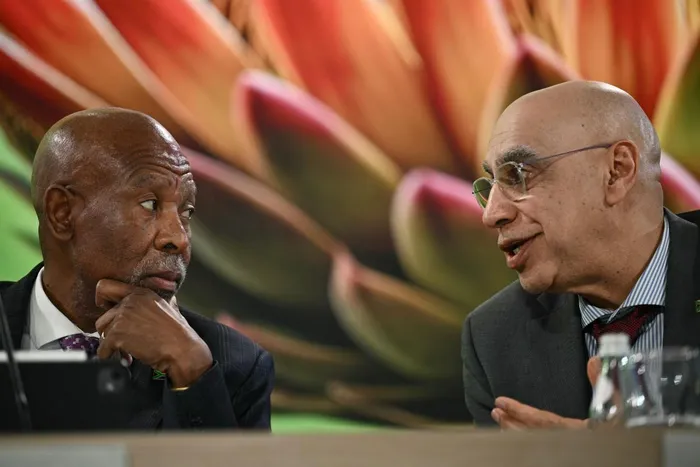
Lesetja Kganyago (right), Governor of South Africa's Reserve Bank (SARB) and his Deputy Dr Rashad Cassim speak at a G20 briefing during the IMF/World Bank annual meetings held in Washington, DC, on October 16, 2025. Government's continued adherence to orthodox IMF liberal prescriptions appears increasingly detached from reality, says the writer.
Image: AFP
Dr Thanti Mthanti
Another Ramaphosa State of the Nation Address has come and gone.
Once again, he offered measured assurances, familiar commitments and renewed faith in IMF-supported reforms. We have heard these lies before, and the gap between promise and delivery continues to widen.
South Africa, under the former liberation movement and its GNU partners, is not short of plans. It is short of revolutionary morality and radical economic transformation.Under Ramaphosa and the GNU, governance has been reduced to crisis management.
Energy systems are deliberately collapsed, and “private sector” participation reforms are announced. Logistics deteriorate, and “partnerships” with the private sector are unveiled. Municipalities fail, and “trading services” task teams are deployed. Each self-created emergency is framed as renewal; each partial stabilisation is presented as progress, whereas the genuine agenda is plunder.
Theft of state assets is not a radical economic transformation. Besides greed, the deeper problem lies in the former liberation movement’s pursuit of neoliberal economic orthodoxy at a time when the liberal global order itself is dead.
Ramaphosa continues to anchor policy in fiscal restraint, market signalling and investor reassurance, and open markets as though global conditions remain unchanged. They are not. The geopolitical landscape has shifted decisively. The re-emergence of economic nationalism, state-led industrial policy and strategic protectionism across major economies, particularly the United States, signals the decline of the liberal global consensus.
The rhetoric and policies associated with nationalistic figures such as Donald Trump did not create this shift; they accelerated and made explicit an existing realignment. Major global powers now openly prioritise domestic industry, supply-chain sovereignty and strategic technology control.
In this context, our continued adherence to orthodox IMF liberal prescriptions appears increasingly detached from reality. Ramaphosa’s attempt to pursue incremental reform within a collapsing liberal global framework is not prudence — it is stupidity.
The central national question remains race and ownership: Who owns the land? Who controls productive assets? Who commands technology? Until we prioritise all the people in the country and these questions are addressed decisively, unemployment and racialised inequality will persist regardless of how often so-called “investment summits” are convened.
The MK party’s radical economic transformation is therefore not ideological excess. It is a structural necessity, and land reform must sit at the centre of this agenda. We recognise that the land question is foundational and economic, not merely symbolic. Land determines collateral, production and spatial justice.
Historical dispossession of the African majority stripped millions of our people of productive leverage and access to the money supply. Without meaningful access to agricultural, urban and industrial land, African participation in the economy will remain at the margins. Yet our economy can only grow when more, not less, of our population is involved in gainful economic activity.
However, land expropriation and redistribution, which were hardly mentioned in Cyril Ramaphosa’s SONA, alone are not sufficient. Land reform must be productive. Beneficiaries require financing, infrastructure, and integration into value chains. Agricultural reform must connect to agro-processing and food manufacturing. Urban land reform must unlock township industrialisation and construction-led growth.
Land without production is symbolism; land with production is radical economic transformation.Equally urgent are technological upgrades. We continue to export raw minerals to the West and East while importing high-value manufactured goods derived from those same resources. Beneficiation is discussed, implementation fails, and the manufacturing decline accelerates.
This is not accidental; it is a structural dependency encouraged by the former liberation movement that has lost its revolutionary morality. Technological capability must become the organising principle of economic policy. Industrial strategy, higher education, research institutions and state procurement must align around targeted sectors.
Engineering capacity, advanced manufacturing and strategic technologies cannot emerge organically in a structurally unequal economy; they require coordinated state leadership and disciplined execution.
As the MK party, we recognise that energy policy must support industrial ambition. An advanced economy requires reliable baseload power alongside grid strengthening. Industrial transformation cannot be built on parasitic IPPs and uncertainty. Eskom must be protected and strengthened.Financial sovereignty is equally critical.
Overreliance on Western capital markets constrains policy space, and the IMF prioritises short-term fiscal optics over long-term structural investment. Domestic capital mobilisation, financial repression and strengthened development finance institutions are essential if South Africa is to pursue genuine economic independence.
Under the MK party, the domestic financial sector will be under political control, and it will pursue developmental priorities.The unemployment crisis underscores the urgency. Millions of young people remain excluded from meaningful economic participation, with youth unemployment over 60%. Incremental reform within a declining liberal framework will not resolve this structural emergency.
We stand at a crossroads.
We can continue managing decline like Ramaphosa through cautious IMF orthodoxy, or we can recognise that the global order has shifted and respond with bold, imaginative and decisive action.Resilience without restructuring preserves inequality. Reform without redistribution preserves racialised ownership patterns. Stability without sovereignty preserves colonial dependency on the parasitic West.
The MK party’s radical economic transformation — centred on productive land reform and strategic technological upgrades— will contribute to a prosperous South African society. It is the only credible pathway toward restoring African dignity by creating employment, sustainable growth and genuine economic sovereignty.
The real question is not whether transformation is radical. The real question is whether the former liberation movement, together with its GNU partners, is not committing a far greater error by clinging to failed neoliberal orthodoxies.
* Dr Thanti Mthanti is the Chairperson of the Economic Transformation Committee of the MK Party.
** The views expressed do not necessarily reflect the views of IOL, Independent Media or The African.