China's Zero-Tariff Policy: A Game Changer for Africa's Trade
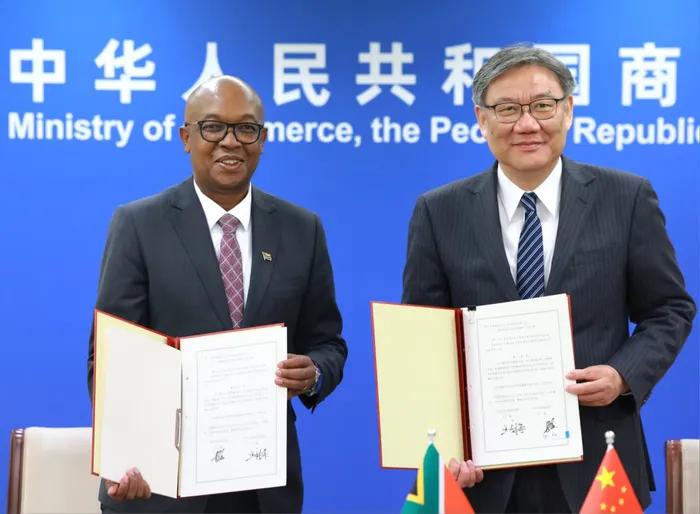
Minister of Trade, Industry and Competition Parks Tau (left) and China’s Minister of Commerce, Wang Wentao, following the signing of a China–Africa Economic Partnership Agreement (CAEPA) on February 6 in Beijing. The landmark deal is set to grant South African exports duty-free access to the Chinese market while boosting investment into country's economy.
Image: DTIC/X
Prof. David Monyae
Chinese President Xi Jinping on Saturday sent a congratulatory message to Joao Lourenco, rotating African Union (AU) chairperson and Angolan president, and Mahamoud Ali Youssouf, chairperson of the AU Commission, extending warm congratulations to African countries and people over the 39th African Union Summit.
In a changing and chaotic world, Xi Jinping reaffirmed China’s steadfast commitment to world peace, shared development, and a community with a shared future for humanity. President Xi announced that from May 1, Beijing will roll out comprehensive zero-tariff treatment for exports from all 53 African nations with diplomatic ties, while pushing economic partnership agreements, upgrading "green lanes" for smoother trade, and broadening market access.
The consistency and upward trend of China’s trade policies, particularly with Africa, fulfil China’s promise for a fair global trade system. These latest steps to expand China's high-standard opening up will unlock new opportunities for Africa's development and the two sides' joint pursuit of modernisation.”
China and Africa are building stronger trade ties at a time when the world needs real partnerships more than ever. As multilateralism seems to falter amid weakening global institutions and a wider North-South divide, China is pursuing common development by working together with countries in the Global South.
The Global South is gaining strength amidst once-in-a-century geopolitical transformations sweeping across the world. The recent trade deals, like the one between South Africa and China, show how openness and cooperation can lift both sides. These policy positions align with Africa's development goals and China's smart plans, creating jobs, growth, and new tech across the continent.
Trade between China and Africa hit $282 billion in 2023 and keeps growing, with South Africa as the leading African trade partner. In 2024, their trade reached $34.18 billion, accounting for nearly 12% of China's total trade with Africa.
On February 6, South Africa's Trade Minister Parks Tau and China's Minister of Commerce, Wang Wentao, signed the Framework Agreement on Economic Partnership for Shared Development (CAEPA) in Beijing. This deal provides for South Africa’s stable zero-tariff access under WTO rules, plus investment opportunities.
Soon after the CAEPA deal, China announced zero tariffs on all goods from 53 African countries with diplomatic ties under the "Pre-early Harvest" description. This deal opens China's huge market to African exports like minerals, farm goods, and processed items. It marks the end of tariffs on African goods. African farmers, manufacturers, and miners can now sell more easily, boosting incomes and jobs back home.
These developments are not accidental. They are the result of decades-long planning and execution that are bearing fruit. China's growth story inspires Africa and encourages partnerships and collaboration. Over 70 years and 14 Five-Year Plans, China turned from a closed economy into a tech and green powerhouse. It lifted millions out of poverty with bold plans, factories, and roads.
Africa can draw several lessons, learn and build on China’s experience through collaboration. China's 15th Five-Year Plan (2026-2030) focuses on trade openness, green tech, AI, and digital growth. In the 15th FYP, Beijing has committed to continuing to promote an open international economic system through supporting a stable multilateral trading system.
Africa’s own development blueprint, Agenda 2063, puts trade at the heart of development. It aims to double intra-African trade, add value to raw materials, and build factories. The African Continental Free Trade Area (AfCFTA) is a key node aiming for a single market for 1.4 billion people.
A continental commodities strategy promotes industrialisation by adding value to raw materials, fostering regional value chains, and minimising export dependency on unprocessed goods. It’s intended to cut barriers and link supply chains.
South Africa's Medium-Term Plan (2024-2029) pushes AfCFTA too, fixing high trade costs and weak competitiveness. It strategically anchors BRICS+ for the Global South common development agenda. China's zero tariffs and investments support this goal.
These ties help Africa dodge global financial and economic headaches. China and South Africa’s trade negotiations come at a time of increasing geopolitical tensions and uncertainty. US tariffs hit South African exports at 31%, negatively influencing growth. China's openness gives breathing room. China makes 80% of the world's solar panels and battery cells in 2025. It produced 16 million electric vehicles, exporting $70 billion worth.
South Africa has platinum, manganese, chromium, and vanadium, which are perfect raw materials for batteries and clean energy. Chinese firms can build factories there, using AfCFTA to serve all of Africa. It represents an opportunity for South Africa to become the continent's green energy hub.
Moreover, the Yuan internationalisation speeds this process up. Africa's Finance Corporation (AFC) announced plans for a panda bond this year. This is expected to cut costs from 4% US rates to 1.8% Chinese ones. Afreximbank did one last year, followed by Egypt and Kenya. Kenya swapped $3.5 billion in dollar loans to yuan, saving $215 million annually. Zambia opted to take the yuan for taxes.
Lastly, Standard Bank joined China's CIPS for fast payments, and nearly 80% of China-Africa goods trade uses the yuan now. These developments safeguard against dollar swings, save fees, and build trust.
For Africa, it's a time of limitless opportunities. Exports grow, factories rise, skills spread. China's tech in AI, biotech, and climate tools can help Africa bypass the slow industrial build-up and utilise Chinese tech and expertise to drive local development through partnership and innovation. Joint centres and training incubate local innovators.
Green infrastructure fights climate change while creating jobs. Africa’s development plans, like Agenda 2063 goals with value chains integration and free movement of goods, get a boost.
South Africa shows the model. As the BRICS chair, it builds Global South ties. It supports reform of international organisations and trade rules, lifting investor barriers in manufacturing, and zero tariffs for least-developed countries, among other progressive measures. This alignment draws Chinese investments into electric vehicles (EVs) and solar.
However, challenges exist. Africa must build capacity, build better road networks, talent management, skills development and high development standards to grab opportunities. It should also avoid over-reliance and diversify partners to sustain real multilateralism and push local content in deals, just like China did and turn visions into results. Geopolitics adds urgency, and as China-US tensions reshape chains, Africa gains leverage as a bipartisan and open trade partner.
In sum, China-Africa trade is mutually beneficial as China pursues common development, not dominance. Its zero tariffs and trade policies unlock markets, and the Yuan tools cut risks and costs. Chinese Tech and green synergies drive Agenda 2063.
South Africa's CAEPA leads; others follow. As Xi says, pursue modernisation together. This partnership turns challenges into progress. Africa rises not alone, but hand-in-hand with friends like China.
* Prof. David Monyae is the Director of the Centre for Africa – China Studies at the University of Johannesburg.
** The views expressed do not necessarily reflect the views of IOL or Independent Media.