A Political Intervention To Restore The State's Institutional Credibility
SONA 2026
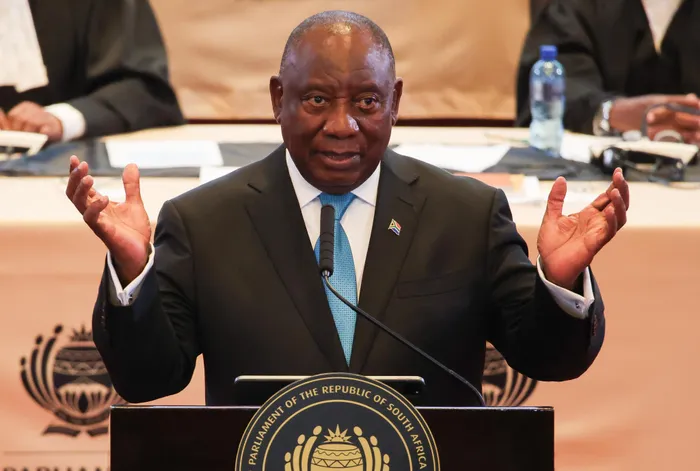
President Cyril Ramaphosa delivering the State of the Nation Address (SoNA) at a joint sitting of Parliament on February 12.
Image: GCIS
Zamikhaya Maseti
The President delivered his State of the Nation Address with composure and a deliberate sense of historical awareness. He sought to present what his government considers to be the real state of the South African nation, situating the present moment within a broader continuum of struggle, recovery, and renewal.
His address was, in essence, a political intervention designed to reassure citizens, restore confidence in the state, and signal that South Africa has entered a phase of stabilisation following a prolonged period of institutional erosion, economic stagnation, and declining public trust.
It was an attempt to project authority, continuity, and resolve at a moment when both citizens and markets remain uncertain about the durability of the country’s economic recovery.
At the centre of the address lies a carefully assembled narrative of recovery. The President asserts that economic growth has resumed, inflation has stabilised, and the foundations for renewed investment have been laid. This narrative is neither accidental nor rhetorical ornamentation.
It represents a conscious effort to restore the legitimacy of the democratic state as the primary organiser of economic life and the guarantor of stability. In political economy terms, it reflects a state seeking to rebuild its institutional credibility after a decade during which governance failures weakened its authority, eroded public trust, and undermined economic confidence.
Yet beneath this narrative lies a deeper structural reality which cannot be concealed. The President himself acknowledged that unemployment, poverty, and inequality remain deeply entrenched features of South Africa’s socio-economic landscape. These outcomes are not temporary disruptions. They are structural consequences of an economy whose productive base remains narrow, capital-intensive, and insufficiently labour-absorbing.
The fundamental crisis confronting South Africa is therefore not merely one of recovery, but one of structural transformation. An economy that grows slowly cannot absorb labour. An economy that fails to absorb labour cannot resolve unemployment. An economy that cannot resolve unemployment cannot sustain long-term social and political stability without risking deeper systemic fractures.
The absorptive capacity of the South African economy is inseparable from its growth trajectory. Without sustained expansion above current levels, the economy will continue to reproduce exclusion and perpetuate structural unemployment.
Economic growth must therefore be accelerated deliberately and strategically. This requires interventions that expand productivity, extend participation, and unlock new sources of employment creation.
One such intervention is the deliberate construction of a day and night economy, modelled on the Dubai economic architecture. Dubai has demonstrated that extending economic activity across a continuous twenty-four-hour cycle increases productivity, strengthens investment flows, and significantly expands employment opportunities.
South Africa possesses the infrastructure, financial system, and urban base necessary to implement such a model, provided the state acts with coordination, discipline, and strategic clarity. This would require rethinking urban planning, improving public transport safety, and aligning municipal governance with national economic objectives to support continuous economic activity.
South Africa must also draw lessons from within the African continent itself.
Rwanda has demonstrated how institutional discipline, policy certainty, and strategic leadership can sustain high levels of economic growth over extended periods. Namibia, closer to South Africa both geographically and structurally, has achieved growth of approximately four per cent through targeted investment in mining, energy, and logistics. These examples illustrate a fundamental political economy principle.
Economic transformation is neither accidental nor inevitable. It is the outcome of deliberate policy execution, institutional credibility, and sustained strategic leadership. Countries that grow consistently do so because their states act decisively to remove constraints, mobilise investment, and align institutional capacity with national development objectives.
In contrast, the International Monetary Fund projects South Africa’s economic growth at a mere 1.4 per cent in 2026. This projection stands in sharp contrast to the recovery narrative articulated by the President. It is a reflection of the structural constraints that continue to suppress economic expansion.
Growth at such levels is insufficient to absorb labour, insufficient to transform the productive structure of the economy, and insufficient to alter entrenched patterns of inequality. It confirms that the South African economy remains trapped in a low growth equilibrium from which it cannot escape without decisive and sustained intervention.
Low growth weakens fiscal capacity, constrains social spending, and reduces the state’s ability to invest in infrastructure, education, and industrial expansion, thereby reinforcing the cycle of stagnation.
Economic recovery will not emerge spontaneously from favourable, hopeful projections. It must be constructed deliberately through sustained structural reform, institutional discipline, and strategic economic intervention. This requires dismantling the structural constraints that weaken productivity, undermine confidence, and suppress investment. It also requires institutional reforms.
The President must give serious consideration to disbanding the National Planning Commission and reassessing the continued relevance of the National Development Plan(NDP), whose growth assumptions have been overtaken by empirical reality.
The projection of five per cent growth by 2030 no longer reflects the material conditions of the South African economy. Economic planning must therefore be grounded in realism, measurable execution, and institutional capability rather than aspirational projections detached from structural realities.
Equally significant is the President’s commitment to confront corruption and restore institutional integrity. Corruption is not merely an ethical failure. It is a structural constraint on economic growth. It weakens institutions, deters investment, and undermines the credibility of the State.
The Corruption Perceptions Index assigns South Africa a score of 41 out of 100, reflecting persistent institutional vulnerability and governance risk. Investors interpret corruption as a signal of instability and policy uncertainty.
Without institutional credibility, investment will remain subdued and economic recovery will remain fragile. The restoration of state integrity is therefore foundational to economic recovery. A capable State inspires confidence. A credible State attracts investment. A disciplined State creates the conditions necessary for sustained growth.
The historic responsibility before the President is therefore unequivocal. He must act decisively against these heinous acts of corruption, for they constitute a direct obstacle to foreign direct investment and sustained economic growth.
Corruption distorts markets, weakens institutions, and signals to global capital that the rule of law is negotiable. There must therefore be no ambiguity in the application of justice. All those found guilty of corruption, whether minor officials or powerful elites, must face prosecution and imprisonment.
The era of impunity must come to an end. Only through decisive leadership, institutional discipline, and the restoration of state credibility can South Africa escape the low growth trap and reclaim the promise of economic transformation.
* Zamikhaya Maseti is a political economy analyst and holds a Magister Philosophae(M.Phil) in South African Politics and Political Economy from the erstwhile University of Port Elizabeth, now Nelson Mandela University.
** The views expressed do not necessarily reflect the views of IOL, Independent Media or The African.