SONA 2026: Ramaphosa's Message Of Hope Disconnected From Reality
STATE OF THE NATION ADDRESS
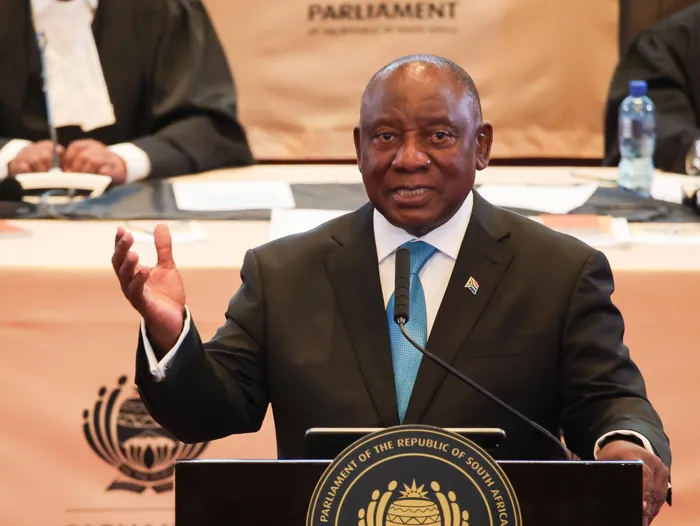
President Cyril Ramaphosa delivering the State of the Nation Address (SoNA) at a joint sitting of of Parliament in Cape Town on February 12, 2026. While the President may sincerely aim to inspire and satisfy, effective leadership requires more than good intentions, says the writer.
Image: GCIS
Dr. Reneva Fourie
It is genuinely difficult to be overtly negative when one watches the President and senses a man who is trying his best. He speaks the language of hope. He wants to be liked, trusted, and to reassure a country that has been battered by years of corruption, mismanagement, and deepening inequality. That intention matters. It resonates with a population desperate for leadership that feels human and sincere.
Yet it is precisely in this desire to appease everyone that a troubling subconscious bias reveals itself. In trying to balance all interests, the scales inevitably tilt in favour of those who already have power and resources. Once again, the rich get the meat, while the poor are expected to be grateful for the crumbs.
President Ramaphosa’s State of the Nation Address, delivered on 12 February, was notably different in tone and structure from the preceding ones. Gone was the long list of self-congratulatory achievements that often felt detached from the lived reality of ordinary South Africans. Instead, the President opted for an address that acknowledged frustration and pain.
He spoke about crime and the fear that has become a daily companion in many communities. He spoke about service delivery failures, particularly the indignity and hardship caused by unreliable water supply. He addressed the stagnant economy, the strain on the health system, the challenges in education and the devastating persistence of malnutrition.
There is value in that acknowledgement. A government that refuses to recognise suffering cannot hope to resolve it. By placing these issues at the centre of the address, the President signalled an awareness of the crises confronting the country.
It created the impression of an administration that understands the urgency of the moment and the depth of public frustration. However, empathy without substance quickly rings hollow. Once the speech moved from diagnosis to prescription, the familiar fault lines of policy and ideology became visible.
The influence of the Left within the Alliance aligned with the majority party was accommodated. Calls for an industrial policy were answered. The emphasis on developing labour-intensive sectors featured prominently.
A comprehensive social security net, long demanded by progressive voices, was presented. Indeed, the address outlined what could be described as the most expansive set of social security interventions since 1994. On paper, this appears transformative.
Yet when one looks beyond the headlines and into the details, the picture becomes far less reassuring. Despite the rhetoric, there is no truly meaningful intervention aimed at fundamentally addressing unemployment, poverty and inequality.
Social grants and short-term employment programmes, such as the Expanded Public Works Programme, the Community Works Programme and the Presidential Employment Stimulus package, while essential for survival, do not alter the structural conditions that produce mass unemployment. They manage poverty rather than eliminate it. They keep people afloat without offering a path to dignity and self-sufficiency.
The real instruments for development and job creation remain the state-owned enterprises. When the state acts as an employer and investor, particularly at the local level, it does more than create direct jobs. It stimulates surrounding economic activity, crowds in additional investment and strengthens community resilience. Infrastructure projects anchored in public ownership can anchor long-term development rather than short-term profit.
However, years of corruption and mismanagement have eroded public trust in these entities. That loss of faith has been weaponised to justify privatisation and the creeping corporatisation of the state. The argument is always the same. The state has failed, therefore the private sector must step in.
But this framing ignores the real problem. The failure was not inherent to public ownership. It was the result of deliberate corruption, political interference and weak accountability. Selling off public assets or outsourcing their core functions does not resolve these issues. It merely shifts power and wealth from the public sphere to private hands that are accountable only to shareholders.
Whether through build-operate-transfer models or public-private partnerships, the pattern is consistent. Private companies emerge as the primary beneficiaries. Yes, there may be downstream benefits for the public, but these are incidental rather than central. Private capital captures the lion’s share of value, while communities are left with higher costs and reduced control over essential services.
The energy sector offers a stark example. South Africa now has private sector participation across generation, distribution and transmission. The President proudly declared that the energy monopoly has been broken, presenting competition as an unqualified good. Yet the lived reality tells a different story.
The incentives that attracted independent power producers, particularly in renewable energy, could have been channelled into rebuilding Eskom as a public asset. Instead, fragmentation has driven up costs, limited expansion into less profitable areas, and weakened overall electricity security.
We should have learnt from our experiences with load shedding and the fragility of the system that it exposed. Introducing multiple private actors with profit-driven incentives further complicates coordination and long-term planning. If private companies decide that supply is no longer profitable or seek leverage through disruption, the entire country is placed at risk. Energy security is not a commodity. It is a cornerstone of national sovereignty.
The President’s discussion of water infrastructure was perhaps the most jarring. He spoke with apparent sincerity about the severity of the crisis and the urgent need for intervention. Yet his solution mirrored that proposed for rail and ports. Invite the private sector and create a new coordinating agency.
This sits uneasily alongside repeated commitments to austerity. Corporatising the state by creating additional agencies increases administrative costs and distances decision-making from communities. It is a continuation of the New Public Management doctrine that was already shown to be deeply flawed in the early 2000s.
Critical minerals and beneficiation present another missed opportunity. Rather than positioning the state as a leader in mining and value addition, with the potential to establish a sovereign wealth fund, the strategy once again relies on incentivising private extraction. The promise to ordinary South Africans is minimal. Perhaps a low-paid job, while vast wealth is exported and profits flow offshore.
Crime was one area where the address offered a glimpse of decisive action. Increased visible policing, institutional reforms, victim-friendly interventions and a stronger focus on violent crime are all long overdue.
While the deployment of the military should always be approached with caution, a limited and clearly defined role in addressing extreme criminality may be defensible. Ultimately, however, crime cannot be solved through force alone. It is rooted in poverty, inequality and social exclusion.
The strengthening of whistleblower protection and procurement reform is welcome, but the proliferation of task teams and anti-corruption bodies inspires little confidence. South Africans no longer need new structures. We need arrests, prosecutions and convictions. Accountability must be visible and relentless.
For millions living below the poverty line and millions more seeking work, the response remains painfully familiar. Grants, temporary employment programmes and promises of growth driven by private sector investment. Basic needs become profit opportunities, and people are told to wait for benefits to trickle down.
Most tellingly, the address was silent on social cohesion, national unity and the protection of sovereignty. These are not abstract concepts. They are essential to rebuilding a fractured society. It is precisely those actors who have most undermined social cohesion and national sovereignty who stand to gain the most from the policy direction outlined in this SONA.
Ultimately, while the President may sincerely aim to inspire and satisfy, effective leadership requires more than good intentions. When compromise consistently favours capital over people, hope becomes a privilege for the few, leaving many with little support.
* Dr Reneva Fourie is a policy analyst specialising in governance, development and security.
** The views expressed do not necessarily reflect the views of IOL, Independent Media or The African.