Empowering Local Government For Economic Inclusion In South Africa
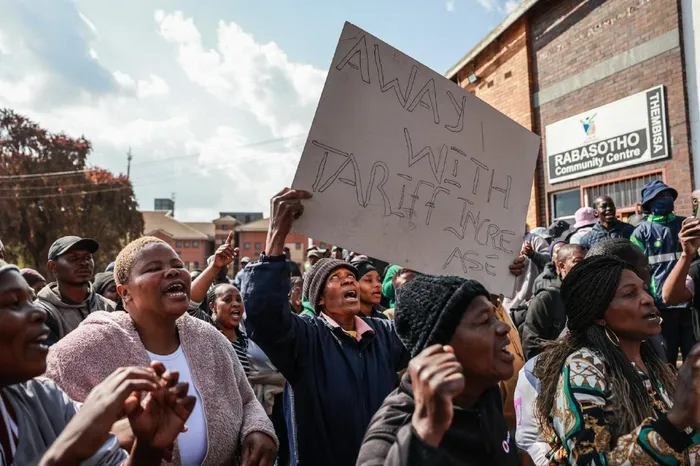
Residents of Tembisa township sing and chant while another holds a placard reading ‘Away With Tariff Increase’ during their service delivery demonstration in Tembisa on July 21, 2025.
Image: AFP
Dr. Reneva Fourie
President Cyril Ramaphosa’s State of the Nation Address presented a positive account of government performance over the past year and outlined ambitions for the year ahead. Yet large sections of society continue to be excluded from economic participation and the benefits of growth. This gap between official optimism and lived reality underscores a more profound structural problem.
While national indicators show modest improvement, the spaces where people live, work and seek opportunity remain sites of crisis. The address emphasised stabilisation, reform and recovery, pointing to modest but steady economic expansion.
The green shoots are there, with 2025 GDP growth having hovered around 1.2% to 1.5% and a favourable outlook for continued improvements in 2026. Inflation has eased, public finances have stabilised to some degree, and confidence has improved in selected sectors. These gains, however, remain thinly distributed and have not altered the structural conditions shaping inequality.
Local government is the primary interface between the state and citizens, and it is here that unemployment, poverty and inequality are either confronted or entrenched. When municipalities function effectively, they can become hubs of job creation, infrastructure development and local economic growth.
When they fail, inequality deepens and social cohesion frays. Despite this, local government remains marginal in policy prioritisation, treated as an implementation space rather than a central driver of development.
Public debate continues to focus heavily on national reforms, fiscal consolidation and the performance of state-owned enterprises. While these issues matter, they obscure the reality that billions of rand are transferred annually to municipalities with limited improvement in outcomes.
Weak oversight, political instability, high staff turnover and persistent skills shortages undermine the effectiveness of this expenditure. The result is a cycle of underperformance that erodes public trust and limits the state’s ability to respond to community needs.
Much of the recent emphasis on reform has been channelled through initiatives such as Operation Vulindlela, which is presented as a coordinating mechanism across sectors including energy, logistics, water and telecommunications. While it has reduced some bureaucratic delays, its expanding reach into local government raises concerns.
The stated aim of this intervention is to address administrative failures, improve service delivery and stabilise municipal finances, particularly in major cities. Yet municipalities are not simply implementation arms of national policy. They are a distinct sphere of government with their own constitutional, political and developmental mandates.
Reform initiatives driven from the centre, without sufficient engagement with local realities, risk undermining rather than strengthening institutional capacity. When performance targets take precedence over social outcomes, communities are often left behind.
Private sector management is often presented as a solution to municipal inefficiency, yet it does not necessarily unlock the economic potential of municipalities or address the socio-economic needs of residents. The impacts of austerity, privatisation and the broader neoliberal policy trajectory are felt most sharply at the local sphere, where communities depend directly on public services.
Reduced public investment limits maintenance, weakens planning capacity and constrains the ability of municipalities to respond to growing demand linked to urbanisation, unemployment and inequality. Outsourcing essential state services limits the ability to control prices and secure supply to less affluent communities.
The consequences of this approach are visible in the ongoing water crisis in Johannesburg. Over the past three months, residents, particularly in townships and informal settlements, have endured prolonged water shortages, early-morning queues for tankers, health and sanitation challenges, rising social tension, and economic strain.
Small and micro enterprises have been forced to close due to water insecurity, which disrupts livelihoods and local economic activity. These experiences demonstrate the cost of neglecting local state capacity and treating essential services as commodities rather than public goods.
Similar dynamics are evident in the energy sector. There has been considerable praise for the fact that South Africa has surpassed 266 consecutive days without load shedding. Yet load reduction has continued in many poorer areas, placing the burden of energy insecurity on communities least able to absorb it.
Likewise, the apparent improvements in the performance of state-owned enterprises require scrutiny. The successes are partly the result of asset sales and short-term interventions, masking underlying structural flaws and long-term costs.
Corruption and crime further weaken local development. Operation Shanela has had some measurable impact, with national data indicating declines in murder and contact crimes. These gains are uneven and largely concentrated in wealthier communities.
In the Western Cape, violent crime trends diverge sharply from national patterns, reflecting persistent spatial inequality and the limited reach of state interventions in marginalised areas. Safety and social stability are essential foundations for local economic activity, yet they remain unevenly secured.
There is a belief that the challenges facing smaller municipalities can be resolved through consolidation under metropolitan authorities. The metros themselves are facing serious financial and operational distress, as demonstrated in Gauteng.
Ongoing service failures, infrastructure decay and administrative paralysis cause doubts regarding their capacity to support surrounding municipalities or drive regional development. Strengthening local government requires investment in capacity across all municipalities, not further centralisation.
Meaningful transformation demands a reorientation of the development agenda towards the local sphere. Job creation, infrastructure rollout, support for small businesses and tourism development are most effectively driven at the municipal level.
Local government must be positioned as the centre of development, with adequate resources, professional administration and protection from excessive political and technocratic interference. Community participation should move beyond formal consultation towards genuine involvement in planning and oversight.
The continued emphasis on provincial government structures has diluted focus and resources. Provinces duplicate functions and absorb skills that could strengthen municipalities. The provincial system emerged from political compromise rather than clear developmental logic and now plays a limited role in addressing local crises. Redirecting resources and skilled personnel directly to municipalities would support a more responsive and accountable state.
South Africa’s ability to address unemployment, poverty and inequality depends on restoring the developmental role of local government. This requires moving away from profit-driven and centralised reform approaches towards people-centred development rooted in local economies.
An inclusive society will be built through municipalities that serve communities, strengthen local production and activate the full potential of citizens.
* Dr Reneva Fourie is a policy analyst specialising in governance, development and security.
** The views expressed do not necessarily reflect the views of IOL, Independent Media or The African.