SONA 2026: Another Performance In The Long Politics Of Pretence?
STATE OF THE NATION ADDRESS
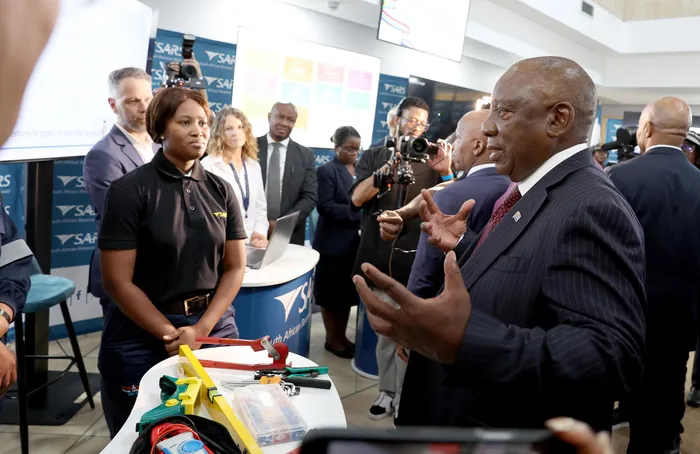
President Cyril Ramaphosa conducted on a walkabout of Exhibitions showcasing the work of various SARS business units, including Customs, Taxpayer Engagement, and the Modernizations and Innovation Hub during an oversight visit at the SARS National Command Centre in Brooklyn, Pretoria on February 5. The visit was part of his stakeholder engagements ahead of SONA 2026.
Image: GCIS
Dr Clyde N.S. Ramalaine
President Cyril Ramaphosa’s decision to absent himself from the World Economic Forum in Davos, citing preparatory work for the 2026 State of the Nation Address (SONA), is symbolically loaded. It gestures toward a presidency seeking to reassert domestic attentiveness amid political fragility.
Yet symbolism alone cannot rescue a presidency whose principal failing has been the repeated substitution of rhetorical assurance for structural resolve. In the Ramaphosa era, preparation has rarely translated into disruption, and intention has too often displaced accountability.
As South Africa approaches SONA 2026, the stakes are high. The address will be delivered against the backdrop of coalition governance, eroded institutional legitimacy, deepening inequality, and an electorate increasingly sceptical of the language of reform.
To anticipate what South Africans are likely to hear, one must interrogate the patterns embedded in the President’s recent SONAs to discern whether this moment signals reckoning or merely rehearses managed decline.
Continuity Disguised as Change
A defining feature of Ramaphosa’s SONAs since 2023 has been narrative stability amid state instability. Each address has returned to familiar motifs, economic recovery, infrastructure-led growth, and social compacting, delivered with managerial confidence and an almost liturgical repetition of “progress underway.” Beneath this rhetorical coherence lies a persistent avoidance of political confrontation with the sources of state failure.
SONA 2023 foregrounded post-pandemic recovery and structural reform, particularly in energy and logistics. Load shedding and Transnet’s dysfunction were acknowledged, but framed as transitional challenges rather than systemic decay. Task teams, partnerships, and phased reform displaced accountability.
SONA 2024, delivered on the eve of national elections, intensified the populist register. Employment schemes, social relief, and infrastructure commitments dominated, yet the address relied heavily on aspirational governance, the articulation of outcomes without credible implementation pathways. Structural unemployment and municipal collapse were acknowledged, but responsibility dissolved into abstraction.
SONA 2025, delivered after the formation of South Africa’s unprecedented coalition government, was the most revealing. Unity was elevated as a virtue and pragmatism as a principle, while ideological incoherence, particularly in economic and foreign policy, was carefully sanitised.
Divergent coalition loyalties on sanctions and global conflicts now constrain coherent positioning. The address reflected a presidency constrained not only by coalition arithmetic but by its own aversion to ideological clarity.
Across all three SONAs, a pattern emerges: diagnosis without disruption, reform without rupture, and leadership without confrontation. These coalition constraints directly shape the economic “green shoots” narrative anticipated in 2026.
The Myth of Momentum
SONA 2026 is expected to frame recent economic performance as evidence of emerging “green shoots” rooted in policy stability and reform. Improved energy-sector stability, attributed to Eskom’s operational gains and expanded private-sector participation in renewables, will be highlighted.
Accelerated reforms under Operation Vulindlela in logistics, water licensing, and digital communications will be presented as efficiency gains, attracting investment. Modest improvements in manufacturing and retail indicators are likely to reinforce claims of recovering business confidence.
The official unemployment rate, declining to 31.9%, alongside approximately 250,000 additional jobs recorded in late 2025, largely in construction, will be cited as labour-market progress. These developments will be reinforced by references to improved public finances, an S&P credit-rating upgrade, easing interest rates, and better-than-expected GDP performance. The formation of the Government of National Unity will again be invoked as a stabiliser, enhancing policy continuity.
Yet this is stabilisation masquerading as momentum. The green-shoots narrative elevates marginal improvement into recovery and statistical moderation into reformist success.
A political-economy reading reveals deeper constraints. Energy stabilisation reflects state withdrawal from generation rather than decisive reform. Operation Vulindlela’s gains are technocratic, leaving ownership patterns, productive structure, and spatial inequality largely untouched. Employment growth remains temporary and sector-specific, leaving mass structural unemployment intact.
Fiscal consolidation and GDP gains, driven by finance and capital-intensive sectors, chiefly enrich established capital, while township economies, rural production, and small-scale industrialisation remain peripheral. Public–private partnerships entrench dependency on private actors for functions once imagined as state-led development.
Growth projections of 1.2–1.6%, moderating inflation, and public debt stabilising around 75% of GDP are framed as recovery, yet more accurately describe stagnation management. Employment figures are curated; participation is celebrated while dignity remains elusive.
Conversations with economists Redge Nkosi and Duma Qubule affirm that the state-led narrative of economic green shoots, though loudly proclaimed, is deliberate in construction and misleading in effect.
This narrative persists despite clear countervailing evidence. Real GDP per capita has followed a sustained downward trajectory for nearly a decade, with the largest portion coinciding with the Ramaphosa presidency since February 2018.
According to the IMF’s October 2025 World Economic Outlook, South Africa is projected to be the only country to experience continued declines in real GDP per capita in both 2025 and 2026, following contractions in 2023 and 2024, outcomes symptomatic of prolonged economic mismanagement.
The pressure on the middle class further exposes this fragility. Real disposable income is estimated to have declined by approximately 53% between 2016 and 2024, as wage growth failed to keep pace with inflation and rising living costs.
Gross capital formation, central to long-term growth, has remained structurally stagnant. While short-term volatility may manufacture the illusion of green shoots, the dominant trajectory since 2018 has been systemic decline.
The green-shoots narrative is thus an orchestrated performative act, set to be rehearsed in both SONA 2026 and the Budget Speech pencilled in for 18 February, insulating the grand coalition from confronting the structural limits of a growth model privileging investor reassurance over productive restructuring.
Foreign Policy as Collateral Damage
The consequences of managed reassurance extend abroad. SONA 2026 is likely to invoke constitutionalism and multilateralism, yet this rhetoric sits uneasily within a Grand Coalition marked by divergent global allegiances. Positions on sanctions regimes, geopolitical conflicts, and strategic partnerships increasingly emerge from fragile compromise rather than principled statecraft.
Divergent approaches to relations with the United States, the Israel–Palestine conflict, Russia’s war in Ukraine, and South Africa’s posture within BRICS versus Western capitals reveal deep fault lines. Some coalition partners emphasise non-alignment and South–South solidarity, while others prioritise market confidence and alignment with Euro-Atlantic norms.
The result is a hesitant, internally divided foreign policy, collateral damage of coalition governance.
The Politics of Pretence
This politics of pretence is no longer merely fragile; it is corrosive. Public trust erodes not from impatience, but from repeated demands to suspend disbelief amid unaltered realities. Accountability remains selective, corruption is framed as an administrative malfunction rather than a structural outcome, and institutional failure is detached from those who preside over it. The state appears permanently in repair, yet never renewed.
Within this context, Ramaphosa’s SONAs have functioned less as national reckonings than as rituals of reassurance. They stabilise expectation without mobilising resolve, naming crises without naming culpability. Reform is spoken, not enacted; failure is acknowledged, not owned.
A Test of Courage, Not Competence
SONA 2026 arrives when South Africa suffers not from a deficit of plans, but of conviction. The country does not require another inventory of intentions. It requires leadership willing to name failure with moral clarity, confront vested interests, and risk political capital.
If SONA 2026 merely rehearses green shoots and incremental progress, it will confirm what many fear: that the presidency has mastered speaking change while governing continuity. Absent reckoning, SONA 2026 will be remembered not as a turning point, but as another performance in the long politics of pretence, where eloquence again stood in for courage.
* Dr Clyde N.S. Ramalaine is a political scientist and analyst whose work interrogates governance, political economy, international affairs, and the intersections of theology, social justice, and state power.
** The views expressed do not necessarily reflect the views of IOL, Independent Media or The African.