Steenhuisen's Exit Draws A Line Under The DA's Ideological Crisis
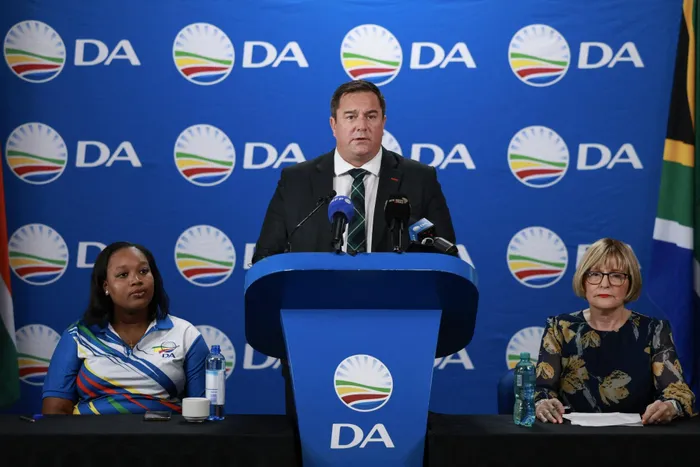
Leader of the Democratic Alliance (DA) John Steenhuisen (centre) and Federal Council Chairperson Helen Zille (right) at a press conference on the party’s preparations for the upcoming local government elections in Johannesburg on January 28, 2025. The current trajectory of the DA stands in tension, if not outright contradiction, with the political project that Zille historically championed, says the writer.
Image: AFP
Zamikhaya Maseti
John Steenhuisen’s announcement that he will step down as leader of the Democratic Alliance (DA) in April did not come as a shock, at least not to me. What is truly astonishing is not his departure, but the reasoning he offered for it, which is, to put it mildly, deeply unconvincing.
He cited the outbreak of foot and mouth disease as the reason and claimed that he now wishes to concentrate on it. Oh, really? To put it bluntly, as the social media slang goes, he seems to think that we are all from Northwood (in Durban, KZN, where he was born).
In truth, Steenhuisen is obscuring the obvious: the ideological implosion of the. This crisis became unmistakable after the removal and ultimate resignation of Dion George, the former Federal Finance Chairperson of the DA, who openly expressed his profound unhappiness with the party’s posture toward the Government of National Unity (GNU).
This was not a mere personal disagreement; it was symptomatic of a deeper ideological fracture within the DA. Further credence to this thesis was lent by the leader of AfriForum, Kallie Kriel, who publicly asserted that Steenhuisen had deviated from the DA’s core mandate, accusing him of effectively becoming a lackey of the ANC rather than a principled opposition leader. To paraphrase Kriel, Steenhuisen has betrayed the mandate that the DA’s constituency entrusted to him.
These developments are undoubtedly giving Helen Zille not only anxiety but, one suspects, many sleepless nights. She is now confronted with a profound reversal of the very strategic approach and ideological legacy that she so carefully crafted and bequeathed to the party. The current trajectory of the DA stands in tension, if not outright contradiction, with the political project that Zille historically championed.
Admittedly, Helen Zille remains a shrewd strategist, and I concede this without hesitation. I take my hat off to her for the intellectual discipline, political calculation, and organisational coherence that once defined her leadership of the DA.
Yet, precisely because of her strategic acumen, the present disarray within the Party must be deeply unsettling for her. She now presides over a moment in which her own ideological architecture is being quietly dismantled under the banner of coalition pragmatism.
Zille inherited the leadership of the DA from Tony Leon, a figure widely regarded, not without justification, as a far-Right ideologue, who had formulated what became known as the Fight Back Strategy. That strategy was widely construed as an attempt to reassert White political dominance, if not a subtle regression toward the politics of Apartheid under a new Liberal guise.
Leon pursued this strategy with almost missionary zeal during the era of Thabo Mbeki as President of the Republic of South Africa (RSA), a towering intellectual and statesman who, by contrast, was advancing the grand vision of the African Renaissance, not only within South Africa, but across the African Continent and indeed the World.
In this sense, Tony Leon’s Fight Back Strategy and Thabo Mbeki’s African Renaissance were not merely different political positions; they were diametrically opposed ideological projects.
The former was anchored in defensive racial anxiety and the entrenchment of minority privilege, while the latter was rooted in a progressive, decolonial, and Pan-African imagination of renewal, sovereignty, and continental self-assertion.
Flowing from this, it must be said that Tony Leon’s Fight Back Strategy did not merely provoke ideological contestation; it actively alienated the majority of Black people. It constructed the DA as a party of defensive minority entitlement rather than inclusive Liberalism, thereby foreclosing any meaningful possibility of Black political identification with its project.
Within that context, Black leaders in the DA, such as Siyabonga Mnisi, a Member of Parliament, and David Malatsi, also an MP, were rendered politically hollow. They functioned less as autonomous thinkers and more as symbolic adornments to a Party that remained structurally and culturally resistant to Black rule.
In the eyes of the majority of Black people, they were little more than political zombies, visible yet substantively inconsequential, and widely perceived as traitors and renegades who had abandoned the historical struggle for liberation in favour of assimilation into a Party anchored in a reactionary past.
From within this reactionary legacy, Helen Zille arrived at a decisive realisation: Tony Leon’s Fight Back Strategy was not merely combative, but fundamentally regressive and politically counterproductive in a transforming South Africa. Accordingly, she crafted a recalibrated strategic project anchored upon three interrelated pillars.
First, she sought to woo and attract the Black people into the DA, particularly the emergent Black middle class, recognising that without Black legitimacy the DA would remain a permanent minority formation.
Second, she resolved to retain the Western Cape as a DA-governed province, treating it as both a political stronghold and a governance showcase.
Third, she aimed to erode the ANC’s parliamentary majoritarianism, not necessarily to replace it immediately, but to weaken its hegemonic grip on the national political terrain.

DA leaders (from left) Lindiwe Mazibuko, Helen Zille and Mmusi Maimane leading a march to the Johannesburg headquarters of the Congress of South African Trade Unions (Cosatu) on May 15, 2012.
Image: AFP
For a significant period, this three-point strategy worked with remarkable effectiveness. Under Zille’s stewardship, a new cohort of Black leaders rose to prominence within the DA: Mmusi Maimane, Herman Mashaba, Lindiwe Mazibuko, Solly Msimanga in Gauteng, and Mbali Ntuli in KwaZulu-Natal.
Crucially, Zille did not merely recruit them as symbolic figures; she afforded them genuine political space and influence, enabling them to emerge as some of the Party’s most visible and powerful leaders.
Simultaneously, Zille embarked on an extensive political campaign across the country, deliberately entering Black townships and rural communities. In a highly symbolic gesture, she even traversed the nation dressed as a Makoti, identifying with newly married African women and attempting to signal cultural empathy rather than aloof liberal detachment. In this period, Zille also made deliberate inroads into rural South Africa, including Limpopo and the Eastern Cape.
In the Eastern Cape, in a politically significant and symbolically charged moment, King Buyelekhaya Dalindyebo of the AbaThembu publicly aligned himself with the DA. This was not a trivial development; it signalled that Zille’s outreach strategy was beginning to penetrate spaces traditionally regarded as firmly within the ANC’s political terrain.
These efforts translated into tangible gains. She consolidated DA control over the Western Cape and successfully wrested the City of Cape Town from the ANC.
Moreover, while the ANC’s Parliamentary majoritarianism was not dismantled, it was noticeably weakened, influenced by multiple political variables, including the formation of the Congress of the People (COPE), an ANC breakaway that siphoned off a portion of its support base.
In this respect, COPE inadvertently advanced the third pillar of Zille’s strategy by fragmenting the ANC vote and diluting its hegemonic dominance in Parliament.
This did not simply weaken the ANC; it reconfigured the broader balance of forces within South Africa’s Parliamentary democracy. Zille’s strategy, whether one agreed with it or not, was coherent, disciplined, and historically conscious.
It recognised that power in a post-Apartheid order could not be seized through confrontation alone, but through a calculated combination of persuasion, institutional leverage, and electoral realignment.
Yet, precisely because of its sophistication, Zille’s project required ideological consistency and organisational unity. It depended on a DA confident in its identity, anchored in Liberal constitutionalism, yet sufficiently flexible to engage a changing Black electorate.
What we are witnessing today under Steenhuisen is the unravelling of that carefully constructed architecture. The very pillars that once propelled the DA forward are now being undermined by internal fragmentation, coalition ambivalence, and a leadership crisis that Zille never envisaged.
Steenhuisen therefore inherited, or more accurately was bequeathed, a DA that had once been shaped by a coherent, if contested, strategic architecture.
Yet, as leader of the Party, he manifestly did not develop a comparable strategic compass of his own. It appeared that he was still learning the ropes of national leadership, navigating a complex political terrain without a clearly articulated doctrine or long-term vision for the DA.
The outcome of the 29 May General Election compounded this dilemma. The electoral results afforded him insufficient time, and perhaps insufficient political latitude, to deliberate, reflect, and craft a considered strategic response.
Instead of consolidating the Party internally, refining its ideological posture, and recalibrating its relationship with the electorate, Steenhuisen precipitously plunged the DA into the belly of the beast: the Government of National Unity (GNU).
In doing so, he accelerated the very contradictions that Zille had once sought to manage, exposing the DA to the perils of coalition politics before it had resolved its internal identity crisis, and thereby deepening, rather than alleviating, the Party’s current predicament.
Consequently, the current turmoil within the DA must be understood not as an isolated leadership failure, but as the gradual erosion of a once-coherent strategic project, a project that sought to reposition the DA from a defensive minority Party into a competitive national force, but which now appears stranded between its past and its uncertain future.
It is against this historical backdrop that the current crisis of the DA must be understood. The departure of John Steenhuisen is not simply a leadership transition; it signals the exhaustion of a political project that has oscillated between Leon’s combative, racially inflected oppositionalism and a more pragmatic, coalition-friendly posture inherited, at least rhetorically, from Zille. The Party has never fully resolved this contradiction in theory or practice.
The removal and resignation of Dion George, alongside Kallie Kriel’s public rebuke from AfriForum, are therefore not aberrations. They are symptoms of a Party that has lost its ideological compass, caught between a Fight Back legacy that no longer commands legitimacy in a changing South Africa and a coalition strategy that its base deeply distrusts.
Consequently, Steenhuisen’s invocation of foot-and-mouth disease as his primary reason for stepping aside reads less like public duty and more like an attempt to evade accountability for a party in disarray. The real dilemma confronting the DA is whether it can reconstruct a principled ideological foundation in an era where coalition politics rewards expediency over conviction.
The DA’s participation in the Government of National Unity has laid bare the limits of its oppositional identity. In theory, coalition politics should be a terrain of principled compromise; in practice, for the DA, it has become a site of ideological dilution.
By entering the GNU without a clearly articulated doctrine or historical mission, the Party blurred the very line between opposition and co-governance that once defined its brand.
Likewise, Kallie Kriel’s intervention reflected the anxiety of a key segment of the DA’s traditional constituency that the Party has abandoned its adversarial posture toward the ANC and, in effect, betrayed the Fight Back inheritance.
Accordingly, Steenhuisen’s retreat under the pretext of foot-and-mouth disease appears less statesmanship and more a convenient exit from an untenable political position. The broader question remains whether the DA can exist as a distinct political force in a coalition-dominated era, or whether it will be absorbed into the very governing consensus it once sought to challenge.
* Zamikhaya Maseti is a political economy analyst and holds a Magister Philosophae(M.Phil) in South African Politics and Political Economy from the erstwhile University of Port Elizabeth, now Nelson Mandela University.
** The views expressed do not necessarily reflect the views of IOL, Independent Media or The African.