Joburg's Delinquent Leaders' Pushing Residents to the Brink
SERVICE DELIVERY COLLAPSE
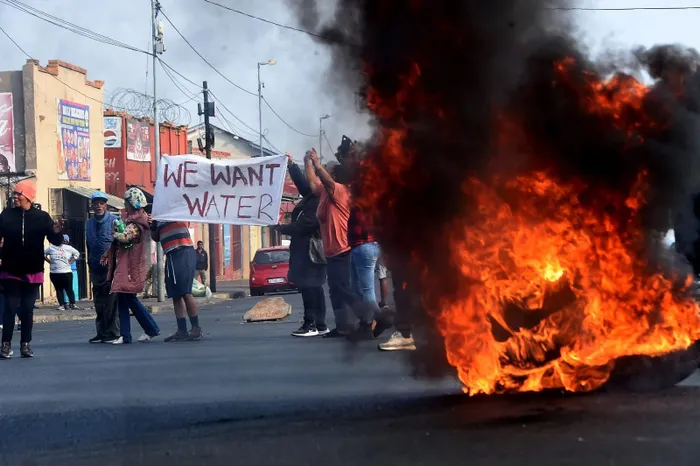
Johannesburg residents venting their anger over persistent water cuts in the country's economic hub. As Johannesburg’s woes continue unabated, one wonders if the time is not ripe to invoke Section 139 of the Constitution, asks the writer.
Image: Itumeleng English/Independent Newspapers
Prof. Bheki Mngomezulu
The City of Johannesburg is currently in crisis – a fact that is denied by the leadership. Lack of water supply, intermittent electricity supply, piles of refuse which remain uncollected for days, challenges regarding the changing of the payment platforms, and potholes which damage people’s cars, making driving around the city a nightmare, are some of the concerns citizens of Johannesburg wrestle with.
The current Mayor Dada Morero blamed the previous DA-led administration for the city’s declining revenue collection, rising debt levels and unauthorised expenditure, which he said had strained Johannesburg’s finances. He went on to say that during his three-year term, he made notable progress in cleaning up the city.
What was glaring was that at no point did Morero give credit to the G20 Summit, which played a major role in fixing certain things in the city. Even President Ramaphosa’s convoy had to avoid potholes as he inspected the state of the city in preparation for the G20. In other words, had Johannesburg not been blessed by the opportunity to host the G20 Summit, the situation would have been worse.
While these issues are happening, the power struggle and the fight for control of the city seem to be what politicians are investing their energies in instead of addressing the service delivery challenges enumerated above.
On December 5, 2025, history was made when Loyiso Masuku was announced as the winner in the Johannesburg regional conference, which was held at Cedar Woods Hotel in Sandton. Masuku obtained 184 votes while Morero obtained 149. The 35-vote difference was enough to propel Masuku to victory.
Ideally, these results should have earned the ANC accolades for having produced the first female regional leader. Intriguingly, the opposite happened. The outcome of this election left the ANC divided to the core – starting from Luthuli House.
The entry point was that there were irregularities in the election, which left Morero’s camp disgruntled. Meanwhile, Masuku’s camp celebrated the victory, arguing that nothing untoward happened during this election.
The discovery of used ballot papers on the premises of the person who was tasked to oversee the election ignited an inferno. Importantly, it tested the leadership dexterity of the Secretary General of the ANC, Fikile Mbalula.
Procedurally, he was justified in entertaining the concerns raised by Morero’s camp. However, his subsequent action left a lot to be desired. Instead of handling the matter following the standing ANC protocol and procedures,
Mbalula involved the South African Police Service (SAPS). This gave impetus to the allegation that he would have preferred to see Morero emerging victorious because this would boost his aspirations to run for office during the ANC’s 2027 elections. Masuku’s victory scuttled this plan.
The synopsis presented above points to internal leadership squabbles within the ANC. There is another level where these power dynamics could be ventilated. Helen Zille is set to be Johannesburg’s mayoral candidate in the upcoming Local Government Election (LGE). This means that as the ANC is engaged in intraparty feuds, the DA is positioning itself to usurp power from the ANC. As these elephants fight, the grass (the masses of Johannesburg) continues to suffer from a lack of service delivery.
On January 29, 2026, the Johannesburg Council approved the creation of a Deputy Executive Mayor position. A total of 107 councillors voted in favour of this motion, with 87 councillors voting against. Noticeably, 37 councillors abstained.
While this decision is not in contravention of the law, it raises a few questions. Why now? Was this decision genuine, or was it a mechanism to appease certain individuals who might find themselves in the political cold? Was the decision another way of saving the multiparty coalition by making it possible to have the Executive Mayor coming from one party and the deputy coming from another party? Importantly, will this move result in improved service delivery in Johannesburg?
One wonders what the city manager does to better the situation or to support the mayor. Moreover, it remains unclear what the job of Members of the Municipal Council (MMCs) is in rescuing the situation. It is hard to understand that people who claim to serve citizens can allow the country’s economic hub to deteriorate under their watch.
Instead of creating this position, it would have been preferable to establish what is impeding the leadership from rendering services to the people and address those issues. Surely, the new incumbent will be remunerated handsomely. Could the money not have been used to address some of the many concerns outlined earlier?
As Johannesburg’s woes continue unabated, one wonders if the time is not ripe to invoke Section 139 of the Constitution. Subsection 1 of this section states that “When a municipality cannot or does not fulfil an executive obligation in terms of the Constitution or legislation, the relevant provincial executive may intervene.” Such intervention may take different forms meant to ensure that services reach the people on the ground.
Alternatively, Section 154 of the Constitution could be invoked, whereby provincial or national government could support and strengthen the municipality. If that were to happen, it would not be for the first time.
In June 2024, the KwaZulu-Natal government placed the eThekwini Metropolitan Municipality under Section 54 administration, which is a supportive intervention. Among other things, this was meant to address significant service delivery failures, financial mismanagement, and low infrastructure grant spending, which the metro was suffering from.
The move was necessitated by pressure exerted by political parties such as the DA on then Premier Nomusa Dube-Ncube to act. Eventually, she complied, and the results were positive. This is evidenced in the fact that eThekwini Municipality recorded an improved audit outcome for the 2024/2025 financial year. The focus had to shift to evident service delivery so that residents could feel the change.
Therefore, as Johannesburg struggles to improve service delivery, urgent action should be taken before the situation gets out of control. The option would be to invoke Section 139 or 154 of the national Constitution.
* Prof. Bheki Mngomezulu is Director of the Centre for the Advancement of Non-Racialism and Democracy at Nelson Mandela University.
** The views expressed do not necessarily reflect the views of IOL, Independent Media or The African.