Madlanga Probe: A Fragile Promise of Criminal Justice Reform
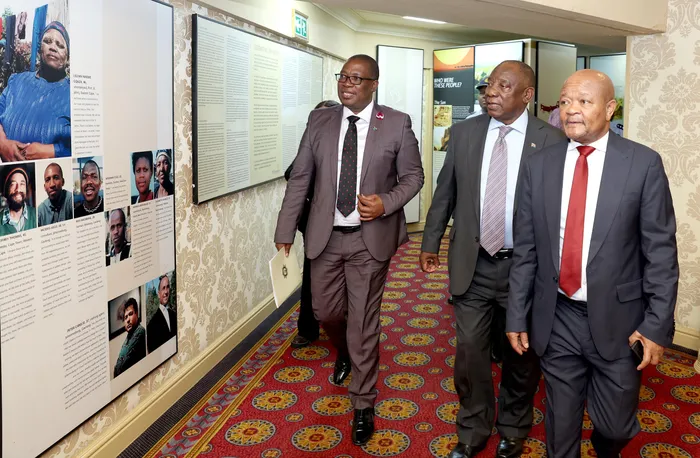
Gauteng Premier Panyaza Lesufi (left), President Cyril Ramaphosa and Police Minister Senzo Mchunu at the inaugural Policing Summit held at the Emperors Palace Convention Centre in Gauteng April 08, 2025. Ramaphosa's failure to outrightly dismiss Mchunu, which is the prerogative of the president, reinforces the perception that accountability stops where internal party dynamics begin, says the writer.
Image: GCIS
Dr. Reneva Fourie
In late January 2026, President Cyril Ramaphosa issued a measured but significant response to the interim report of the Judicial Commission of Inquiry into Criminality, Political Interference, and Corruption in the Criminal Justice System.
Chaired by retired Constitutional Court Justice Mbuyiseli Madlanga, the commission was established following shocking allegations by KwaZulu-Natal Police Commissioner Lieutenant General Nhlanhla Mkhwanazi that a criminal syndicate had infiltrated the police, the prosecution service, intelligence structures, and elements of the judiciary itself.
The interim report, delivered in December 2025 after intensive hearings, offered South Africans a glimpse into the depth of institutional decay within the criminal justice system.
The Commission’s findings were grave. After hearing testimony from 37 witnesses over 45 days, it identified prima facie wrongdoing by several senior officers in the South African Police Service and the Ekurhuleni Metro Police Department.
These included major generals, brigadiers, and a serving sergeant, all of whom were referred for urgent criminal investigation, disciplinary action, or suspension. The assassination of key witness Marius van der Merwe in December 2025, executed in front of his family, stripped away any lingering illusion that these were merely bureaucratic failures.
What was exposed was an ecosystem of power, violence and impunity that had normalised criminality within institutions meant to protect the public, rendering reform both urgent and perilously difficult.
Ramaphosa’s acceptance of the interim recommendations in full was therefore significant. He instructed the acting Police Minister, Professor Firoz Cachalia, and the National Police Commissioner, General Fannie Masemola, to establish a special investigations task team reporting directly to the commissioner.
He endorsed referrals to the Independent Police Investigative Directorate (IPID), the police service itself and the Ekurhuleni Metropolitan Municipality, and publicly emphasised the urgency of restoring public trust. In a political culture accustomed to delay, equivocation and symbolic gestures, this decisiveness appeared unusual and, to some, encouraging.
Yet the central question remains whether this moment represents genuine reform or another carefully managed performance.
The interim report itself remains confidential, limiting meaningful public scrutiny and informed debate. The task team is housed within the very institution accused of systemic corruption and reports to a commissioner who testified before the commission and whose deputy was suspended in relation to similar allegations.
In a context where witnesses have been murdered and threatened, internal processes offer little reassurance. South Africa’s recent history suggests that corruption networks survive precisely because they are shielded by procedural complexity, institutional loyalty and political caution.
The Commission’s own mandate reflects an understanding that ordinary mechanisms have failed. Its terms of reference empower it to recommend urgent suspensions and prosecutions because internal accountability within the criminal justice system has systematically been compromised.
Locating the task team under the authority of the national commissioner risks reproducing those failures. Criminal interference is no longer theoretical, as the killing of a witness made brutally clear. Political interference remains a danger while senior figures implicated in testimony continue to wield influence across the security cluster. Without independent oversight, the task team could function less as a weapon against capture and more as a buffer against consequence.
The responsibility assigned to acting Police Minister Professor Firoz Cachalia offers a rare moment of cautious optimism in a political landscape more often defined by expediency than principle. As a former academic and veteran anti-apartheid activist, he is outside of the entrenched patronage networks currently within the police and dominant political circles. His presence offers a degree of insulation from factional bargaining and signals a commitment to professionalisation.
However, policing is constitutionally subject to political oversight, and complete depoliticisation is neither possible nor desirable in a democratic system. The real question is whether Cachalia serves as a shield that allows the presidency to distance itself from difficult decisions, particularly regarding his predecessor, or whether he has been empowered to act decisively within a constrained cabinet environment shaped by loyalty and compromise.
That constraint is most visible in the continued protection of former minister Senzo Mchunu. Placed on special leave in mid 2025 to limit interference in investigations, he has neither been dismissed nor formally cleared. Administratively, this reflects procedural caution and respect for due process.
Politically, it appears as an attempt to avoid confrontation with a powerful political party figure whose influence extends beyond the security cluster. The failure to outrightly dismiss him, which is the prerogative of the president, reinforces the perception that accountability stops where internal party dynamics begin.
The role of IPID is equally fraught. The Commission correctly referred matters to IPID and demanded explanations for stalled cases. Yet IPID is chronically under-resourced and burdened by enormous backlogs accumulated over many years. Its investigators often face intimidation while probing officers who outrank them and control access to evidence.
Past efforts to weaken its leadership and limit its independence have eroded public confidence. Without protected funding, additional investigative capacity and strong guarantees against retaliation, IPID risks becoming a procedural dead end rather than an engine of accountability.
Justice Madlanga’s request for an extension of the Commission’s mandate is therefore both inevitable and justified. With new witnesses emerging, legal challenges mounting and thousands of pages of evidence already amassed, a rushed final report would undermine the credibility of the entire process. An extension should be considered, but it must be accompanied by clear milestones, enhanced witness protection and a commitment to publish findings transparently and in full.
The interim report and the presidential response contain genuine signs of movement. Suspensions have been ordered, referrals made, and an outsider installed at the helm of the police ministry. But the structural risks remain profound and unresolved. An internal task team, a politically protected former minister, a weakened investigative directorate and a murdered witness all point to a system still operating in defensive mode.
Meaningful reform will not be measured by announcements or committees, but by prosecutions, dismissals and the dismantling of the networks that hollowed out the state. South Africans are watching closely. The final report must demonstrate that the syndicate has been broken, not merely renamed. Failure would deepen cynicism and entrench decay.
* Dr. Reneva Fourie is a policy analyst specialising in governance, development and security.
** The views expressed do not necessarily reflect the views of IOL, Independent Media or The African.